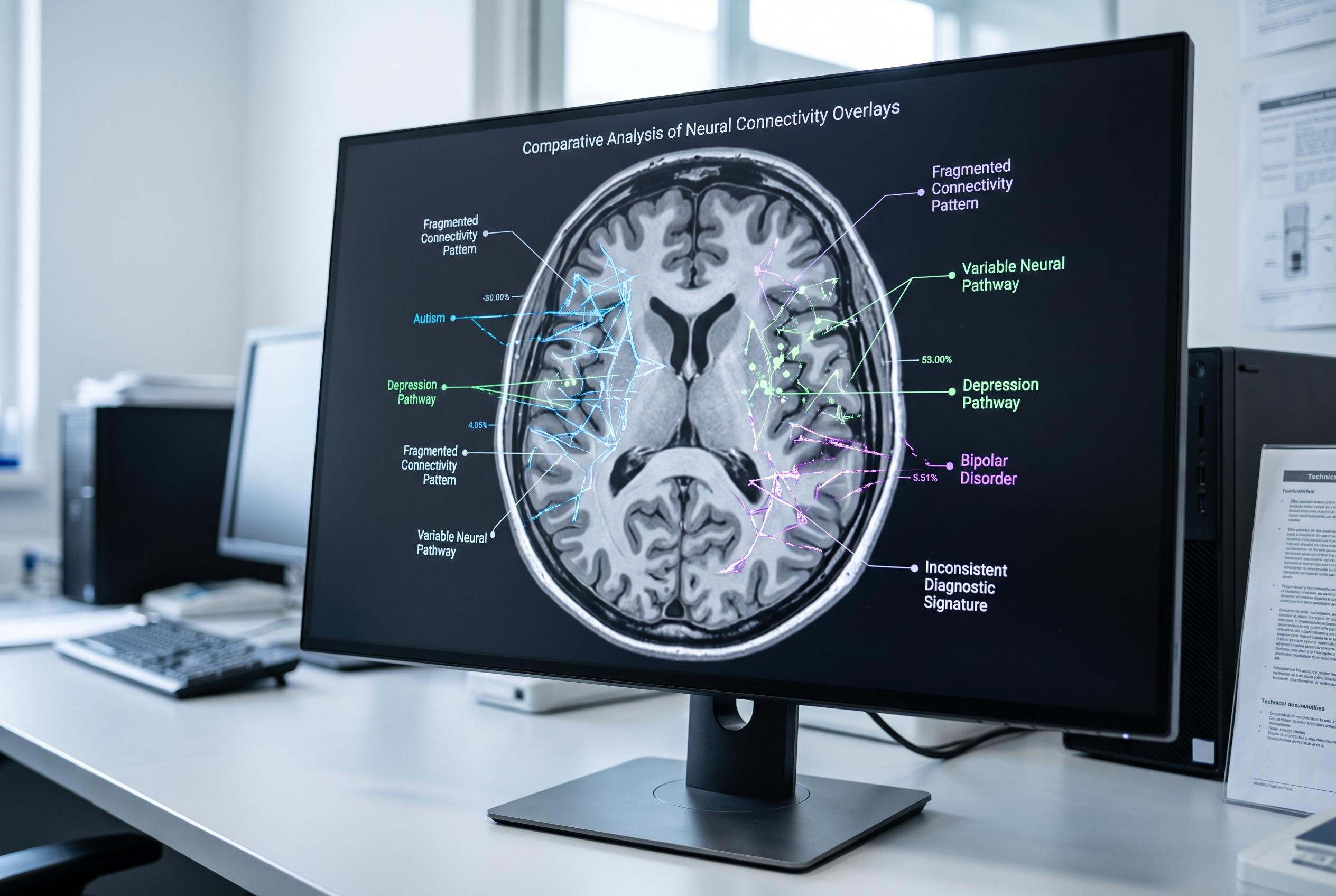

A comprehensive analysis of structural MRI scans across multiple studies reveals inconsistent brain signatures for autism, depression, and bipolar disorder, casting doubt on their use as diagnostic tools in psychiatry.
Structural MRI scans have failed to produce consistent brain signatures for autism, depression and bipolar disorder across independent studies, according to new research that raises fresh doubts about the search for simple imaging biomarkers in psychiatry.
Researchers led by Alex Fornito at Monash University analysed scans from thousands of people across multiple sites, applying the same processing pipeline to measures of cortical thickness and grey matter volume. The study, published in Nature Neuroscience, found that, unlike Alzheimer’s disease, which showed a clear and repeatable pattern, the psychiatric conditions examined produced little agreement from one dataset to the next. The team also found that differences in age, sex, scanner type and other technical factors did not explain the inconsistency.
Fornito said the results should change expectations about what structural MRI can deliver in mental health research. Joshua Roffman, a psychiatrist at Harvard Medical School who was not involved in the work, told the researchers that cortical thickness measurements carry an unavoidable degree of error even under ideal conditions. Louise Mewton of the University of Sydney said the findings fit a broader problem in psychiatry: across this study and many others, researchers are still not seeing evidence that mental disorders fall neatly into discrete categories.
The analysis also points to limits in sample size alone as a fix. Mathematical modelling suggested that reproducibility improved for schizophrenia as cohorts grew larger, reaching the level seen in Alzheimer’s disease when simulated groups exceeded 200 people. But that pattern did not clearly emerge for autism, depression, schizoaffective disorder or bipolar disorder, although the available datasets for some of those conditions were smaller. Fornito suggested the difference may reflect how schizophrenia is diagnosed, compared with the broader and more variable clinical criteria used for other disorders.
The findings add to a growing view that brain imaging is unlikely to work well as a stand-alone diagnostic tool for psychiatry. Maria Di Biase of the University of Melbourne said structural MRI will probably be most useful when combined with genetics, molecular biology and longitudinal clinical data. Other researchers are looking to alternative frameworks such as the Hierarchical Taxonomy of Psychopathology, or HiTOP, while large collaborations such as ENIGMA continue pooling imaging and genetic data from dozens of countries to separate robust signals from noise.
Disclaimer: This content is for informational purposes only and is not intended to be a substitute for professional medical judgment, advice, diagnosis, or treatment.