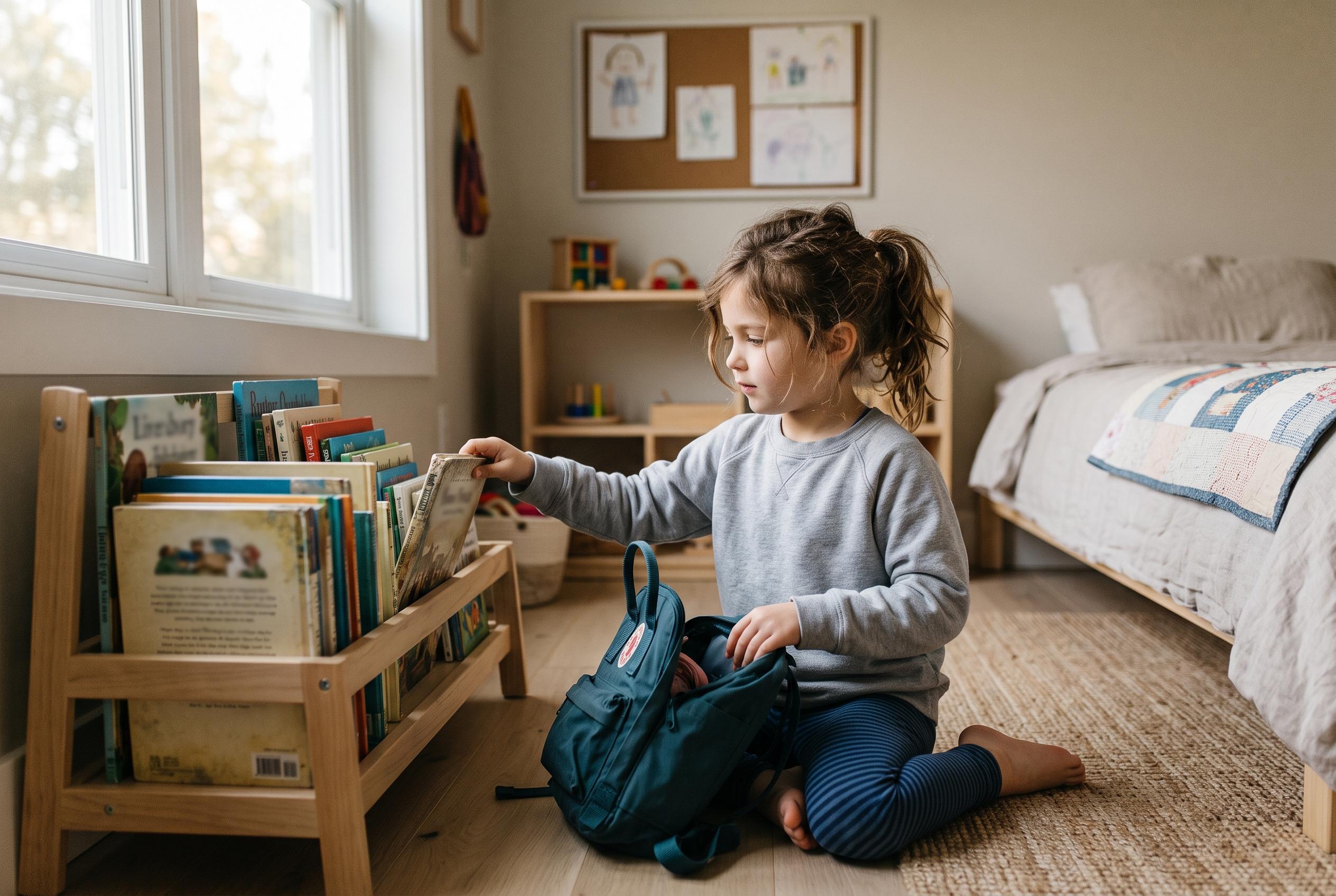

Parenting guidance from Montessori and TACSEI emphasises fostering independence and organisation at home to create stress-free mornings, with practical tips on environment and routine adjustments for children in early primary school.
Families looking for calmer school mornings may need to stop treating the clock as the main problem and start looking at what children can already manage for themselves. A parenting guide from the Montessori Academy of Arlington says many children in grades 1 to 3 are capable of waking to an alarm, getting dressed, making breakfast, filling a water bottle, packing lunch and remembering a coat and backpack. A child-development handout in TACSEI’s Backpack Connection Series makes the same broader point: the morning routine is not just a race to get out of the door, but a daily chance to build skill and confidence. (tmaonline.org)
That argument rests on predictability. Montessori Mom says young children thrive on a dependable sequence such as waking, dressing, eating and leaving, because a settled order helps them understand what is expected without constant adult prompting. TACSEI’s guidance says routines at school work for the same reason: when children know what comes next, anxiety falls and participation tends to rise. (montessorimom.com)
In practical terms, the advice is less about buying a system than about rearranging the home so the child can succeed. Montessori Mom recommends low hooks for coats and bags, a reachable tray or basket for shoes and storage placed at child height, so tidying is physically possible rather than merely demanded. Its back-to-school guidance also points parents towards a step stool at the counter, allowing children to wash hands, brush teeth and help with breakfast. Montessori.com adds another simple measure: keep backpacks and water bottles in one designated place, and reset the kitchen after dinner so the day does not begin with yesterday’s mess. (montessorimom.com)
Much of the pressure, these guides suggest, should be dealt with before anyone goes to sleep. Montessori.com advises families to lay out the next day’s outfit in full, including socks, shoes, jacket and backpack, clean out school papers and refill the water bottle each evening, and prepare easy breakfast items in advance. Montessori Mom proposes ending the night in a repeated pattern of tidying up, choosing clothes, setting the bag by the door and closing with a book, so the next morning begins with fewer decisions and fewer surprises. (montessori.com)
For younger children, visual prompts appear again and again in the advice. The Montessori Room recommends routine cards displayed somewhere the family can see them together, such as the fridge, and says they can be even more effective if they use actual photographs of the child and the home. It also argues that cooperation improves when children can exercise small choices inside the routine, including whether to get dressed before or after breakfast. If one step regularly causes delay, the same guide suggests using a visual timer only for that sticking point, or simply allowing more time if the child routinely needs it. (themontessoriroom.com)
Another source broadens the idea of a successful morning beyond getting dressed and out of the house. Montessori Mommy Life recommends setting up a “Morning Basket” in a quiet, uncluttered space, stocked with a small number of books, puzzles, art materials, manipulatives or practical-life tools. The aim is to give a child meaningful, independent work while an adult makes breakfast, packs lunches or tidies, turning the early hours into a period of concentration rather than drift or conflict. (montessorimommylife.com)
The expectations also shift with age. The Arlington school’s lower-elementary guide says children in grades 1 to 3 can often walk in from car line alone, carry their own belongings, serve themselves, clean up spills, complete homework independently and get in and out of a booster seat without help. Just as strikingly, it tells parents to tolerate the mishaps that come with that freedom. Forgotten homework, a lunch left behind, a badly folded jumper or the need to make two trips with too many possessions are all presented as normal parts of learning. (tmaonline.org)
What these sources do not advocate is detachment. The Montessori Room cautions against multitasking while a child is still learning a new skill, suggesting that adults stay close enough to brush teeth together or sit nearby while shoes are put on. TACSEI urges parents to praise the effort in specific terms, offering the example, “Wow! You got up and got dressed all by yourself! Now we will have a few extra minutes to play with trains.” Montessori.com adds one more relational habit: spending five calm minutes at breakfast talking about the day ahead, sharing gratitude or offering positive affirmations. (themontessoriroom.com)
Taken together, the guidance points to a different measure of success. A good morning is not necessarily the fastest one, but the one in which more of the sequence belongs to the child: the breakfast they helped prepare, the bag they loaded, the coat they found, the mess they helped clear. TACSEI says repeated routines give children practice in dressing, grooming and other daily skills while building a sense of confidence and success. The Montessori writers reach the same conclusion from the home side: when the environment is prepared well, the adult can step back and the child can carry more of the day for themselves. (challengingbehavior.org)
Disclaimer: This content is for informational purposes only and is not intended to be a substitute for professional medical judgment, advice, diagnosis, or treatment.