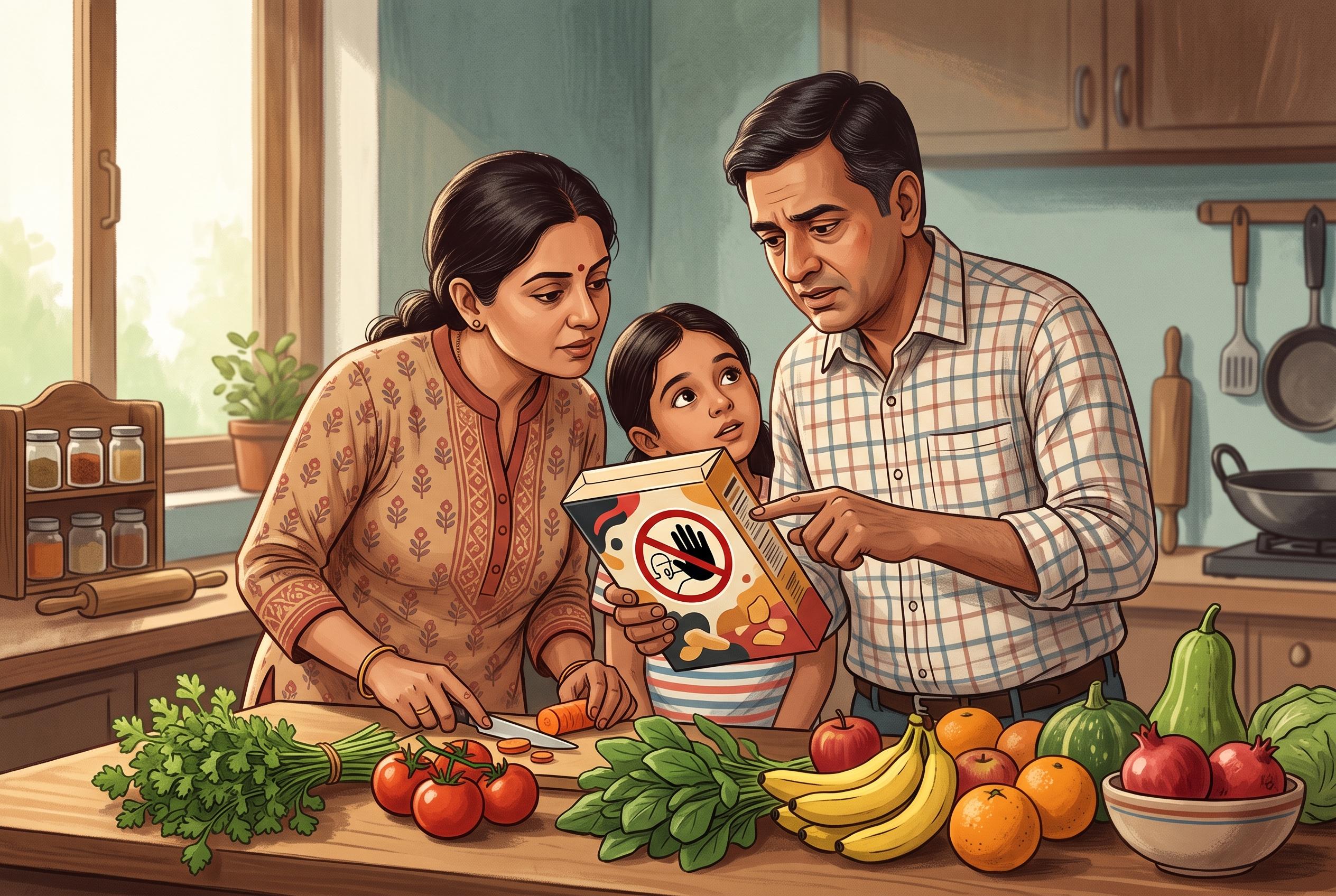

India’s food regulator proposes bold front-of-pack warning labels on packaged foods and drinks, signalling a significant shift in regulation and a response to rising obesity and public outcry, challenging industry opposition.
India’s food regulator has proposed front-of-pack warning labels on packaged foods and drinks, a sharp reversal that follows mounting public anger over weak disclosure rules for products high in sugar, salt or saturated fat. The Food Safety and Standards Authority of India said in a filing to the Supreme Court on Friday that it wants a red hexagonal mark for items that are high in at least two of those nutrients, in a move that could reshape labelling across one of the world’s largest packaged-food markets.
The proposal is a blow to food and beverage companies, including Coca-Cola and industry groups linked to Nestlé and PepsiCo, which have argued that warning symbols are confusing and do little to change behaviour. According to Reuters, the regulator’s latest filing shows a more forceful stance than earlier this year, when the government had stepped back from a labelling plan after private objections from industry.
The Supreme Court has repeatedly pushed the authorities to act, citing public-health concerns and rising obesity. Indian Express reported that judges warned the government earlier this month that they would rule if it failed to move quickly, while Business Standard said the court has also pressed officials to examine whether corporate pressure has slowed reform. The case has become a broader test of how far India is willing to go in regulating ultra-processed foods.
Under the proposal, labels would spell out terms such as “HIGH FAT”, “HIGH SUGAR”, “HIGH SALT” and “HIGHLY SWEETENED BEVERAGE” so shoppers can identify products more easily, especially for children and other vulnerable consumers, the filing said. Rajiv Shankar Dvivedi, lead counsel for the non-profit 3S And Our Health, told Reuters the group was reviewing the government’s position. Mili Bhattacharya, a senior Coca-Cola India executive, had argued at a March meeting that it was too simplistic to assume a symbol alone would materially improve diets. The regulator said the measure would be introduced in phases, with single-ingredient foods exempted.
Public anger over the issue has intensified online, in part because companies such as Coca-Cola and Nestlé already use similar warnings in some European markets. The regulator’s change of course also comes against a wider backdrop of concern over India’s obesity burden; a recent study in The Lancet suggested that as many as 450 million Indians could be overweight or obese by 2050.
Disclaimer: This content is for informational purposes only and is not intended to be a substitute for professional medical judgment, advice, diagnosis, or treatment.