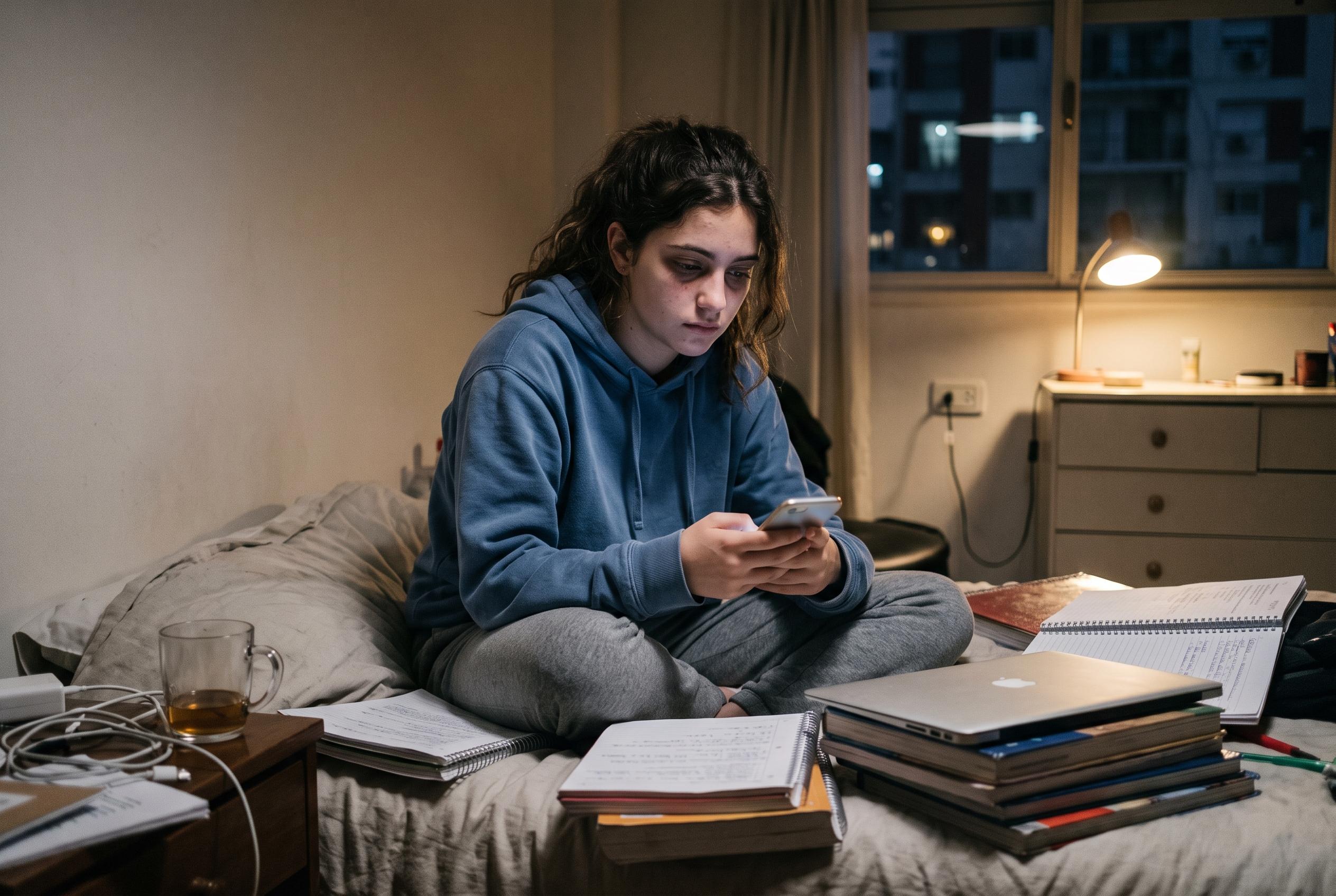

A new study in Buenos Aires reveals teenagers are spending an average of over six hours a day on their phones, with significant links to anxiety, depression, and sleep issues, prompting the city to tighten screen restrictions in schools.
Buenos Aires teenagers are spending so long on their phones that the city government is now using hard usage data to bolster its campaign against screens in schools. The first large-scale monitoring exercise of secondary pupils in the capital found an average of 6 hours and 10 minutes a day on mobiles, while four in 10 showed at least one warning sign linked to anxiety, depression, daytime sleepiness or problematic smartphone use.
The findings were presented on Monday, 7 September 2026, by education minister Mercedes Miguel alongside senior officials including Samanta Bonelli and Inés Cruzalegui. City Hall has framed the study as evidence for a tougher line it has already taken in schools, after first restricting phones in classrooms in 2024 and later moving to a broader ban during the school day in secondary education, apart from planned teaching use. Miguel said the authorities had heard from families that some pupils seemed to leave school with a kind of withdrawal response once classroom access was curbed, which is why the city also launched its “Compromiso Familiar” scheme; more than 100,000 families have signed up.
What distinguishes the Buenos Aires research from many earlier surveys is that it did not rely on teenagers guessing their own screen time. According to Infobae, pupils were asked to open the built-in tracking tools on their phones so researchers could record actual use. The project itself was announced by the city and the Instituto Tecnológico de Buenos Aires in May as a much broader investigation into mobiles, artificial intelligence and reading habits, with an intended sample of 5,000 first- and fourth-year pupils in state and private schools. Officials said participation would be voluntary and the data protected by statistical secrecy. The work was led by Fabricio Ballarini, with Valeria Abusamra and Pedro Bekinschtein also named as scientific leads.
The published results cover 3,261 pupils across public and private schools, and the averages mask wide differences inside that group. Fourth-year students were on their phones for 6 hours and 35 minutes a day, 51 minutes more than first-year pupils. Teenagers from the poorest income quintile logged roughly an hour and a half more screen time than those from the richest. Girls averaged half an hour more than boys. Some cases topped 11 hours a day. TikTok dominated the rankings: among pupils who identified it as their main app, total daily phone use rose to 6 hours and 34 minutes.
The mental health breakdown was also stark. C5N and TN reported that 38.1% of pupils showed warning signs associated with depression, 37.2% with daytime sleepiness, 31.2% with anxiety and 24.9% with problematic smartphone use. The biggest gap in screen time appeared among teenagers whose responses suggested depression: they spent 49 minutes longer on their phones than peers without that alert signal. The difference was 46 minutes for problematic phone use, 36 minutes for anxiety and 19 minutes for daytime sleepiness.
Yet the report’s most pointed conclusion is not simply that more hours are bad. According to the study, the stronger link to poorer wellbeing came from how teenagers use phones, and whether that use has become difficult to control, rather than from the raw total alone. Infobae said “problematic use” covered difficulties disconnecting, psychological dependence, using technology to regulate emotions, conflicts with other people caused by phone habits and possible effects on school performance. The same outlet reported no gap between state and private schools on anxiety indicators, but it did find higher risk among girls and older pupils. Teenagers above the alert threshold for problematic use also tended to show much higher scores on depression, anxiety and sleep-related measures.
City leaders have used that argument to defend their classroom policy. Miguel said “el uso abusivo de los celulares está hackeando la atención de los estudiantes”, while Jorge Macri said the aim was to recover attention in lessons and face-to-face socialising during breaks. The government has already been citing earlier survey evidence in support of that approach. After the 2024 regulation, teachers reported better concentration in class, and later city polling found that many secondary pupils said they were speaking more with classmates and paying more attention when phones were less present.
The results are also likely to feed a wider policy discussion about what teenagers do instead of scrolling. Infobae reported that around 10,000 adolescents currently take part in city-backed weekend activities such as youth clubs, choirs and orchestras in public schools, a relatively small share of the total student body. By Monday evening the study had spread well beyond the original print and television reports into local radio bulletins, including Radio 33 and FM 92.5 Volver, a sign that the debate in Buenos Aires has moved from whether phones shape teenage life to how much that relationship is now costing in attention, sleep and emotional wellbeing.
Disclaimer: This content is for informational purposes only and is not intended to be a substitute for professional medical judgment, advice, diagnosis, or treatment.