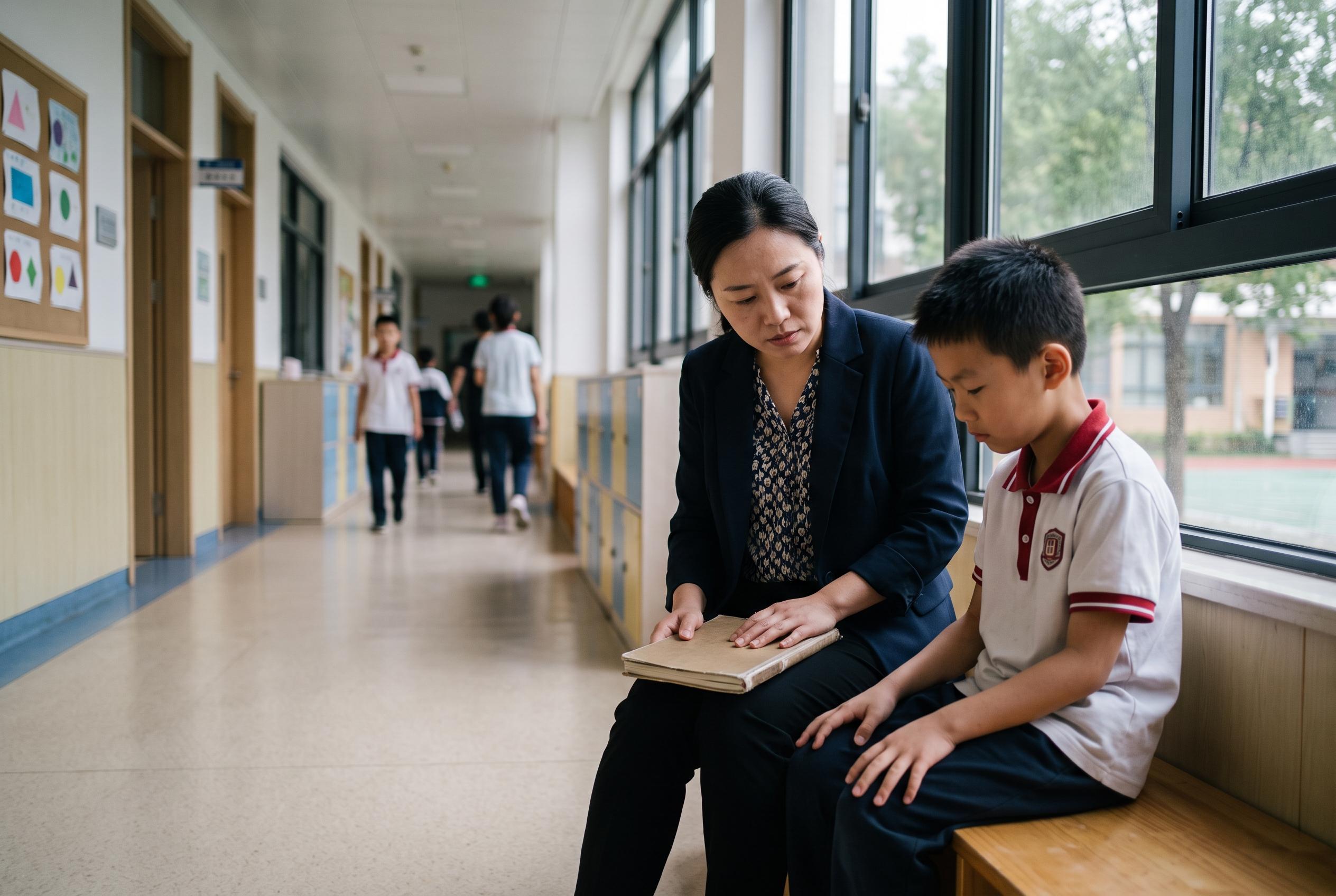

A case study from Suining County in Jiangsu highlights the complexities and risks of relying on teachers, parents, and community workers to deliver mental health support amid a national push for broader access, raising questions about effectiveness and privacy.
A county in eastern China has built a stopgap mental health system that leans heavily on teachers, classmates and parents to spot trouble early and steer children towards specialist care, offering a close-up view of how local authorities are trying to deliver a national policy push without anything like a full professional workforce.
The study, published online by Frontiers in Psychiatry, focuses on Suining County in Jiangsu and argues that this is not a case of amateurs replacing clinicians. Instead, the authors describe a bounded arrangement in which existing school staff handle the front end of support while hospitals and trained mental health specialists keep control of diagnosis and treatment. That matters in a county with about 140,000 pupils across 110 primary and secondary schools, but only 79 full-time school mental health teachers. Local education records cited by the researchers say roughly 35% of schools had a full-time post, while another 285 teachers held relevant certificates but were mostly working part time. The county has earmarked RMB 800,000 a year since 2023 for screening and counselling-related work, yet the paper says staffing, supervision and cross-agency routines remain patchy.
The national backdrop is clear. A notice issued on 11 May 2023 by China’s Ministry of Education and 16 other departments set a 2023-2025 action plan covering prevention, monitoring, counselling, crisis response, early warning and stronger links between schools, families and wider society. State media reporting that October described the same drive as a three-year plan issued in April 2023 by the National Health Commission and 16 other departments, underlining how broad the official backing is even if the bureaucratic framing differs slightly. A 2024 scoping review of school mental health strategies in China said effective support would require government, schools, teachers, families and social sectors to work together, but also noted that delivery is often fragmented and that routine screening is seldom validated as part of a wider intervention process.
What Suining appears to have done is to fold mental health vigilance into ordinary school life. The researchers, who interviewed 52 people and observed 10 schools between September 2023 and June 2024, found homeroom teachers watching for shifts in facial expression, appetite and demeanour, an informal routine some described as the “three daily observations”. Subject teachers also acted as an early-warning point. One teacher said a pupil wrote two pages about his parents’ divorce and feeling that life had no point, prompting an immediate referral to the homeroom teacher. Peer mental health representatives and parent volunteers could listen and pass concerns on, but were explicitly not meant to diagnose, keep sensitive files or handle high-risk cases alone.
That division of labour closely mirrors the logic of the World Health Organization’s mhGAP guidance, which is designed for non-specialist settings and says lower-threshold tasks can be structured through algorithms, follow-up rules and clear referral thresholds, while more complex decisions stay with trained professionals. A separate WHO training manual for humanitarian settings makes the same point in practical terms: non-specialists can be taught through suggested schedules, learning objectives and step-by-step modules, but only within tight boundaries. In Suining, those boundaries were repeatedly stressed by staff. Teachers were expected to listen, offer basic reassurance, ask whether distress was worsening and check for self-harm risk, but not to label a child or attempt therapy. As one homeroom teacher put it, “What we provide is initial reassurance and an understanding of the situation, not therapy.”
Once a case moves beyond that first layer, the system becomes more formal and more fragile. School mental health teachers assess the pupil, decide whether brief school-based support is enough and, if necessary, alert administrators and guardians so a hospital referral can be made. The paper says a fast-track route to medical services reduced delays that had previously left families waiting a week or two for an appointment. But the most stubborn obstacle was often not the paperwork. It was parental resistance. Teachers described parents fearing stigma, medical records and possible effects on schooling, leaving schools able to complete every internal step yet still unable to get a child to a doctor.
The work does not end when a pupil comes back from treatment. The study describes teachers lowering academic pressure, adjusting homework, checking in after lessons and helping classmates reabsorb a returning child into everyday school life. That kind of re-entry support can make a marked difference, but it also raises hard questions about privacy. The authors say useful information is often lost when children move between school stages, yet a full psychological dossier could turn into a lasting label. Their answer is a deliberately narrow one: share only what is needed for immediate safety and educational support, and keep access tightly restricted.
Other Chinese programmes suggest the model can go further if more institutions are genuinely drawn in. A 2025 paper on Chongqing’s “hospital-school-home-community” system reported screening of more than 330,000 students, gatekeeper training for educators and parent courses on communication and symptom management. It said teacher training materials uploaded through official channels drew more than one million views, 84% of teachers said they had used mental health literacy in parent-teacher meetings, and student-initiated counselling requests rose from 5.2 to 11.7 per 1,000 pupils after the intervention. By contrast, the Suining case still looks school-centred: hospitals appear when risk rises, but community organisations and social-service bodies are not yet routine parts of daily support.
The paper is careful about what it can and cannot claim. This is a single-county case study, not proof that the approach improves clinical outcomes or would travel neatly to other parts of China. The authors also warn against overreading local screening numbers, noting that the platform’s psychometric documentation could not be independently verified. Still, the study offers a sharply drawn picture of what happens when political ambition runs ahead of professional capacity. Its central conclusion is less a celebration than a caution: task sharing may widen access to front-end support, but only if specialist gatekeeping, regular supervision, reliable referral channels and disciplined handling of sensitive information remain firmly in place.
Disclaimer: This content is for informational purposes only and is not intended to be a substitute for professional medical judgment, advice, diagnosis, or treatment.