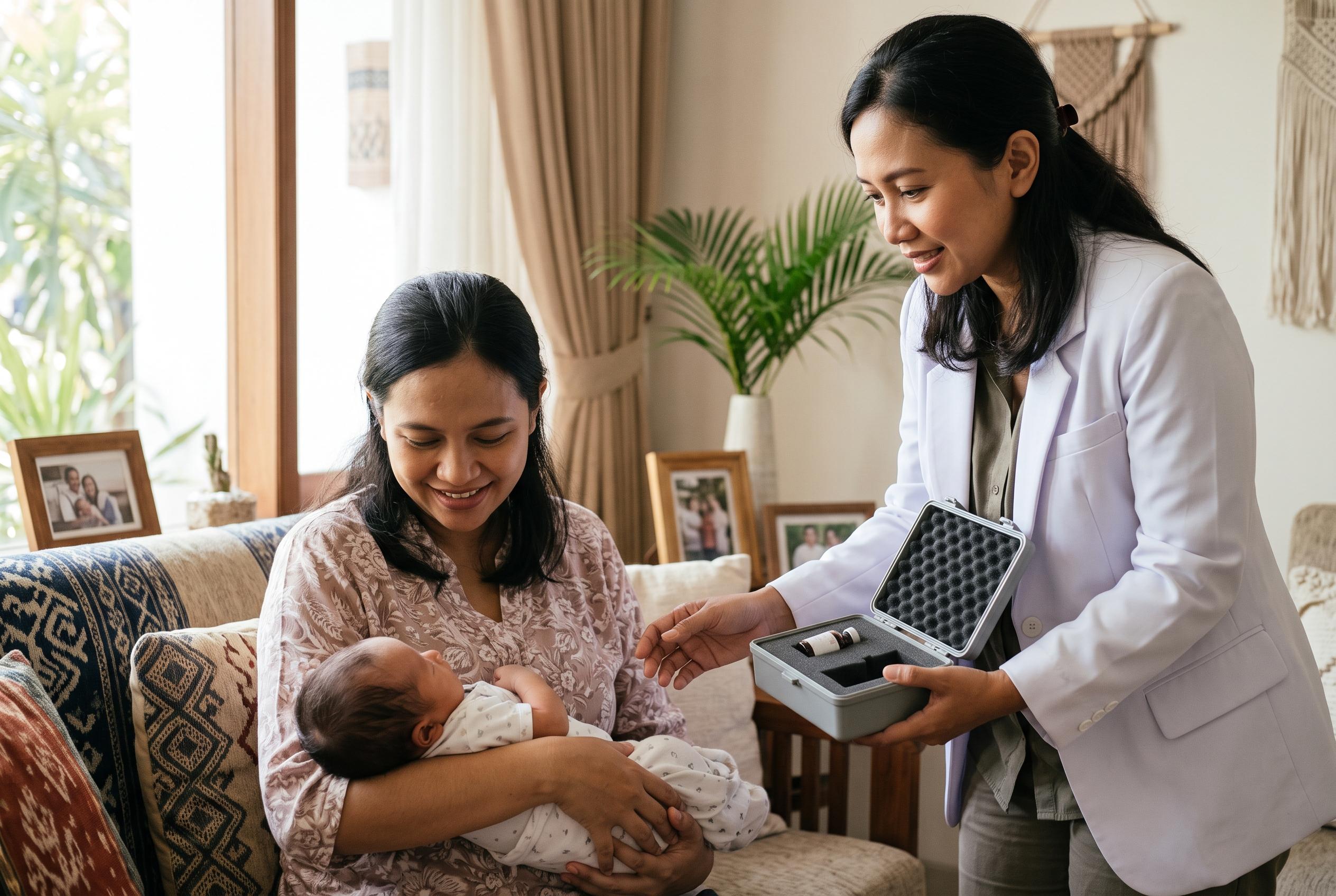

Indonesia’s drug regulator has authorised the use of Bio-RV, the first oral rotavirus vaccine designed for newborns, aiming to reduce severe diarrhoeal disease in infants before peak vulnerability.
Indonesia’s drug regulator has cleared a new oral rotavirus vaccine for use from the first days of life, a move that gives state-controlled manufacturer Bio Farma permission to market Bio-RV after BPOM issued its authorisation on 2 September 2026. The three-dose schedule starts when a baby is 0-5 days old, with follow-up doses at 8-10 weeks and 12-14 weeks, making it a rare neonatal regimen aimed at protecting infants before the period when severe rotavirus illness typically peaks. (idntimes.com)
That matters in Indonesia because rotavirus remains a major cause of serious diarrhoeal disease in young children. Data cited by Bio Farma, Murdoch Children’s Research Institute and Indonesian health outlets from the Indonesia Rotavirus Surveillance Network show the virus accounted for about 41-58 per cent of diarrhoeal cases among under-fives needing hospital treatment between 2001 and 2017. IDN Times reported that rotavirus attacks the intestinal lining and can trigger watery diarrhoea, vomiting, fever and rapid dehydration, while detikHealth noted that repeated bouts of acute diarrhoea can disrupt nutrient absorption and contribute to growth problems, including stunting. (mcri.edu.au)
Bio-RV is a naturally attenuated live vaccine given by mouth rather than injection, and Bio Farma says BPOM’s decision means the product passed the regulator’s checks on safety, efficacy and quality. The schedule is also the central scientific selling point: vaccination begins in the neonatal period, when families are already in contact with maternity and primary care services. That birth-dose idea has been part of the project for years. In a 2023 article, Universitas Gadjah Mada said the RV3-BB vaccine platform behind Bio-RV was being developed in Indonesia specifically as an early-life or neonatal candidate, and microbiologist Hera Nirwati said Bio Farma was expected to mass-produce it. (idntimes.com)
The approval is the latest step in a research story that stretches back more than five decades. According to ANTARA and Bio Farma, human rotavirus was first identified in 1973 by Murdoch Children’s researchers Ruth Bishop and Ian Holmes at the University of Melbourne. ANTARA said Bishop and Barnes later worked with UGM’s Yati Soenarto, who helped establish rotavirus as a leading cause of diarrhoeal deaths and hospitalisation among Indonesian children. In 1982, Bishop identified RV3, an unusual strain found in newborns without causing illness, and Julie Bines later led the development of RV3-BB from that strain through clinical work in Australia, New Zealand and Indonesia. Bio Farma and ANTARA also said the programme drew support from the Gates Foundation, Australia’s National Health and Medical Research Council, Universitas Airlangga’s Airlangga Integrated Research Clinic and PATH. (en.antaranews.com)
Evidence for the neonatal approach had already been published before this week’s regulatory decision. IDN Times, citing a phase 2b study in The New England Journal of Medicine, said the underlying RV3-BB candidate was tested in 1,649 healthy Indonesian newborns in a randomised, double-blind, placebo-controlled trial. The journal’s abstract reports that, with the neonatal schedule, efficacy against severe rotavirus gastroenteritis was 94 per cent at 12 months and 75 per cent at 18 months. IDN Times also said serious adverse events were recorded at similar rates in vaccine and placebo groups and that no cases of intussusception were found in the 21-day post-dose risk window. Separately, BPOM published a 2020 summary for a 1,400-subject phase III study of Bio Farma’s RV3 vaccine and lists a related phase III neonatal trial in its clinical-trial registry as closed. (idntimes.com)
Bio Farma is presenting the product as both a public-health tool and an industrial milestone. President director Shadiq Akasya said, “Bio-RV is not simply about introducing a new vaccine,” describing a long process of research, clinical work, technology transfer, regulatory filing and manufacturing preparation. In a separate quotation carried by ANTARA, he said the goal was “protection for Indonesian children as early as possible” while preserving Indonesia’s ability to secure its own vaccine supply. Bio Farma and MCRI say domestic production should strengthen availability, reduce reliance on imported products and help sustain the national immunisation programme over time. (mcri.edu.au)
What comes next is less clear than the licensing decision itself. By 5 September 2026, the public statements from Bio Farma, MCRI and the main follow-up news reports were still focused on the authorisation rather than on a launch timetable. IDN Times said there had been no public detail on pricing, distribution points or when Bio-RV might be folded into routine state-backed immunisation, suggesting that the regulatory milestone has arrived before the practical rollout plan has been fully set out. (idntimes.com)
Disclaimer: This content is for informational purposes only and is not intended to be a substitute for professional medical judgment, advice, diagnosis, or treatment.