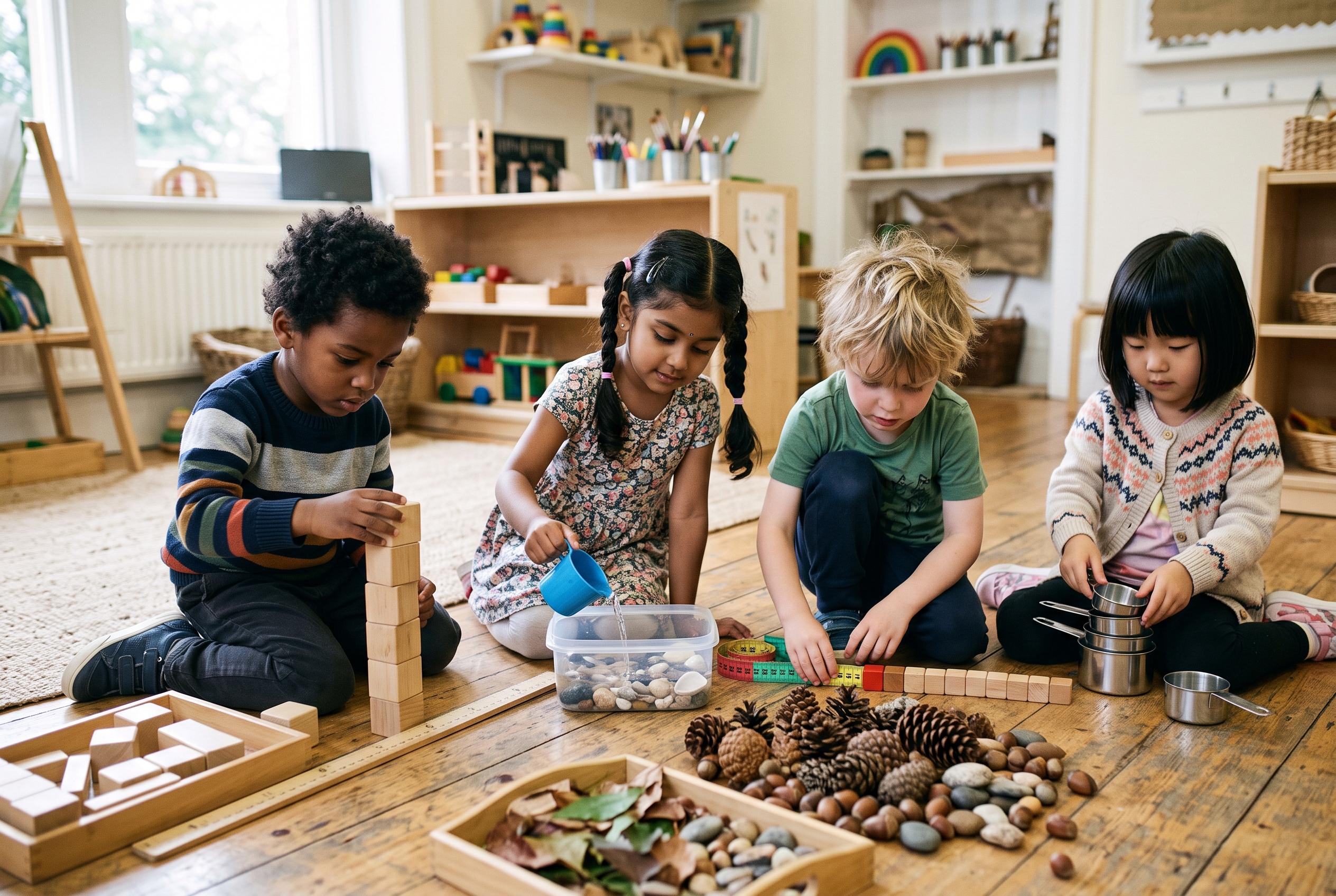

Engaging preschool children in practical measurement activities using familiar materials promotes foundational skills in comparison, prediction, and problem-solving, setting the stage for mathematical understanding.
Measurement can begin long before a child can name a ruler or read a clock. In the preschool years, children are already curious about whether a toy fits in a box, which tower is tallest, or why a tall glass of water does not seem to match a wide bowl. According to Editorial Ge, the most useful adult response is often not a quick answer but a prompt to investigate.
That approach matters because measurement play is about more than numbers. It gives children a chance to compare, predict, test and rethink. Preschoolers may start with words such as big, small, long, heavy, full and empty, then move on to direct comparisons and informal units such as blocks or footsteps. The Education.com and ABCmouse activity guides both stress that these early experiences can build confidence with length, weight, capacity and time through familiar, hands-on tasks.
A key lesson is to start with comparison before introducing formal tools. A child who can place two sticks side by side or line up ribbons from shortest to longest is building the thinking that makes later use of rulers and measuring cups meaningful. The ECE Resource Hub and the Illinois Early Learning Project both emphasise that practical measurement experiences help children understand heavier and lighter, longer and shorter, and other basic attributes through direct observation and play.
Everyday materials are often enough. Blocks, cups, string, spoons, timers and household containers can support weeks of exploration without any special kit. Tinkergarten recommends using simple outdoor materials such as yarn, twine or sticks, while ClassWeekly also highlights non-standard units as a useful bridge between informal comparison and more formal measurement. The point is not perfection, but giving children time to notice patterns and make adjustments.
Water play and cooking offer especially strong opportunities, because children can see results immediately. A child can test which container holds more, count spoonfuls, or compare a full bowl with an empty one. The Illinois Early Learning Project notes that measurement can be woven into everyday routines, including timed activities and practical classroom tasks, while ABCmouse points to cooking and water-based play as natural ways to introduce these ideas.
Weight can be explored in much the same way. A simple balance scale makes heavier and lighter visible without requiring children to read a numerical scale. The ECE Resource Hub recommends this kind of practical comparison, because it helps children see that size alone does not always predict weight. A large sponge may be lighter than a small stone, and that discovery tends to stick better than a verbal explanation alone.
Time is harder for young children to grasp, so familiar routines work better than abstract lessons. Measuring how long it takes to wash hands, put on shoes or tidy toys helps children notice before, after, first and next. Editorial Ge also suggests using plant growth as a slow, repeatable measurement activity, since children can mark progress over several days and see that some changes take time to appear.
The best measurement play leaves room for trial and error. Adults can help by asking clear questions such as how to check, what should line up, or whether the same unit is being used. They should also know when to step back. A gap between blocks or a starting point that has shifted can be a useful mistake, because it shows what the child is thinking and creates a chance to try again.
For parents and caregivers, the main goal is not a perfect answer but a stronger habit of noticing. Children who begin by comparing, arranging, pouring and testing are laying the groundwork for later mathematical understanding. Whether they are measuring a ribbon, a jug, a bridge for a toy truck or a growing plant, the real learning comes from the investigation itself.
Disclaimer: This content is for informational purposes only and is not intended to be a substitute for professional medical judgment, advice, diagnosis, or treatment.