
Maine families embracing flexible, play-based homeschooling for preschoolers, leveraging community spaces and practical life skills, supported by state frameworks and diverse teaching methods.
For Maine families weighing home education for a preschooler or kindergartner, learning can be woven into the rhythm of ordinary days: at the kitchen table, on a woodland walk, while measuring flour for muffins, in the library or at a local park. The state’s early-childhood framework supports that broader view. Maine’s Department of Education describes Pre-K for ME as a play-based, intentional curriculum for 4-year-olds, aligned with the state’s Early Learning and Development Standards and built around social-emotional growth, language, literacy, movement, science and early mathematics.
That approach leaves room for a home environment that helps young children do more for themselves. Low shelves, child-sized tables, stools at the sink and reachable hooks can turn everyday routines into lessons in independence. Simple tasks such as pouring water, folding cloths, setting the table, watering plants and sweeping crumbs build coordination and concentration. Those ideas closely resemble Montessori practice, which emphasises a prepared environment, practical life skills and hands-on work at a child’s pace.
Families do not need to commit to one philosophy alone. Montessori methods can sit alongside Waldorf-inspired storytelling, nature study, art and handwork, or alongside workbooks, phonics and other structured materials. Maine’s broader early-learning programme also encourages playful, developmentally appropriate teaching that builds a sense of belonging, initiative and critical thinking, while the kindergarten version, K For ME, extends that model into literacy, science, social studies, arts and social-emotional learning.
Reading aloud remains one of the most effective tools for young children. Picture books, nursery rhymes and daily stories can build vocabulary and comprehension, especially when parents ask children to predict what happens next or retell a familiar tale. Early literacy at home can also include letter sounds, tracing names, rhyming songs and spotting words on signs or packaging. On the maths side, counting forks, sorting blocks, comparing lengths and measuring ingredients can make number work concrete without long worksheet sessions.
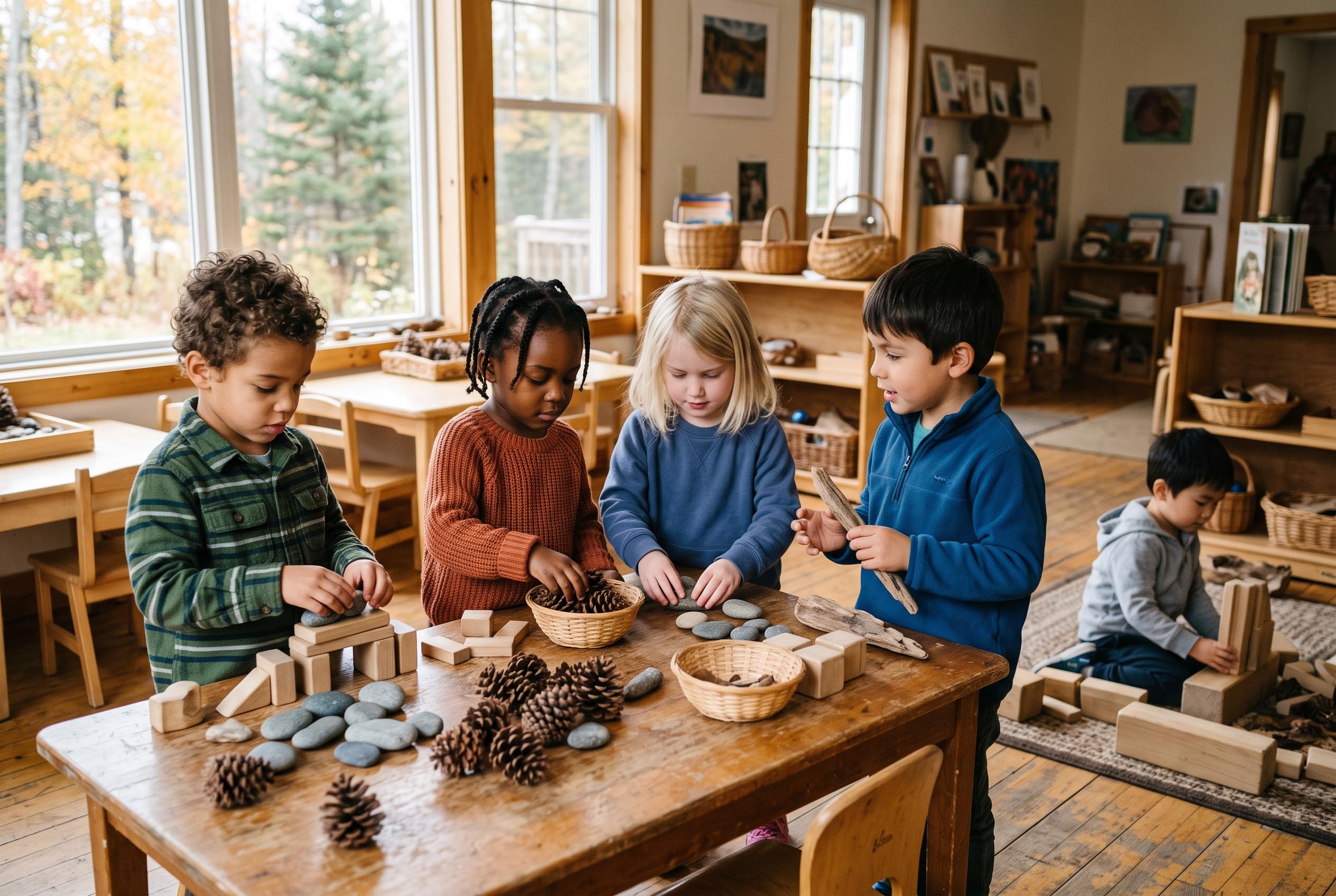
Nature study is especially well suited to young homeschoolers in Maine. A walk in the woods, a visit to a pond or time in the backyard can lead to collecting leaves, pine cones, rocks and seed pods, then sorting, sketching or identifying them later. Maine’s Pre-K for ME units also use themes such as wind and water, colour, shadows and growing things, reinforcing the value of observation and curiosity. Parents do not need to know every answer; looking things up together can be part of the lesson.
Homeschooling does not have to stay inside the house. Libraries, parks, museums and other community spaces can become classrooms in their own right. In the Lewiston-Auburn region, the Sun Journal highlighted places such as Treat Memorial Library in Livermore Falls, Kineowatha Park in Wilton, the Washburn-Norlands Living History Centre in Livermore and the Maine Mineral & Gem Museum in Bethel as examples of how children can learn through stories, play, outdoor exploration and local history. For Maine families, the legal framework also matters: compulsory attendance begins at age 6, parents do not need to file a notice for a 5-year-old, and home instruction for older children requires a notice, at least 175 instructional days and coverage of core subjects.
Disclaimer: This content is for informational purposes only and is not intended to be a substitute for professional medical judgment, advice, diagnosis, or treatment.