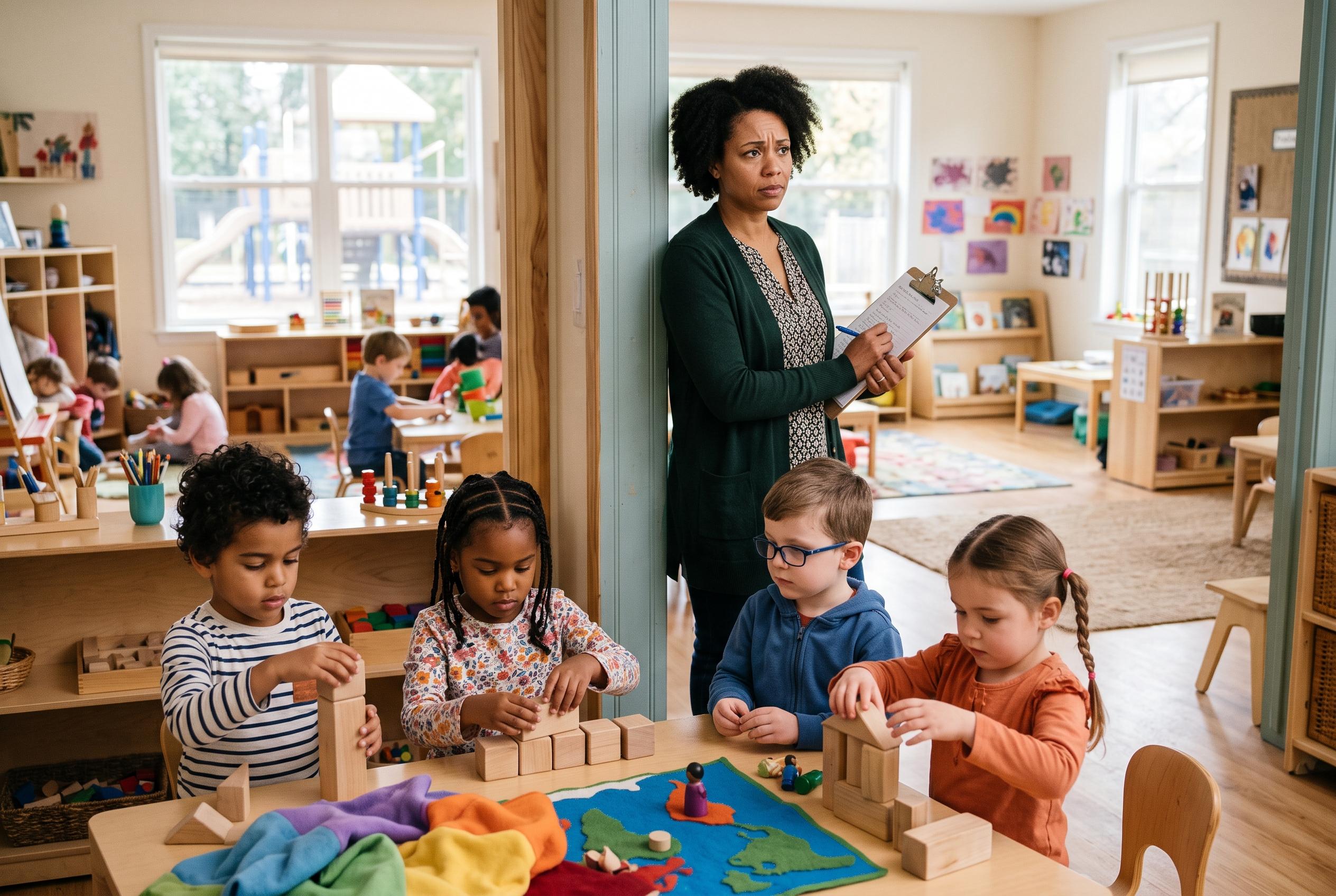

As California extends free transitional kindergarten to all four-year-olds, providers warn the shift is shrinking vital childcare options and threatening the sustainability of early-years services across the state.
As the 2026-27 school year begins, the second in which every four-year-old in California can attend transitional kindergarten, researchers and providers say the state’s biggest early-years success story is also hollowing out parts of the childcare market that families still rely on. Berkeley researchers say public TK enrolment rose from nearly 117,000 children in 2022-23 to about 213,000 in 2025-26, and that the free school-based places are pulling older pre-schoolers out of private nurseries and home-based care faster than those providers can replace them with younger children. Anna Powell, one of the authors, has warned that an interconnected system is being destabilised by a dramatic change in care for one age group.
The financial problem is simple enough to describe and much harder to solve. Older children have long helped subsidise the much costlier care of babies and toddlers. The Berkeley brief says a centre needs three teachers for 12 infants, but only one for 12 four-year-olds. In 2023, average monthly centre prices were about $1,643 for infant care and $975 for pre-school-age care, a gap that does not begin to cover the difference in staffing costs. Only about a quarter of California childcare centres are licensed to serve infants and toddlers, and providers told the researchers that changing a licence can be slow and bewildering. One centre director said an application to take younger children had been sitting for “a couple of years”. Powell’s verdict was that the state had asked a fragile industry to “completely retool itself without a dollar to do that”.
The disruption is no longer anecdotal. UC Berkeley research has put the net loss of non-profit pre-school programmes at roughly 1,100 during the years of TK expansion, though reports drawing on that work have described the tally over slightly different periods, either from 2019 to 2025 or since 2021. KQED reported that the most vulnerable sites were often church-based programmes, smaller centres serving 30 to 50 children, and providers dependent on public subsidy. Only about 15% of affected programmes had made the switch lawmakers originally imagined, moving into infant and toddler care. The same reporting said Berkeley researchers estimated that every 200 children entering public TK translated into 38 fewer places in community-based programmes.
In some communities, the numbers have already become closures. Carquinez Garden School, described by KQED as the only licensed childcare centre in Crockett, shut on 12 June after its roll fell from more than 30 children to 10 in two years. Its director, Heather Posner, said she had effectively worked without paying herself for two years while trying to keep the programme alive. In Berkeley, the early childhood arm of The Berkeley School saw enrolment drop from 90 children to about 25 as the district added more TK classrooms. “It’s a loss for our community, it’s a loss for our school as a whole,” Mitch Bostian, the school’s head, told KQED, saying the Montessori model of mixing ages in the classroom had unravelled when the youngest cohort disappeared.
Home-based providers are under pressure too, even if they can serve a broader spread of ages. CapRadio reported that Yolanda Thomas, who has run the Best Beginnings family daycare and pre-school in Contra Costa County for 27 years, lost a four-year-old to TK and then had to refill the space before the family discovered that the school day did not match their work schedule and wanted to return. Berkeley’s researchers found that by spring 2025 only 57% of licensed family childcare providers were caring for any four-year-olds at all. Thomas said providers like her were still waiting to be treated as part of the state’s long-term plan rather than collateral damage. “We would like our experience to count for something,” she said.
None of this means families are wrong to take the free place. In a state where care for a four-year-old averages about $13,000 a year, the attraction is obvious. Hanna Melnick of the Learning Policy Institute told CapRadio that moving a child out of a pre-school bill that can run from $10,000 to $30,000 a year and into TK “is a good thing”. The difficulty, she said, comes when the provider who used to teach that child is not able to survive long enough to serve younger children instead. That risk is acute because the shortage below TK age has hardly disappeared. CapRadio cited analysis showing that more than 306,000 California three-year-olds were not enrolled in publicly funded early education in 2024-25, while KQED reported that fewer than one-third of three-year-olds are in pre-school of any kind and that the California State Preschool Program is expanding more slowly than TK.
That imbalance has become a funding argument in Sacramento. During budget talks earlier this year, CapRadio reported that childcare and state pre-school providers were in line for a 2.01% cost-of-living rise, compared with 4.31% for school districts, including TK programmes. The final 2026-27 budget later added nearly 23,000 subsidised childcare places, according to KQED, but providers and advocates argued that extra places alone would not steady the sector if reimbursement rates still failed to match the cost of care. Patricia Lozano of Early Edge California said the state needed to help providers serve younger children, “which was the original vision”.
Researchers and some local leaders say the state still has options if it wants to preserve genuine family choice rather than a single dominant free offer. The Berkeley brief calls for capital grants to help centres buy equipment and remake space for babies and toddlers, quicker licensing decisions, specialised training for staff, and stronger partnerships between school districts and community providers. At present, it says, only 9% of districts work with off-site providers for TK extended-day care. The Los Angeles Times recently pointed to one possible model in Vallejo, where Child Start, First 5 Solano and the county office of education are sharing a former elementary school campus. About 100 children were enrolled across eight classrooms opened since April, with seven more waiting on licensing approval. By pooling maintenance, utilities and other running costs, the partners said they had roughly halved their overheads. For a state trying to keep free TK while avoiding further closures, that kind of arrangement may prove less expensive than allowing the rest of the market to wither.
Disclaimer: This content is for informational purposes only and is not intended to be a substitute for professional medical judgment, advice, diagnosis, or treatment.