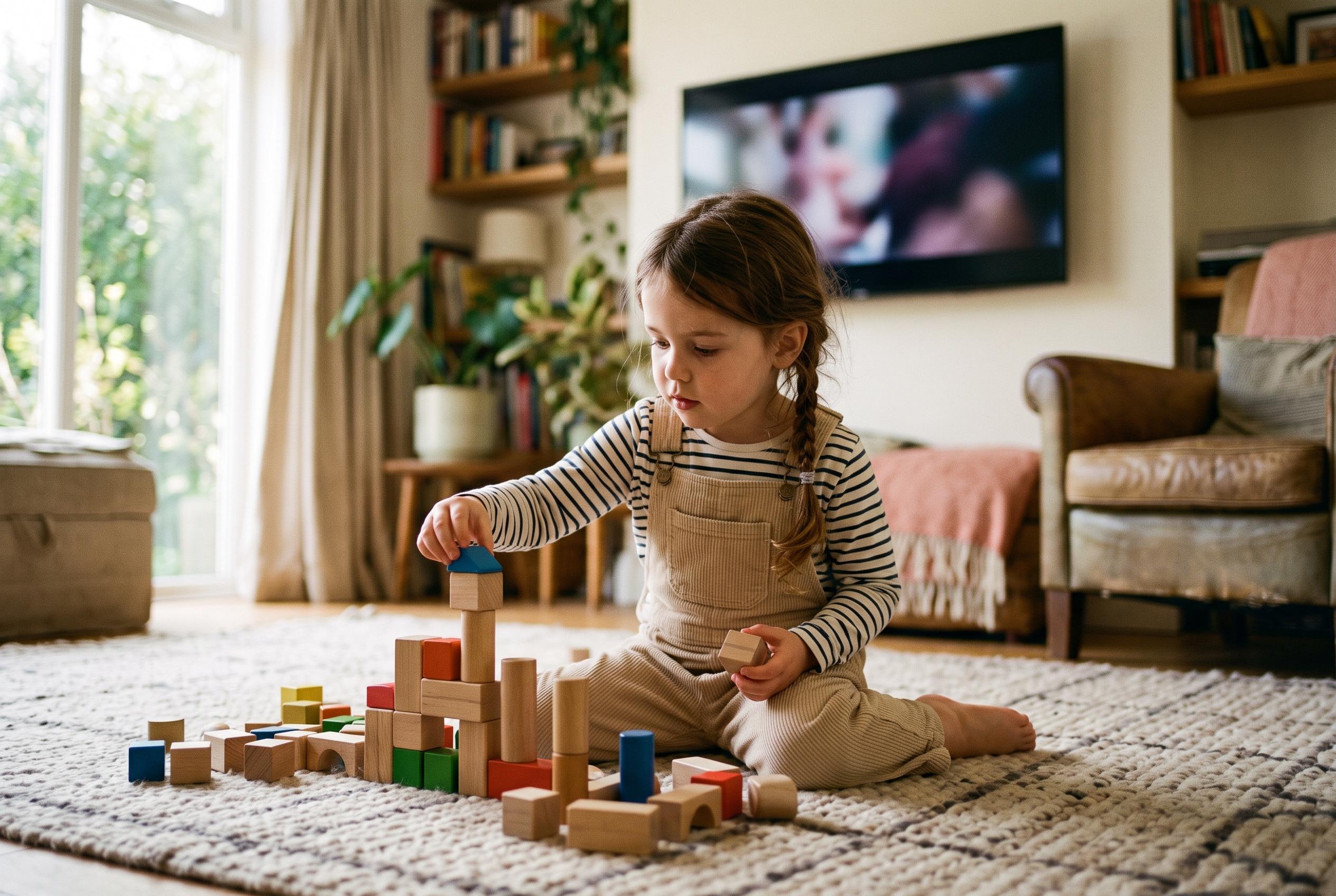

Studies reveal that even fleeting exposure to background TV can diminish young children’s play, focus, and parent-child engagement, raising concerns about longstanding effects and household habits.
Many households once left the television running as a kind of domestic wallpaper: not quite watched, not quite ignored. Research suggests that habit can matter more than it seems, especially for very young children. Studies in child development have found that even a set playing in the background can reduce the length and focus of play, and can weaken the back-and-forth between a child and the adult nearby.
In one experiment led by Rachel Schmidt, 50 children aged 12, 24 and 36 months spent an hour in a room filled with toys while a game show played for half that time on a monaural television set. The children glanced at the screen only briefly, yet their play became shorter and less sustained when the television was on. A companion study the following year, involving 51 toddlers and a parent in a room set up to resemble a family space, found that both the amount and the quality of parent-child interaction fell while the television was running.
That evidence is stronger than the broader claim often built on top of it. The experiments show what happens in the moment: a playing child, a switched-on set and a less focused hour. They do not prove that background television leaves a lasting attention problem that follows a child into school years or beyond. For that, the evidence is thinner and more mixed.
A study published in 2021 in the journal Pediatric Research looked at 1,180 US caregivers of children aged 2 to 8, using 24-hour time-use diaries to track both television exposure and what children were doing at the time. It found that background television during sleep was linked with poorer executive function across age groups. For preschool children, playing alone while the television was on was associated with weaker executive function. But among school-age children, playing with others while the television ran was associated with stronger executive function, underscoring how much the context appears to matter.
Earlier research in Pediatrics showed how common the habit is. In a national survey of 1,454 parents, the average US child aged 8 months to 8 years was exposed to more than 232 minutes of background television on a typical day. Younger children were exposed more often, as were Black children, and leaving the television on when no one was watching, along with owning a television in the bedroom, was tied to higher exposure.
There is also a gap between what the research supports and what is sometimes claimed about teachers spotting these children in class. No study identified here tested whether teachers can reliably recognise children whose homes have a television on in the background, or whether such a judgement would even be accurate. What the research does support is narrower but still useful: a running television changes the immediate environment. It shortens play, interrupts attention and dulls adult-child interaction, even when the child seems barely to notice it.
Disclaimer: This content is for informational purposes only and is not intended to be a substitute for professional medical judgment, advice, diagnosis, or treatment.