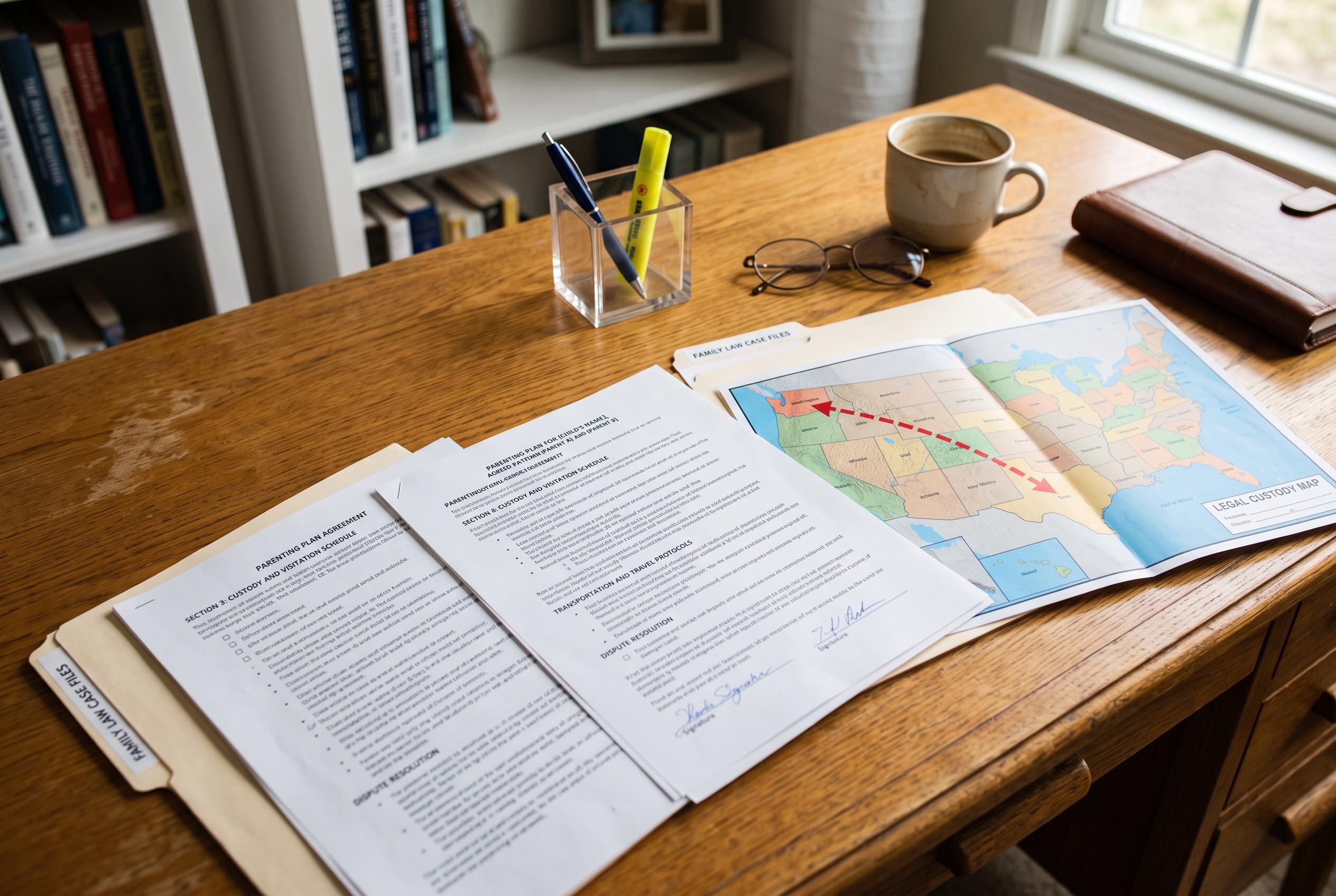

When parents live across state lines, custody arrangements require detailed planning and understanding of jurisdictional rules, highlighting the importance of a comprehensive parenting plan and legal clarity to protect children’s best interests.
When parents live in different states, child custody can become as much a jurisdictional question as a family one. Legal experts say the first issue is not simply which parent wants what, but which court has the authority to hear the case. Under the Uniform Child Custody Jurisdiction and Enforcement Act, the child’s home state is usually the place where the child has lived with a parent for at least six consecutive months before a case is filed.
That home-state rule matters because custody disputes can quickly become complicated once one parent moves away or the family is already split across state lines. According to family law guides in Alabama and elsewhere, courts generally look first to where the child has been living, although exceptions can arise if a child has recently relocated or if another state has a stronger connection to the dispute. The aim is to prevent parents from trying to gain an advantage by filing in a more favourable forum.
Co-parenting across state borders also requires more detailed planning than a typical local arrangement. Legal guidance on long-distance visitation stresses the need for longer blocks of parenting time, such as summer visits and alternating holidays, because frequent back-and-forth travel is rarely practical. Plans also need to address who pays for flights, how children travel alone if they are old enough, and how parents will keep in touch between visits.
State-by-state custody resources show that the rules, terminology and expectations can vary meaningfully from one jurisdiction to another, even where the same broad legal framework applies. In Wyoming, for example, legal guidance notes that child support is calculated under an income-shares model, meaning both parents’ net incomes are combined and then divided proportionally. Other state guides highlight separate issues such as relocation rules, schedule modification standards and communication expectations, all of which can affect how a long-distance parenting plan works in practice.
The practical lesson for separated parents is that distance does not remove legal responsibility. It often makes clear documentation more important. A workable custody arrangement usually depends on a detailed parenting plan that anticipates travel, communication and school-year routines, while also making sure the right court is handling the dispute in the first place.
Disclaimer: This content is for informational purposes only and is not intended to be a substitute for professional medical judgment, advice, diagnosis, or treatment.