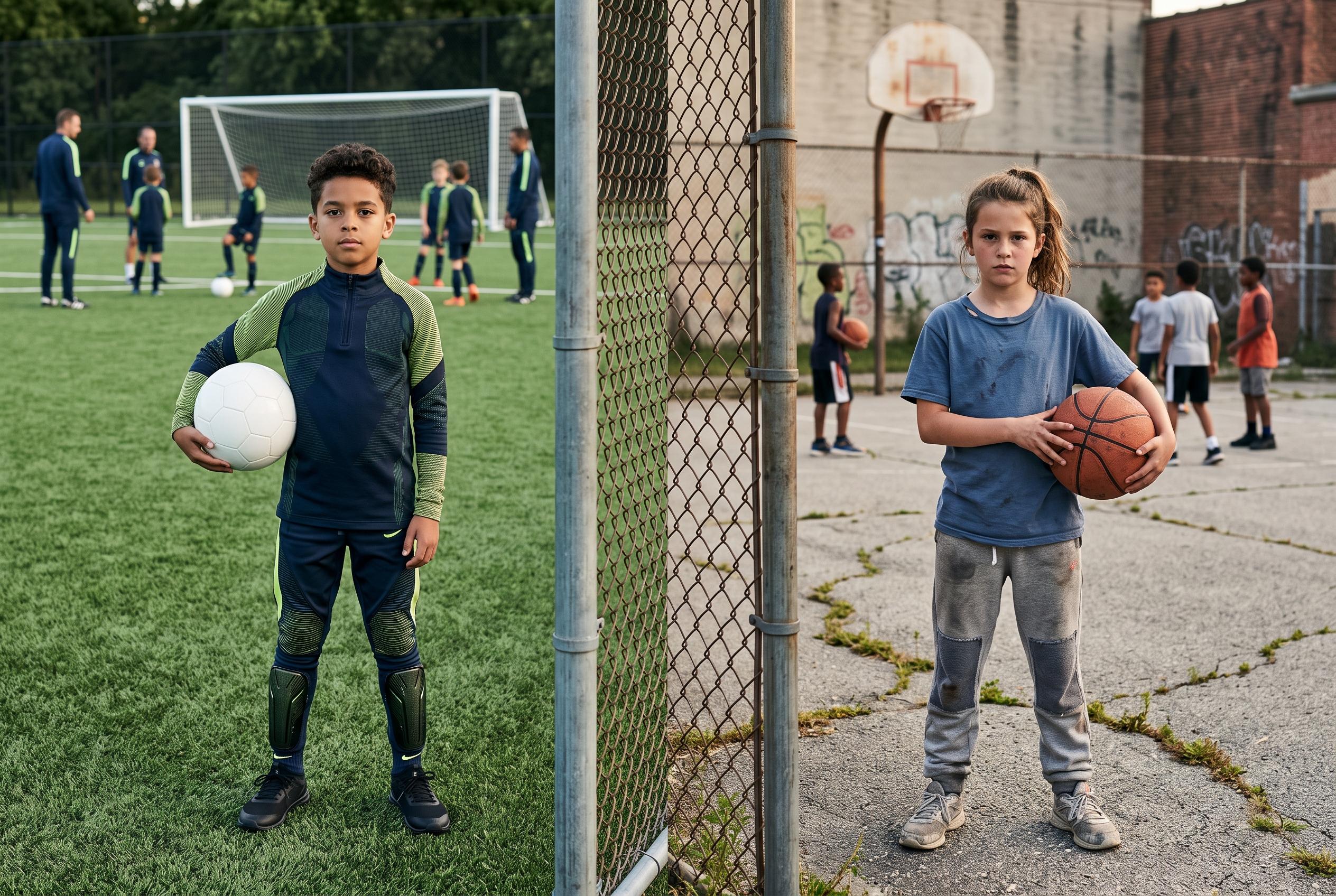

As families spend more than ever to keep children active in organised sports, a widening gap emerges between affluent families and those unable to meet soaring costs, prompting concerns about access and the true purpose of youth sport.
Families are paying sharply more to keep children in organised sport even as fewer children are taking part, exposing a system in which the premium experience is increasingly reserved for those who can afford it. Aspen Institute research published last year found that spending on a child’s main sport rose 46% between 2019 and 2024 to an average of $1,016, and to nearly $1,500 once parents counted other sports as well. The same analysis said participation had slipped to 54.6% of children aged 6 to 17. For Joe Amorosa, whose 10-year-old son Vinny is already a decorated young wrestler, that national trend lands in a very personal way: his family now spends about $10,000 a year on club wrestling and tournaments, and he has begun to question how much of the race is really for the child and how much is driven by fear of falling behind.
That anxiety is not confined to one sport or one income bracket. The Washington Post reported in January that Lindsey Rector, a single mother in Florida, expected to spend at least $8,000 this year on club baseball for her 12-year-old son, including a $3,000 team fee, weekly lessons and out-of-town tournaments. She even turned to GoFundMe to help cover a Cooperstown trip, part of a wider pattern that the fundraising platform said made “competition travel” its leading sports-related cause in 2025. Amorosa voiced a similar unease, saying youth sport now feels like a constant exercise in keeping up, with families pushed to believe that if they skip events, camps or extra bouts, their child will lose ground.
The money is flowing into a business that has grown well beyond volunteer coaches and weekend recreation leagues. Over the past two decades, club teams, private instruction and destination tournaments have been assembled into an increasingly consolidated market backed by investors who see dependable demand from ambitious families. The Washington Post said Unrivaled Sports, launched in 2024 by Josh Harris and David Blitzer, bought nearly 200 youth flag football leagues as well as baseball tournament operations linked to Cooperstown All Star Village and Ripken Baseball, before Dick’s Sporting Goods took a $120 million minority stake in the company. Another operator, 3STEP Sports, has gathered more than 1,000 clubs and leagues under one umbrella. Sports Business Journal described the shift as a progression from town all-star teams to private clubs and academies, with companies now making money from teams, events, facilities and training at multiple points in a family’s season.
The headline fee is often only the start. Associated Press reporting on youth hockey laid out how basic equipment alone can become a barrier: a youth stick can cost about $70, higher-end versions roughly three times as much, recreational skates about $100 and top models close to $1,000. In soccer, Sports Business Journal said even lower-end private travel registration can run to about $1,200 before families add tournament entry, hotel stays, flights and private coaching. A typical travel side may enter 12 tournaments in a year, making five-figure annual spending entirely plausible for one child. In Colorado, parents and club figures told the Denver Post that AAA hockey can climb beyond $35,000 a season once extensive travel is included.
Yet the high-end market is not the whole picture, and that is part of what makes the argument so fraught. An AP-Ipsos poll found that about three-quarters of K-12 sports parents said their children had played on a recreational team and about two-thirds had played on a school team, while only about four in 10 reported travel or club participation or private lessons. Roughly two-thirds said they spent up to $2,000 a year on equipment, fees, training and travel; about two in 10 spent between $2,000 and $5,000; and only around one in 10 spent more than $5,000. Project Play’s own survey similarly found that community teams, free play and school sport remained more common than club settings, even if club pathways exert outsized influence as children get older.
Parents, meanwhile, keep buying in because they do see value in sport, even when the bills bite. The AP-Ipsos poll found that about eight in 10 sports parents described themselves as “proud” and “happy” about their children’s participation, despite widespread complaints about scheduling, logistics, travel and kit costs. Kathryn Stuczynski, a mother in New York whose daughters compete in karate, grappling and wrestling, told AP: “Giving my girls life experiences, it’s priceless,” adding, “I’d rather have the old phone, you know? I’m fine with that.” Around six in 10 parents said hopes of a scholarship or stronger college application played at least some role in enrolling children, even though relatively few young athletes will ever receive that payoff.
That faith in the upside sits alongside mounting evidence that access is narrowing. Project Play said wealthier households spent $1,471 more each year on a child’s primary sport than the lowest-income families, and parents in its survey reported totals ranging from nothing to almost $25,000. Reuters reported in July that former US men’s national team star Landon Donovan said there was “zero chance” he could have played youth football under the current fee structure. Senator Chris Murphy called the situation “a real crisis in youth sports today”, while US Soccer’s chief operating officer, Dan Helfrich, said the sport had to “fundamentally restructure the youth side” by lowering costs and barriers to entry.
The consequence is not only financial strain on households but a deeper question about what organised sport is for. Experts cited by the Washington Post and Project Play argued that the expensive model often sells parents a promise of superior development and recruitment that research does not consistently support, especially when children specialise too young. Amorosa has come to his own version of that conclusion. Two years ago, he said, he would have chased every hard match and every extra bracket for Vinny and his younger son Gino. Now he says he is trying to find “the most fun versions of the sport” and to make sure there is still “tread on the tires” when more consequential decisions arrive later in their sporting lives.
That leaves youth sport in the United States caught between two stories that are both true. For many families, the games still bring confidence, friendship and structure, and most parents are not spending at the extreme end. But the fast-growing commercial layer above local recreation has changed expectations, pricing and access across the system. What used to be an optional route for the best prospects now shapes how ordinary parents think about ordinary childhood sport. The result is a market large enough to attract private capital, but expensive enough to make many families wonder whether they are buying opportunity, peace of mind or simply the fear of missing out.
Disclaimer: This content is for informational purposes only and is not intended to be a substitute for professional medical judgment, advice, diagnosis, or treatment.