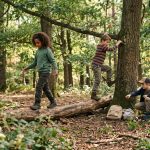
An international review of 74 studies suggests adventurous play can support children’s physical and mental health, social skills and cognitive development, while independent outdoor play is increasingly delayed.
Children who are given more freedom to run, climb, cycle and explore outdoors appear to enjoy better physical and mental health, according to an international review led by the University of Exeter and the University of British Columbia. The analysis, published in PLOS One, found that adventurous play was also associated with stronger social and cognitive development, suggesting that the kinds of games many adults once treated as ordinary may still be important for healthy childhood development.
The review brought together evidence from 74 studies involving children aged three to 12 in different parts of the world. Researchers looked at a wide range of outcomes, including physical health, mental wellbeing, aggression, social skills, thinking abilities, risk competence and injuries. They found that children who had more chances to engage in active, outdoor and adventurous play tended to do better on several of these measures.
Helen Dodd, who leads Exeter’s Centre for Research on Outdoor Play, said the findings underline the value of striking a balance between protection and independence. In a statement released by the university, she said that shielding children too much can deprive them of opportunities to learn through experience. The study also points to a wider shift in childhood habits: Exeter researchers say children are now beginning to play outside without supervision at nearly 11 years old, more than a year later than their parents did.
That delay matters because independent mobility was linked in the review to higher levels of physical activity and less time spent on screens. The findings add to a growing body of research suggesting that outdoor play in natural or more varied environments, including creatively designed playgrounds, can support healthier development. Other Exeter research has also found that more outdoor play during the preschool years is linked with a lower risk of emotional and behavioural difficulties later in childhood.
Disclaimer: This content is for informational purposes only and is not intended to be a substitute for professional medical judgment, advice, diagnosis, or treatment.