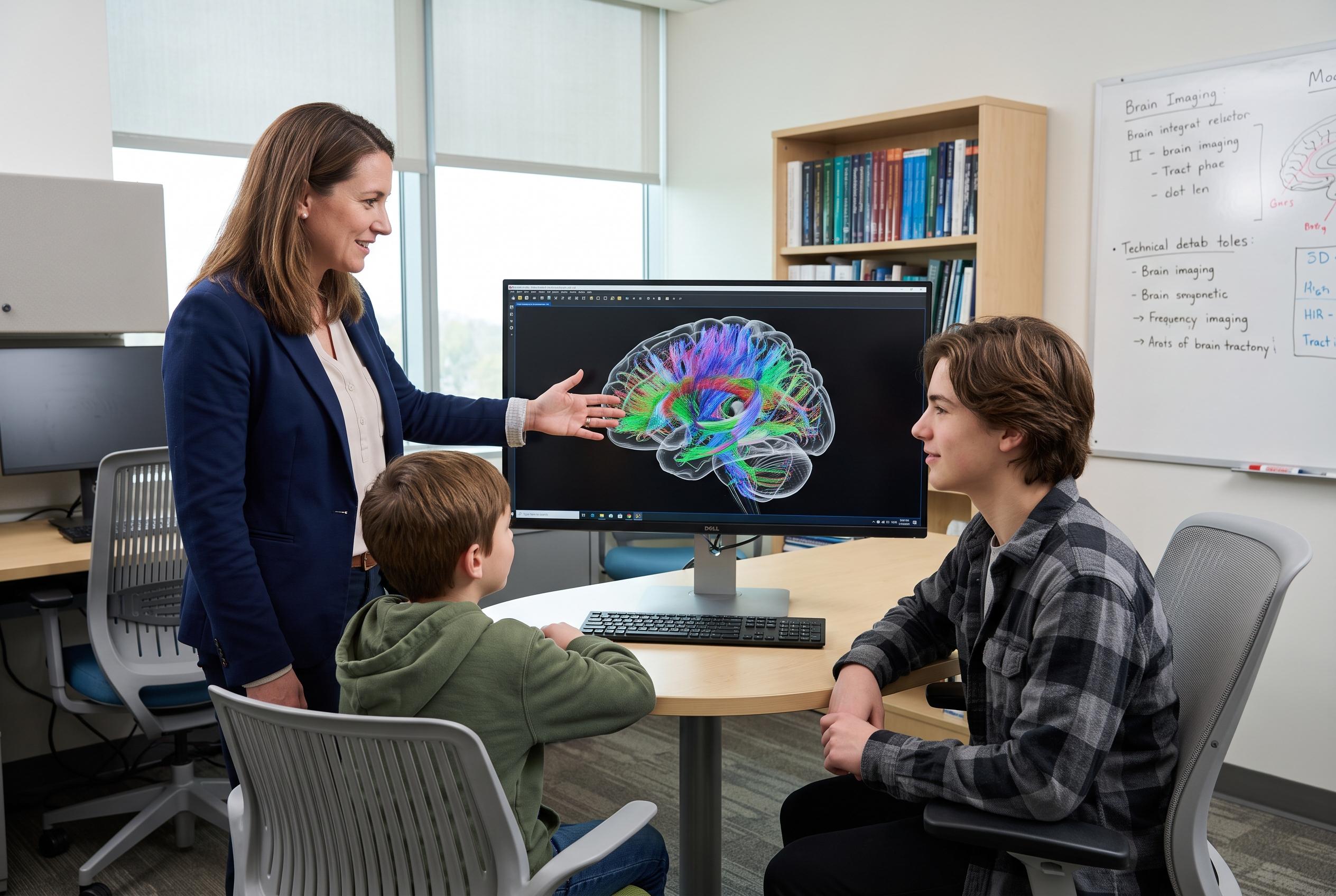

A new study from Frontiers in Psychiatry employs structure-informed brain scans and advanced imaging techniques to distinguish children and adolescents with high-functioning autism, highlighting complex connectivity patterns linked to symptom severity and paving the way for improved diagnostic tools.
A Frontiers in Psychiatry study suggests that a structure-informed brain scan approach may help distinguish children and adolescents with high-functioning autism spectrum disorder from typically developing peers, while also pointing to possible links between connectivity patterns and symptom burden. The research used diffusion tensor imaging and resting-state functional MRI to build an individualised connectome based on 358 cortical landmarks, then tested whether those patterns could separate 37 young people with high-functioning autism from 33 controls.
According to the paper, the model reached 84.29% accuracy in fully nested leave-one-out testing, with sensitivity of 83.78% and specificity of 84.85%. The authors say the strongest features were not confined to a single brain system but spread across connections linking cognitive, affective and mixed cognitive-emotional networks. They also reported that some of the most stable connections were more frequent in the autism group, while others were weaker, suggesting a blend of hyperconnectivity and hypoconnectivity rather than a single uniform pattern.
The findings fit with a wider body of work indicating that autism is associated with disrupted communication across brain networks rather than isolated regional abnormalities. Earlier studies have pointed to altered structure-function coupling in white matter and to atypical transitions between sensory and higher-order regions in autism, supporting the idea that network hierarchy and long-range coordination are important in the condition. In that context, the DICCCOL framework used in this study is notable because it aims to align cortical landmarks across individuals using structural connectivity rather than relying only on atlas-based regions.
The authors also reported exploratory negative associations between several connectivity features and measures of autism-related symptoms and empathic functioning, including scores on the Autism Diagnostic Interview-Revised and the Griffith Empathy Measure-Parent Rating. They stress, however, that these are preliminary signals from a modest, single-centre sample and should not be treated as a diagnostic biomarker. Larger, longitudinal and multi-centre studies will be needed to test whether the pattern holds up and whether it could eventually support earlier or more precise clinical assessment.
Disclaimer: This content is for informational purposes only and is not intended to be a substitute for professional medical judgment, advice, diagnosis, or treatment.