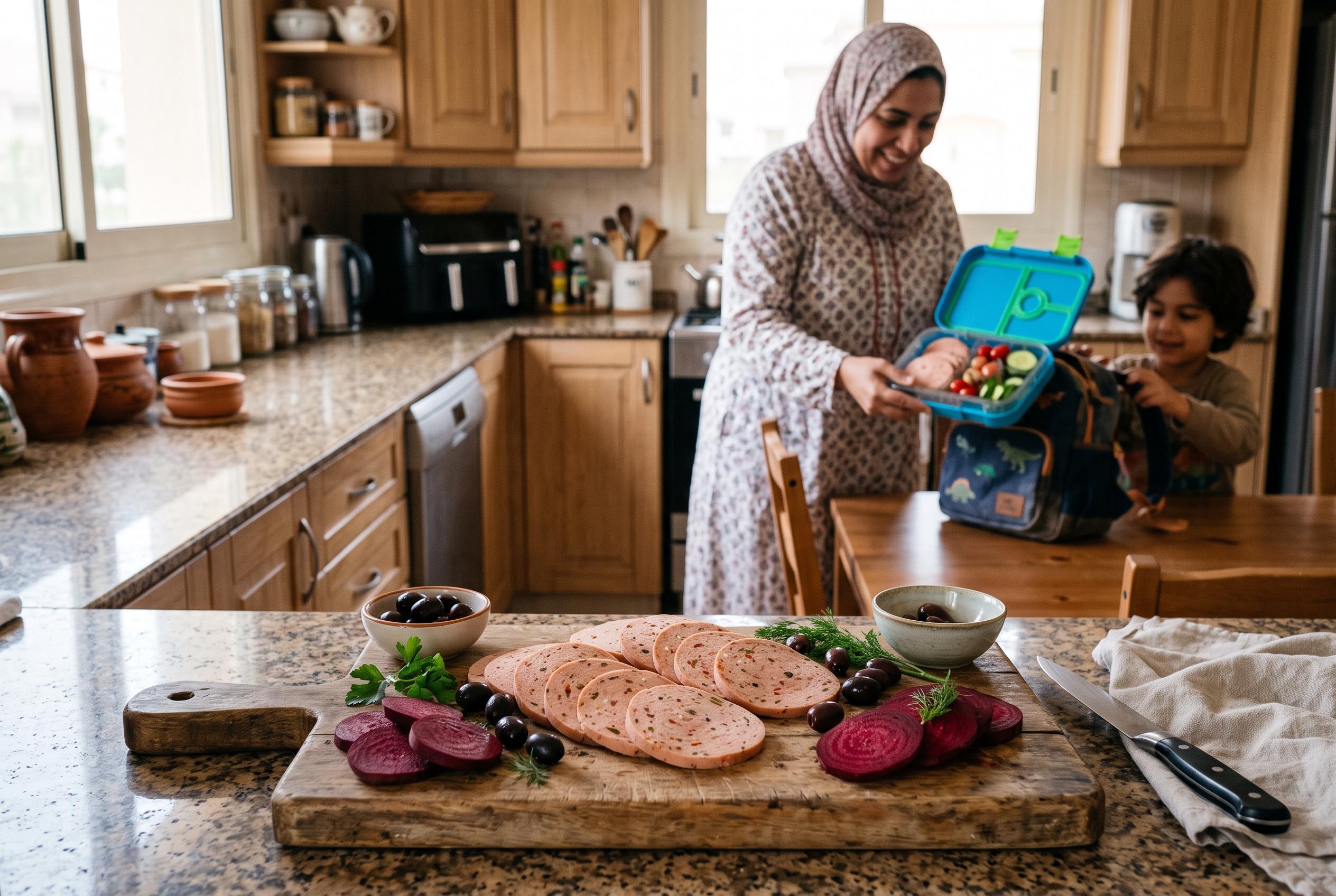

As Egyptian parents seek healthier and customised options for school lunches, a variety of home-made chicken luncheon meat recipes are gaining popularity, emphasising safety, flexibility, and visual appeal through innovative ingredients like beetroot and olives.
As the school term approaches, home-made chicken luncheon meat is being pushed across Egyptian food pages as more than a thrifty kitchen project: it is being sold as a way for parents to take control of what goes into a child’s sandwich. Recent recipes in Al-Masry Al-Youm, El Watan, Al-Mogaz and Al-Jomhoor all frame it as a preservative-free answer to the processed slices long associated with lunchboxes, with each outlet offering a slightly different route to a loaf that can be cut, chilled and packed for school.
What emerges from those versions is not a single canonical recipe but a family of methods built around the same promise: a smooth, sliceable chicken roll that comes close to the ready-made product without relying on factory ingredients. Haneen Al-Salamouni wrote in Al-Masry Al-Youm in April 2026 that many families wanted a filling for breakfast and school sandwiches that contained no preservatives while remaining close in taste to shop-bought luncheon meat. Her recipe uses finely minced chicken breast, eggs, flour or starch, oil, crushed garlic and seasoning, then cooks the mixture in a heatproof bag or wrapped roll in boiling water for about 45 minutes before chilling it for several hours.
Other cooks lean more heavily on what El Watan called the “tricks” needed to mimic the commercial version. In a school-season piece published in September 2024, Nermine Ezzat said chef Saly Fouad on CBC Sofra used chicken thighs rather than breast, along with cream cheese, white honey, nutmeg, ground cardamom and dried coriander. Fouad’s version also folds in sliced green or black olives, giving the loaf a more decorative cross-section for sandwiches while pushing the flavour further from a plain deli-style mixture.
Al-Mogaz, writing in the same back-to-school period, offered an even more engineered method. Its September 2024 recipe uses a quarter kilo of minced chicken breast, triangle cheese portions, eggs, flour and starch, plus both fresh and powdered garlic, ginger and a stock cube. The publication says the oil should be added in a thin stream while the mixer is running until the mixture turns smooth and thick. It then calls for the roll to be wrapped tightly in cling film and foil, boiled for one hour and a quarter in water scented with salt, bay leaves and cardamom, and left to chill for two hours before slicing.
Some household guides move away from the standard boil-and-chill method altogether. El Balad included chicken luncheon meat in a broader feature on school sandwich fillings and presented it as a cheaper, safer substitute for ready-made deli meat. That recipe, part of a three-filling guide rather than a single chef’s demonstration, lists a preparation time of an hour and a half for four people and suggests shaping the mixture into a roll, coating it with smoked paprika, sealing it in a heatproof bag and baking it instead of boiling it. Its ingredient list is also notably richer in eggs and cream cheese than several of the other versions.
Storage and make-ahead advice, often missing from short recipe posts, is where Al-Jomhoor adds the most practical detail. Dina Atef wrote in August 2025 that mothers were looking for school meals that were healthy, filling and free from preservatives, and her chicken version combines minced breast with eggs, cream cheese, milk, flour and oil. After boiling the greased foil-wrapped cylinder for 45 minutes to an hour and refrigerating it for at least four hours, the loaf can be kept in an airtight container in the fridge for five days, the article says, or frozen in slices. It also suggests uses beyond sandwiches, including pizza and pastries, turning the loaf into a batch-cooked staple rather than a one-day lunchbox fix.
The idea has already begun to spin off into more conspicuously “better-for-you” variants. A later Al-Masry Al-Youm piece from September 2025 highlighted a beetroot version, attributed to Wasfat Safra, in which boiled mashed beetroot is blended with minced chicken breast, eggs and flour or oats. The point is not only flavour: the beetroot gives the loaf a natural pink colour intended to appeal to children while adding what the paper described as nutritional value. In a media landscape crowded with warnings about processed meat, that kind of visual and health-conscious twist shows how quickly a simple school sandwich filler can be repackaged.
Taken together, the recipes show how the same lunchbox anxiety is being answered in several ways: by swapping breast for thigh, using cheese for softness, adding honey or stock for a more familiar savoury note, or relying on beetroot instead of artificial colouring. The constants are more revealing than the variations. Nearly every version insists on thorough blending to produce a fine texture, tight wrapping to hold the cylinder shape, and a full chill before slicing. That emphasis suggests the challenge is not cooking the chicken safely, but reproducing the smooth bite and neat sandwich slices that children already recognise.
For parents, the appeal is straightforward. Home-made chicken luncheon meat can be adjusted for salt and spice, bulked out with olives or peppers, made ahead and portioned over several days. For editors and television cooks, it has become a reliable late-summer staple: part recipe, part reassurance, and part response to the annual scramble to fill school lunchboxes with something children will actually eat.
Disclaimer: This content is for informational purposes only and is not intended to be a substitute for professional medical judgment, advice, diagnosis, or treatment.