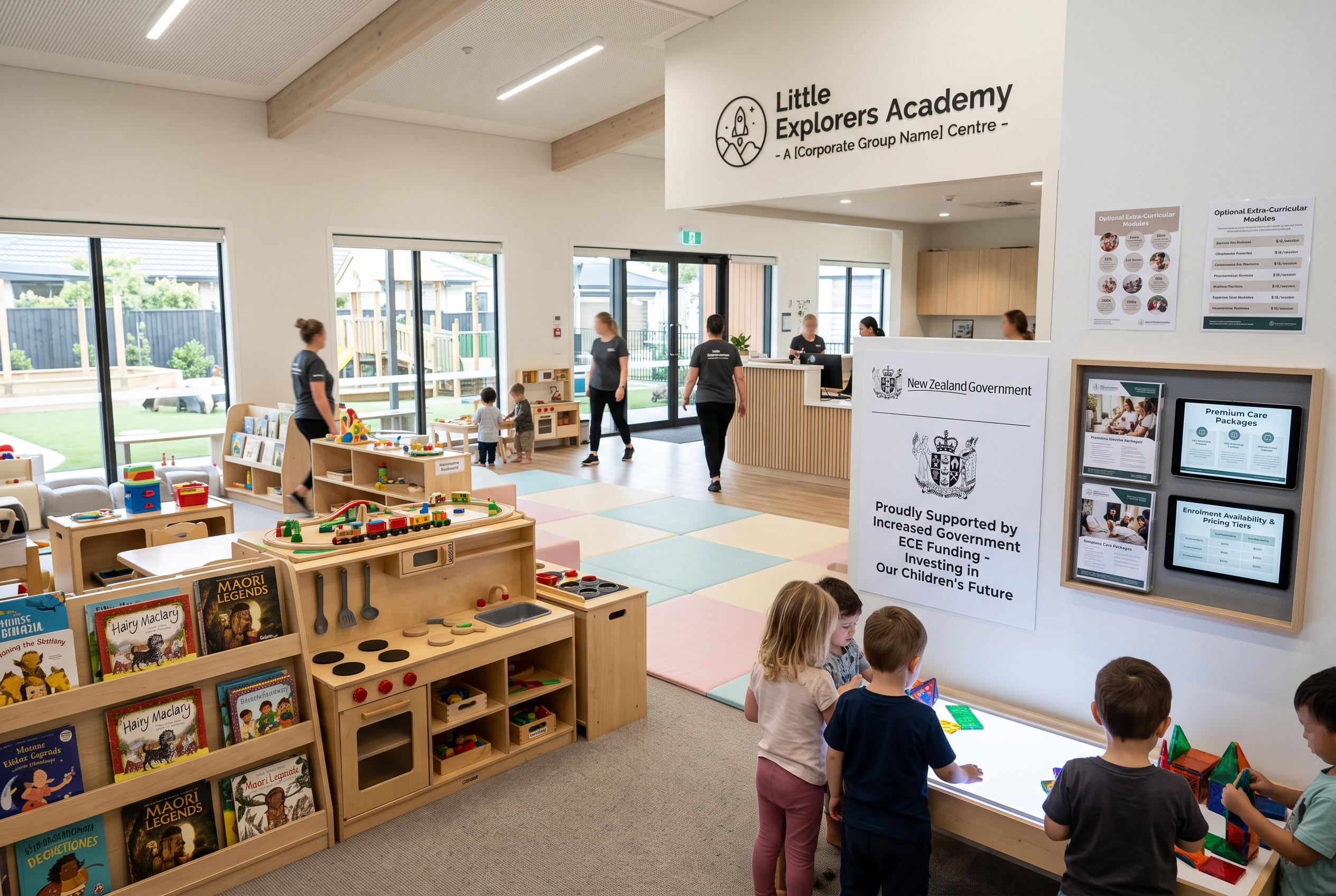

Despite an 80% rise in government spending, New Zealand’s early childhood education sector increasingly resembles a market prioritising profit over quality, raising concerns about accessibility and public investment
New Zealand’s early childhood education system is drifting further from the idea of a public service and closer to a market that rewards scale, subsidies and profit, according to the lead column and recent sector reporting. The result, its critics say, is a paradox: government spending has climbed sharply, yet many parents still face rising fees and providers still post healthy returns.
The lead article argues that fees have continued to rise even as public funding has grown to about $3.1 billion, an increase of 80% over a decade. It says private operators set prices according to what families can bear, not what the subsidy covers, creating a cycle in which higher government support is quickly absorbed by higher charges. That concern is echoed by earlier Education Counts research on the rollout of 20 Hours ECE, which found that adjusting fee structures was complicated and that the financial effect varied widely between services.
Attention has also centred on the ownership model of the sector. The lead column points to large providers posting substantial operating surpluses while some centres are registered as charities or backed by private equity. NZCER has previously argued that the growth of private provision has helped turn early childhood education into a market, with for-profit operators generally less likely to score well on quality measures such as staff qualifications and cultural responsiveness.
The financial pressure on the sector remains acute. Early Childhood New Zealand reported in 2025 that a small budget adjustment left centres facing a sector-wide annual shortfall of $104 million, with some individual services running deficits of up to $167,000. In response, Associate Education Minister David Seymour announced a review of ECE funding in June 2025, saying the aim was to create a simpler and fairer system that would keep costs down for families.
The debate is not confined to New Zealand. The lead column contrasts local conditions with Australia, where governments have also tried to shape fees through funding mechanisms and wage support, although Australian families still face substantial childcare costs, long waiting lists and staffing shortages, according to reporting from The Times Australia. For advocates of reform, the central question remains whether early childhood education should be treated as a business line or as core social infrastructure. The lead column and the supporting research suggest the argument for a more public model is growing louder, even if the politics remain difficult.
Disclaimer: This content is for informational purposes only and is not intended to be a substitute for professional medical judgment, advice, diagnosis, or treatment.