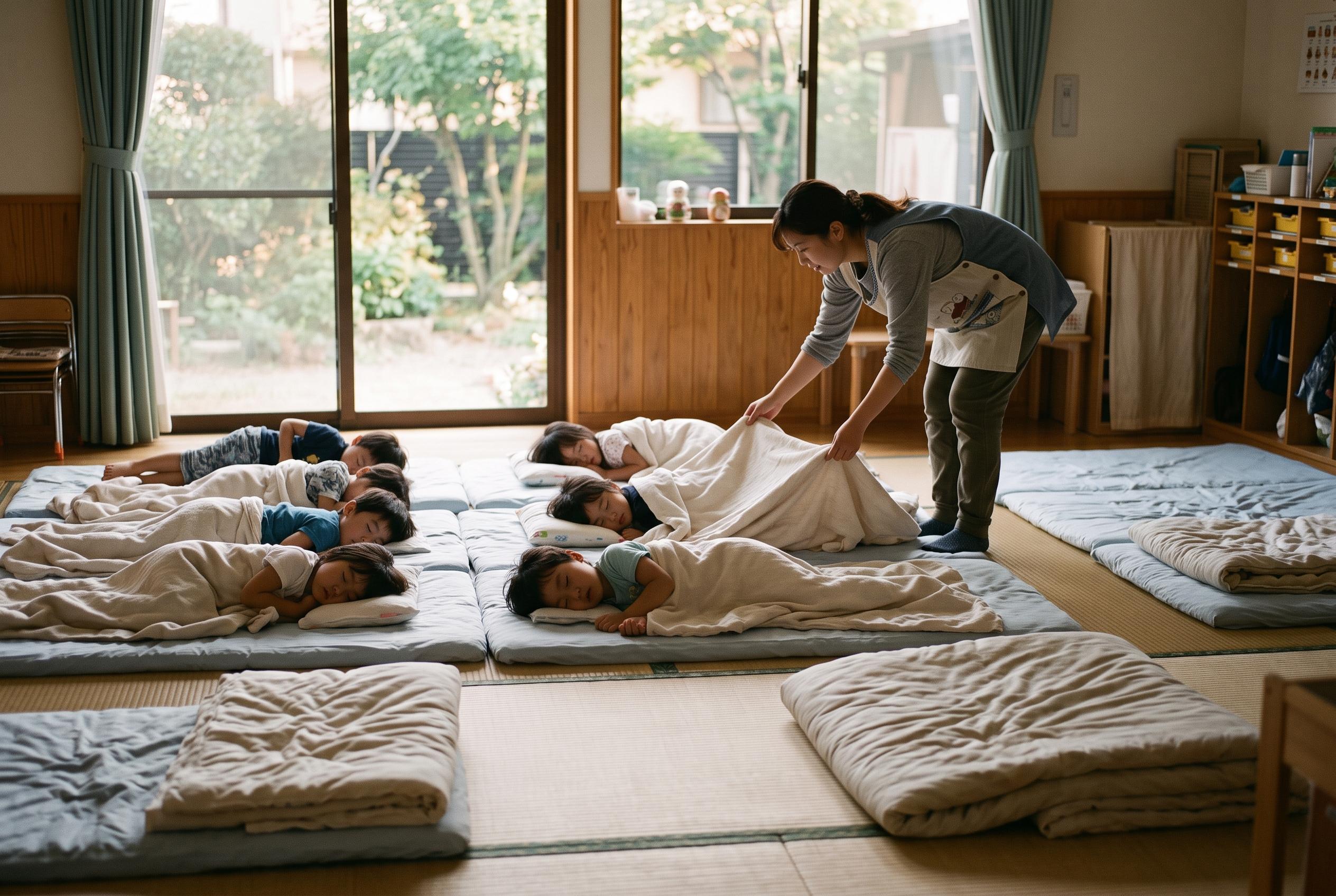

A Japanese study suggests that discontinuing routine group naps in preschool may lead to earlier bedtimes, longer night sleep, and improved sleep efficiency, highlighting the need for flexible nap policies.
A small Japanese study suggests that when routine group naps are stopped in preschool, children may shift sleep into the night rather than simply lose rest. Researchers followed 19 children aged 48 to 59 months in a childcare centre in Hitachinaka City, Ibaraki Prefecture, using wrist actigraphy, sleep diaries and a short computer-based attention test before and after naps were discontinued. According to the paper in the Journal of Sleep Research, bedtime moved earlier, night sleep lengthened and sleep became more efficient, but total sleep time still fell overall.
The findings sit within a broader body of evidence showing that nap habits change rapidly in early childhood. A systematic review and meta-analysis found that most children stop napping by age five, but the preschool years are a period of wide variation in when that transition happens. Other studies have also found that childcare routines can strongly shape nap behaviour, with longer mandatory nap periods linked to more children dozing during the day.
In the Japanese study, nap duration fell by nearly 69 minutes after the routine group sleep ended. At the same time, nighttime sleep increased by about 32 minutes, sleep onset became faster and sleep efficiency improved. The researchers said wake time did not change much, which suggests that the main adjustment was not a later morning but a reordering of when sleep happened. That pattern supports earlier work indicating that daytime napping in preschool can come at the expense of night sleep.
The attention findings were more limited, but potentially important. Group averages on the continuous performance test did not change significantly, yet children who gained more night sleep tended to make fewer missed targets, a sign of better sustained attention. Earlier research has also linked sleep with cognition in young children, including studies showing that night sleep may be more closely tied to attention and language than daytime naps alone.
The authors caution that the work was small, observational and drawn from a single centre, so it cannot prove cause and effect. Still, the study adds to a growing argument for more flexible nap policies in childcare, especially where scheduled group sleep may not match a child’s developmental readiness. Recent research on nap profiles has suggested that some preschoolers continue to benefit from daytime sleep, making one-size-fits-all routines a poor fit for children at different stages of development.
Disclaimer: This content is for informational purposes only and is not intended to be a substitute for professional medical judgment, advice, diagnosis, or treatment.