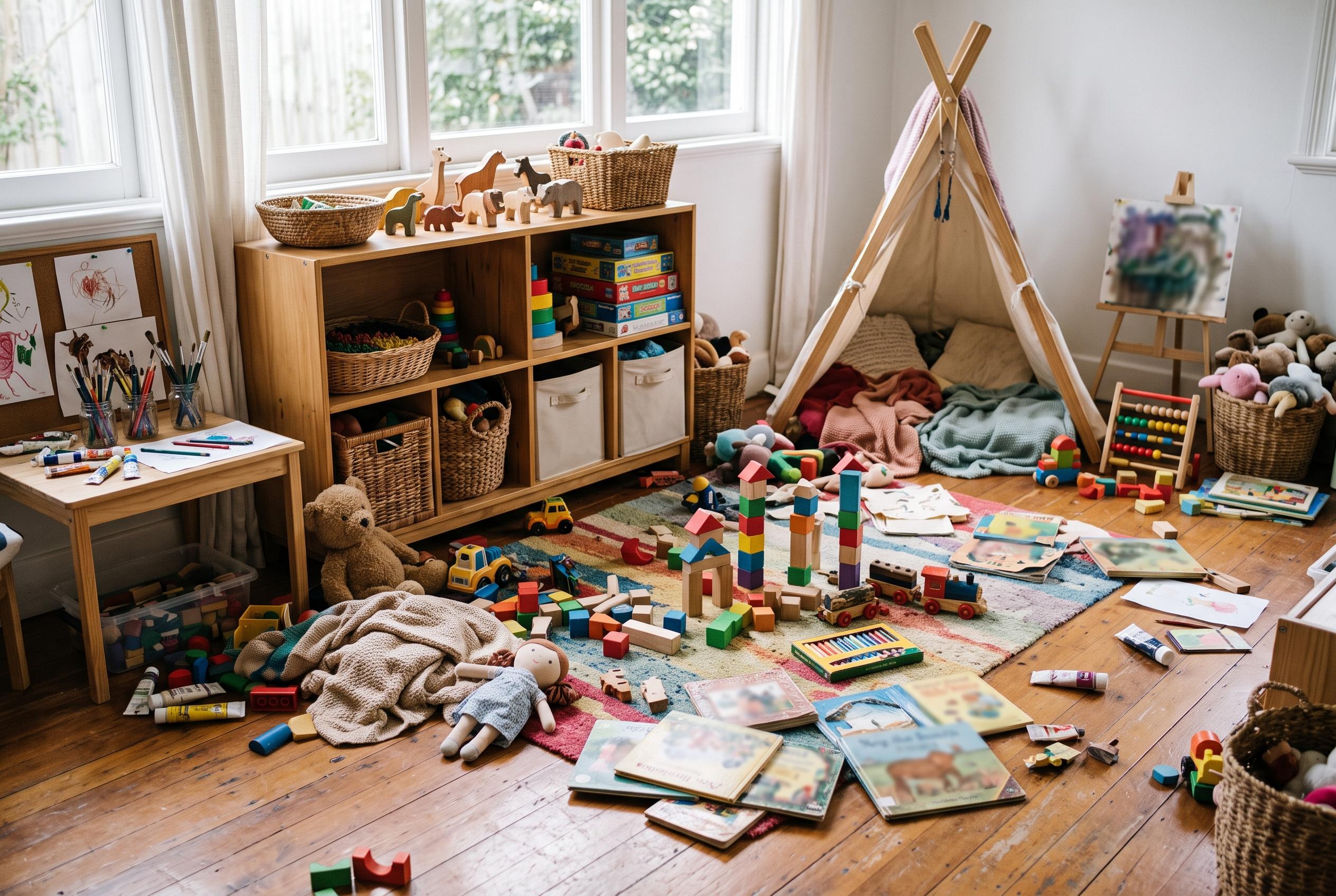

A cluttered playroom may be a mirror to family dynamics, reflecting children’s creativity, household stress, and lifestyle choices, rather than neglect or disorder.
A messy playroom is rarely just a sign of disorder. More often, it is a live record of how a household works: how much time children have to play freely, how stretched adults feel, and whether the home is built around containment or constant movement. The American Psychological Association says unstructured play supports creativity, resilience and social development, which helps explain why a room full of half-used toys can be evidence of healthy activity rather than neglect.
The level of clutter can also reflect pressure elsewhere in family life. When parents are juggling work, care duties or a house move, tidying the playroom is often one of the first tasks to slide. Sleep experts writing for Tom’s Guide have noted that clutter can keep the brain on alert, with visual reminders of unfinished jobs making it harder to relax. In that sense, a chaotic children’s room may sometimes point to broader household stress rather than a simple lack of discipline.
How a playroom is used can reveal just as much as how it looks. Interior designers speaking to Ideal Home say many families now prefer play spaces to spill into shared rooms rather than be sealed away in a separate area, because that keeps children close to caregivers and makes the home feel more flexible. In smaller homes, a packed playroom may say more about limited square footage than about organisation, while in larger homes it may show that family life is happening in several places at once.
The mess can also expose what children are actually drawn to. Toys that are worn, scattered or missing pieces are usually the ones in regular use, while pristine items on higher shelves may be ignored. That is useful information for parents deciding what to buy next, what to store away and what can be donated. Research cited in South Korean and Montessori-related summaries also suggests that open-ended materials and child-led play can strengthen creativity and problem-solving, which fits the idea that a floor covered in building blocks or dress-up clothes may reflect learning in motion.
Even the type of mess can be revealing. Neatly arranged crayons or carefully lined-up figures suggest focused, settled play, while toys flung in every direction may signal excitement, frustration or sibling tension. Tom’s Guide’s reporting on clutter and anxiety points to a wider truth: the state of a room can shape feelings as well as reflect them. A playroom, then, is not just a storage space. It is a snapshot of family rhythm, children’s independence and the daily negotiations that make home life work.
Disclaimer: This content is for informational purposes only and is not intended to be a substitute for professional medical judgment, advice, diagnosis, or treatment.