
Emerging studies reveal that children’s play with blocks advances spatial reasoning, geometry, measurement, and problem-solving, highlighting its vital role in early education.
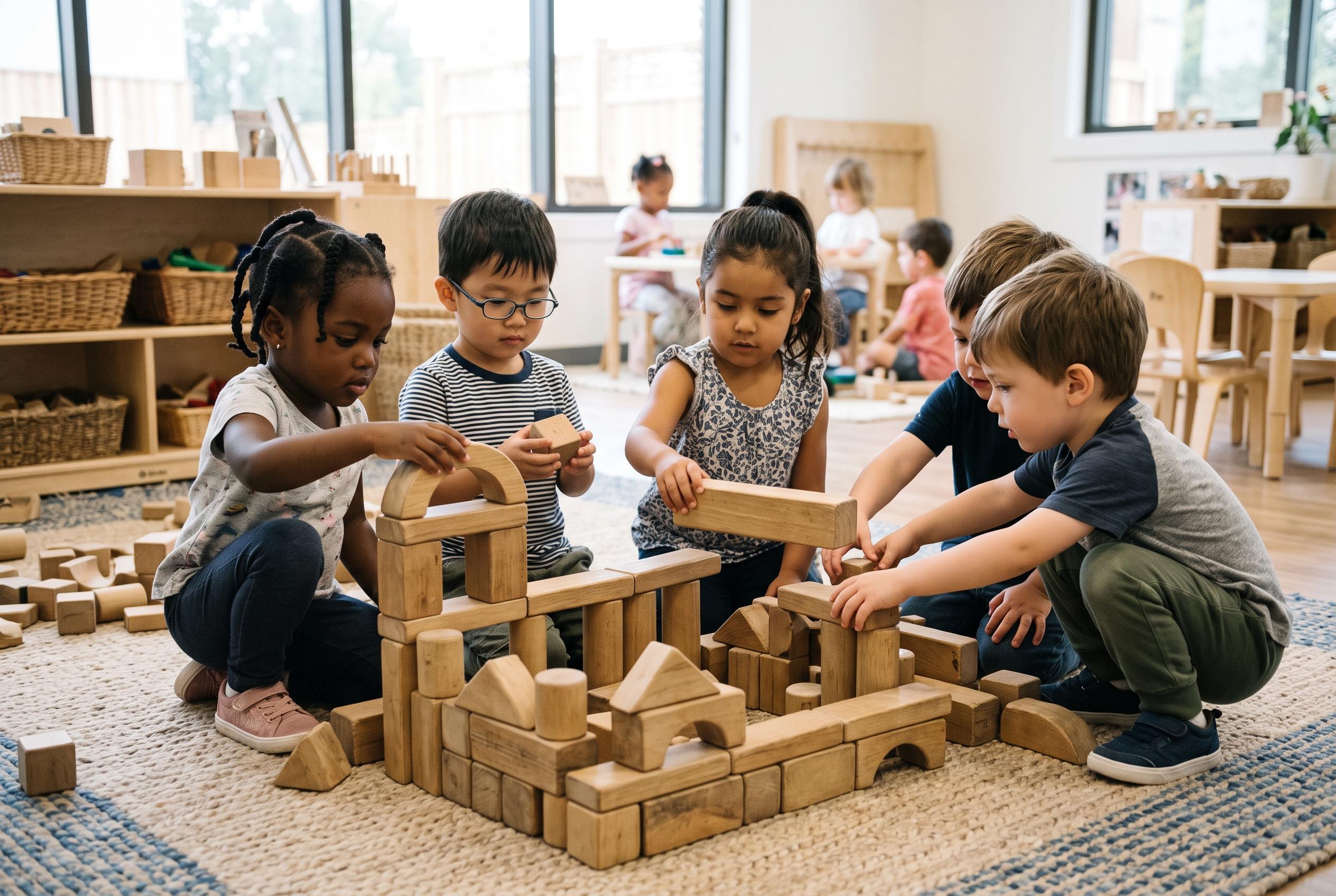
Children do far more than pile up toy bricks when they build with blocks. They compare sizes, judge balance, turn shapes in their minds and revise their plans when a structure leans or collapses. Research suggests that this kind of play is closely linked with early mathematics because it draws on the same spatial thinking children later need for geometry, measurement, pattern recognition and problem-solving. Studies of preschoolers have repeatedly found that stronger block-building performance is associated with better maths outcomes, though that does not mean a tower of blocks can predict a child’s future in any simple or deterministic way.
The most careful reading of the evidence is that block play gives children repeated practice with ideas that mathematics depends on. A child copying a model must look at a shape from one angle, mentally turn it, select the right pieces and correct mistakes when the result does not match. That is spatial reasoning in action, and researchers say it is one reason block building is so often connected with later mathematical skill.
A long-running study published in 2001 found that block-building ability at age four was linked with later maths results, including standardised test scores and school grades in later primary and secondary years, even after taking account of factors such as IQ and gender. More recent work with three-year-olds has also found that more complex block constructions are associated with stronger spatial performance and later mathematical ability. The important point, researchers stress, is correlation rather than proof of a direct cause-and-effect chain. Children who build more advanced structures may also have had more opportunities, stronger language skills or greater confidence with spatial tasks.
Block play is useful partly because it makes geometry tangible. Children discover that a cube behaves differently from a cylinder, that a rectangle can bridge a gap, and that some shapes sit securely only in certain orientations. Over time, they encounter concepts such as edges, corners, symmetry, part-whole relationships and congruence long before they meet formal definitions in the classroom. Adults can strengthen that learning by using clear language in the moment: one side is curved, both sides match, this piece fits when you turn it.
Counting also becomes meaningful when it solves a real building problem. A child may need four blocks for a wall, two more pieces to make both sides of a bridge the same height, or one block for each toy figure. In those moments, children practise one-to-one correspondence and begin to understand that the final number named tells how many are in the set. If the counting gets muddled, arranging the blocks in a line or touching each one once can make the task easier to grasp.
Measurement enters naturally as children compare towers, roads and enclosures. Before they use rulers, they can lay identical blocks end to end, check which structure is taller or estimate how many pieces a wall will need. Research on block play suggests that these activities help children think about length, unit size, estimation and equivalence. The key lesson is not to memorise a number but to notice whether the same unit is being used consistently.
Pattern-making adds another layer. A repeating sequence of colours is only the simplest example; children also build patterns with shapes, heights, directions and alternating arrangements. One study found that richer block structures, alongside peer interaction and the use of blocks without extra replica toys, were linked with stronger maths learning in preschool. Another more recent experiment reported gains from both free and semi-structured block play, with free play especially helping geometry and self-regulation.
The value of the activity often lies in the moment when a structure fails. A bridge sags, a tower topples or a wall bends under its own weight, forcing children to rethink the base, the height or the placement of the supports. That process encourages planning, testing and revision. Researchers have found that block play can support executive function as well as spatial and mathematical skills, although it would be too much to say the toys alone build those abilities in every child.
How adults shape the play matters. Unstructured building gives children room to invent, while lightly guided play can draw attention to ideas they might otherwise miss, such as making two towers the same height or building a structure that can support a toy car. Studies suggest that both approaches can be beneficial, but guidance works best when it stays open-ended rather than taking over the child’s design. A single prompt is often enough; a constant stream of questions can turn play into a test.
The practical lesson for parents and caregivers is straightforward. Offer safe, open-ended blocks, give children time to experiment and use precise language without over-directing the activity. The aim is not to turn block play into homework, but to give children repeated chances to think spatially, compare quantities, notice patterns and solve visible problems. That is what makes blocks valuable: they let children practise mathematical thinking before mathematics becomes a page of symbols.
Disclaimer: This content is for informational purposes only and is not intended to be a substitute for professional medical judgment, advice, diagnosis, or treatment.