

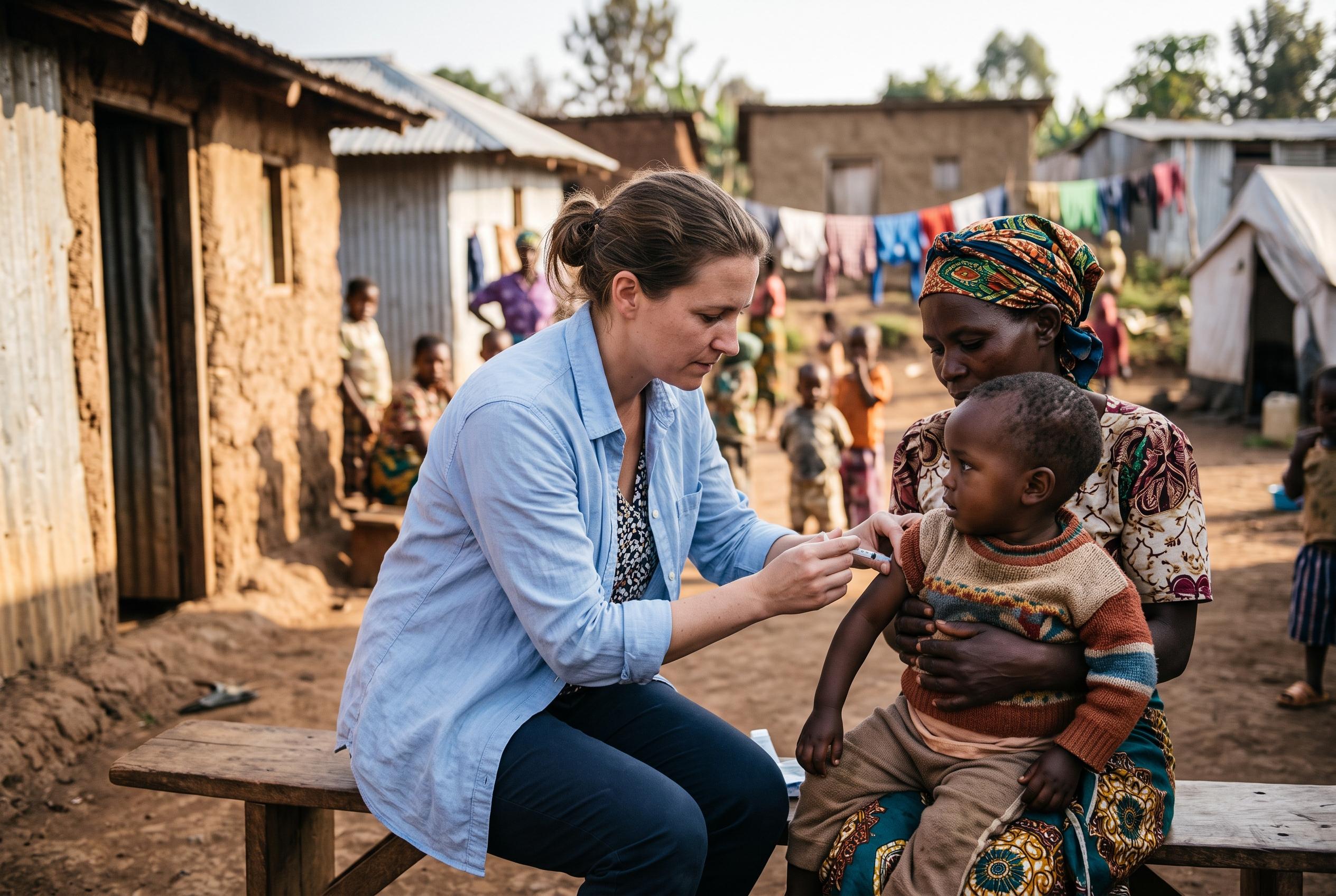

Gavi says 9.5 million children received no routine vaccine in 2025, with conflict-affected communities still facing the greatest barriers despite broader immunisation gains.
Gavi says the number of children missing routine vaccination fell in 2025, but the alliance warned that millions were still being left behind, especially in fragile and conflict-affected settings.
In its 2025 Annual Progress Report, Gavi said 9.5 million children in 57 supported countries received no routine vaccine in 2025. The alliance defines a “zero-dose” child as an infant who has not received a first dose of a diphtheria, tetanus and pertussis-containing vaccine by the end of the first year of life.
The latest figure was 600,000 lower than in 2024 and 25% below the pandemic-era peak of 12.9 million recorded in 2021, when Covid-19 disrupted routine immunisation services. Even so, Gavi said the total remained 4% above the 2019 level, in part because the number of births has continued to rise.
Gavi said children in fragile, conflict-affected and humanitarian settings are still among the most likely to miss vaccines. Nigeria remains one of the countries with the highest number of zero-dose children, with UNICEF estimating that about 2.2 million Nigerian children had never received a routine vaccine in 2025, the highest total in Africa.
The report pointed to progress in selected areas of Nigeria, Ethiopia and Pakistan where Gavi has concentrated support and investment during its 2021-2025 strategic period. The alliance said those gains show the value of targeted spending aimed at communities missed by standard immunisation services. It also said its Zero-Dose Learning Hubs, which study what helps and what hinders vaccine delivery, have highlighted gender-related barriers in countries including Nigeria, Bangladesh, Mali and Uganda.
Despite the persistent gap, Gavi said its supported programmes vaccinated more than 73 million children through routine immunisation in 2025. Over the full 2021-2025 strategy period, more than 351 million children were vaccinated, above the alliance’s target of 300 million. Since 2000, Gavi said countries supported by the alliance have vaccinated more than 1.3 billion unique children.
The report also said Gavi-supported vaccines prevented more than 2.2 million future deaths in 2025, bringing the total averted during the 2021-2025 period to more than 7.8 million. Separate Gavi analysis said under-five mortality in supported countries fell from 59 to 52.6 deaths per 1,000 live births between 2019 and 2024, an 11% drop that exceeded the alliance’s goal of a 10% reduction.
Beyond health outcomes, Gavi said immunisation programmes generated more than $30 billion in economic benefits in 2025, the largest annual total in its history. The alliance said those gains reflect avoided treatment costs, lost wages and productivity losses linked to illness, disability or death. It added that the 2021-2025 period produced more than $104 billion in economic benefits, while the total since 2000 has exceeded $308 billion.
Countries also paid a record $301 million towards co-financing Gavi-supported vaccines in 2025, up 18% from the year before. Gavi said about 80% of that contribution came from domestic resources and roughly 20% from low-interest World Bank loans. Since the co-financing policy was introduced in 2008, countries have contributed $2.2 billion.
Looking ahead to its 2026-2030 strategy, Gavi said it aims to protect another 500 million children, avert between eight million and nine million future deaths, and generate more than $100 billion in economic benefits. The alliance said the next phase will place even greater emphasis on zero-dose and under-immunised children while helping countries build more sustainable vaccination systems. Gavi chief executive Sania Nishtar said the figures show that immunisation delivers returns well beyond disease prevention, while World Health Organization chief Tedros Adhanom Ghebreyesus said countries understand that the cost of not vaccinating is too high.
Disclaimer: This content is for informational purposes only and is not intended to be a substitute for professional medical judgment, advice, diagnosis, or treatment.



