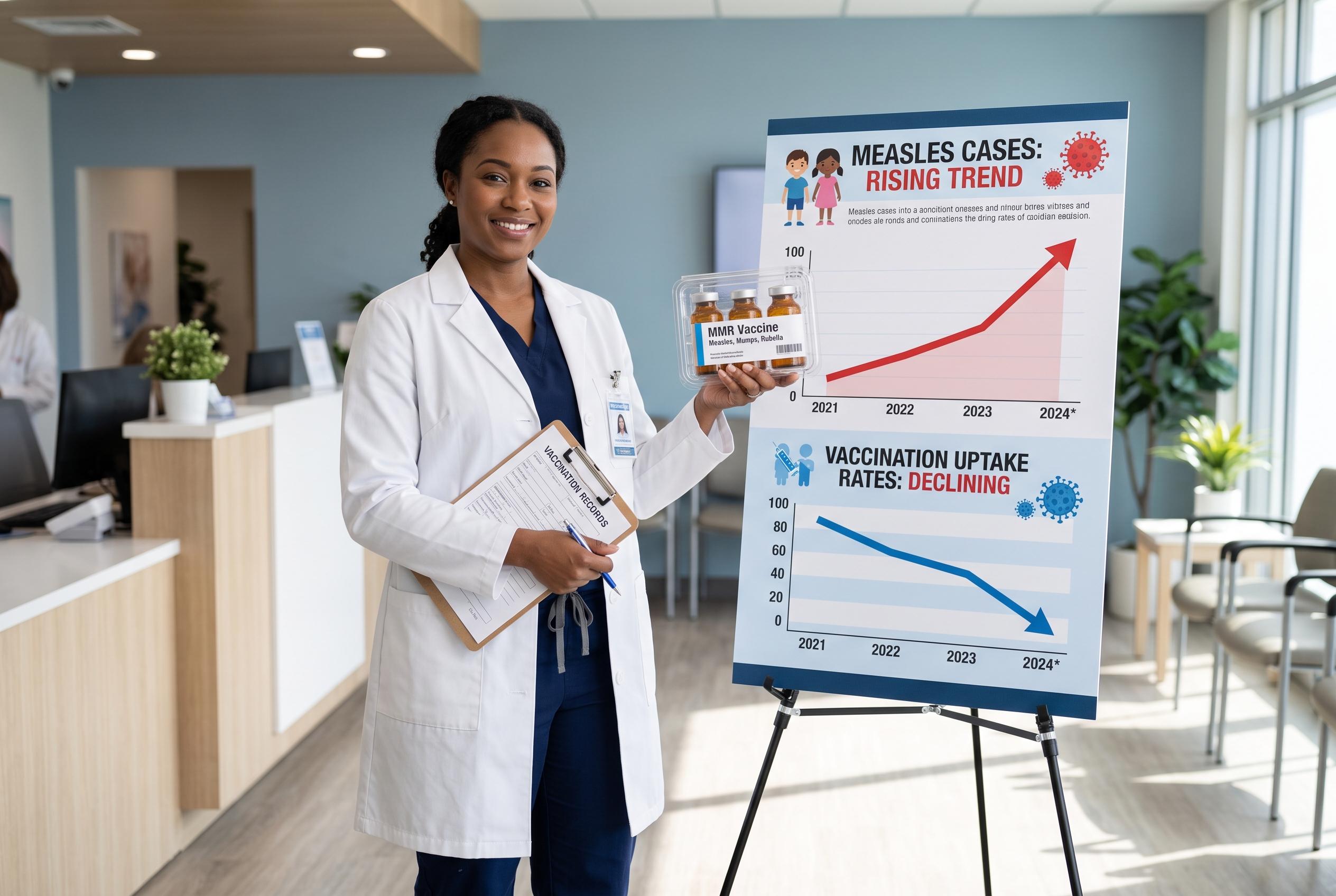

UK health officials renew urgent calls for measles vaccination amid outbreaks linked to declining MMR uptake, highlighting the disease’s high contagiousness and serious health risks.
Doctors and public health officials in the UK are urging people to check their measles protection after warning that the disease spreads with extraordinary ease and can cause severe illness. The UK Health Security Agency has relaunched a public awareness drive, saying measles is nearly twice as contagious as the common cold and that basic hygiene alone is not enough to stop it spreading. The warning comes after outbreaks in parts of England over the past two years, which health officials have linked to falling uptake of the MMR jab.
Measles is among the most infectious viruses known. It is spread through coughs and sneezes and can hang in the air for up to two hours after an infected person has left a room, according to the US Centers for Disease Control and Prevention. The agency says as many as 9 in 10 susceptible people who have close contact with someone with measles will catch it. UK health officials have also stressed that the virus can lead to pneumonia, meningitis, blindness, hearing loss and, in rare cases, death.
The NHS says adults and children born on or before December 31, 2019, who missed earlier vaccinations should catch up with the MMR vaccine, while children born from January 1, 2020, are routinely offered the newer MMRV jab, which also protects against chickenpox. Health authorities say the vaccine is particularly important for children, teenagers and young adults who missed doses, women planning a pregnancy, healthcare workers, people travelling to areas where measles is more common and adults born between 1970 and 1990. Two doses offer long-lasting protection, with the CDC saying the vaccine is highly effective against measles, mumps and rubella, and both the CDC and UK health agencies emphasising that there is no link between MMR and autism.
Disclaimer: This content is for informational purposes only and is not intended to be a substitute for professional medical judgment, advice, diagnosis, or treatment.