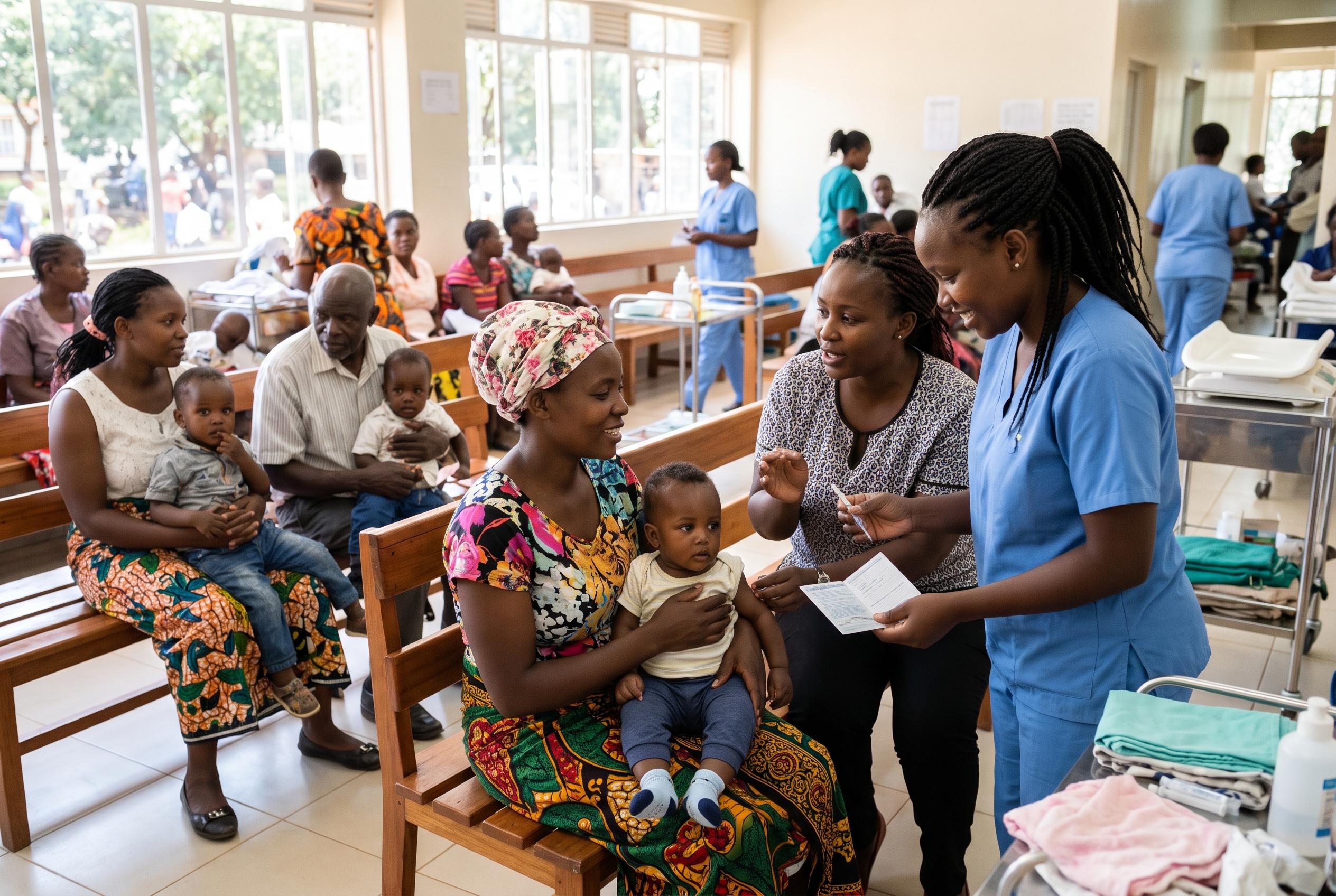

A World Polio Day campaign at Pumwani Maternity Hospital urged families to keep vaccinating children as funding pressures and uneven coverage threaten to revive a disease largely absent from public view.
At Pumwani Maternity Hospital in Nairobi, health workers and Rotary volunteers used World Polio Day to press a simple message: the disappearance of polio from daily life does not mean the threat has gone away. The event brought mothers and babies to the hospital’s maternity ward for free immunisation, with nurses saying the turnout showed both confidence in vaccines and the need to keep reminding families why the injections still matter.
Juliet Otieno, a nurse at the hospital, said nearly 20 mothers brought their babies for vaccination during the campaign. She warned that parents who have never seen a child paralysed by polio may underestimate the disease’s danger, even though it can cause permanent disability and, in severe cases, death. Otieno said Kenya’s routine schedule begins at birth and continues through infancy, with an injectable dose at nine months, and urged families not to assume that one injection is enough.
According to the World Health Organisation, polio is a highly contagious virus that spreads mainly through contaminated food or water and typically affects children under five. The CDC says global cases have fallen by more than 99% since 1988, while UNICEF says the reduction is 99.9%, a sign of how far vaccination has taken the world. But both organisations stress that eradication remains unfinished, with the virus still endemic in Afghanistan and Pakistan and outbreaks of circulating vaccine-derived poliovirus continuing to appear in countries where immunisation coverage is too low.
That concern was echoed by Patrick Mushemi, Rotary Foundation district chair, who said Rotary launched its polio eradication drive in 1985 and has since spent more than US$2.6 billion on the effort, helping to vaccinate more than three billion children in over 120 countries. He said the campaign has shown what long-term investment can achieve, but warned that reductions in donor funding could slow deliveries and public education. Saad Rahman, Rotary District Governor for District 9215, said the success of vaccination programmes has created a new risk: parents may think the disease has vanished simply because they do not see it anymore.
Rahman said the battle against polio cannot be left to one institution alone, pointing to the need for cooperation between families, health workers, governments and international partners. He also said Kenya still needs to improve vaccination coverage, citing a figure of 77% shared at the event and noting that the World Health Organisation’s target is at least 80%. Brian Magana, who oversees Kenya and Sudan, said the visit to the hospital was meant both to support immunisation and to encourage mothers with practical help, while reinforcing the message that every child must be reached if polio is to be eliminated for good.
Disclaimer: This content is for informational purposes only and is not intended to be a substitute for professional medical judgment, advice, diagnosis, or treatment.