

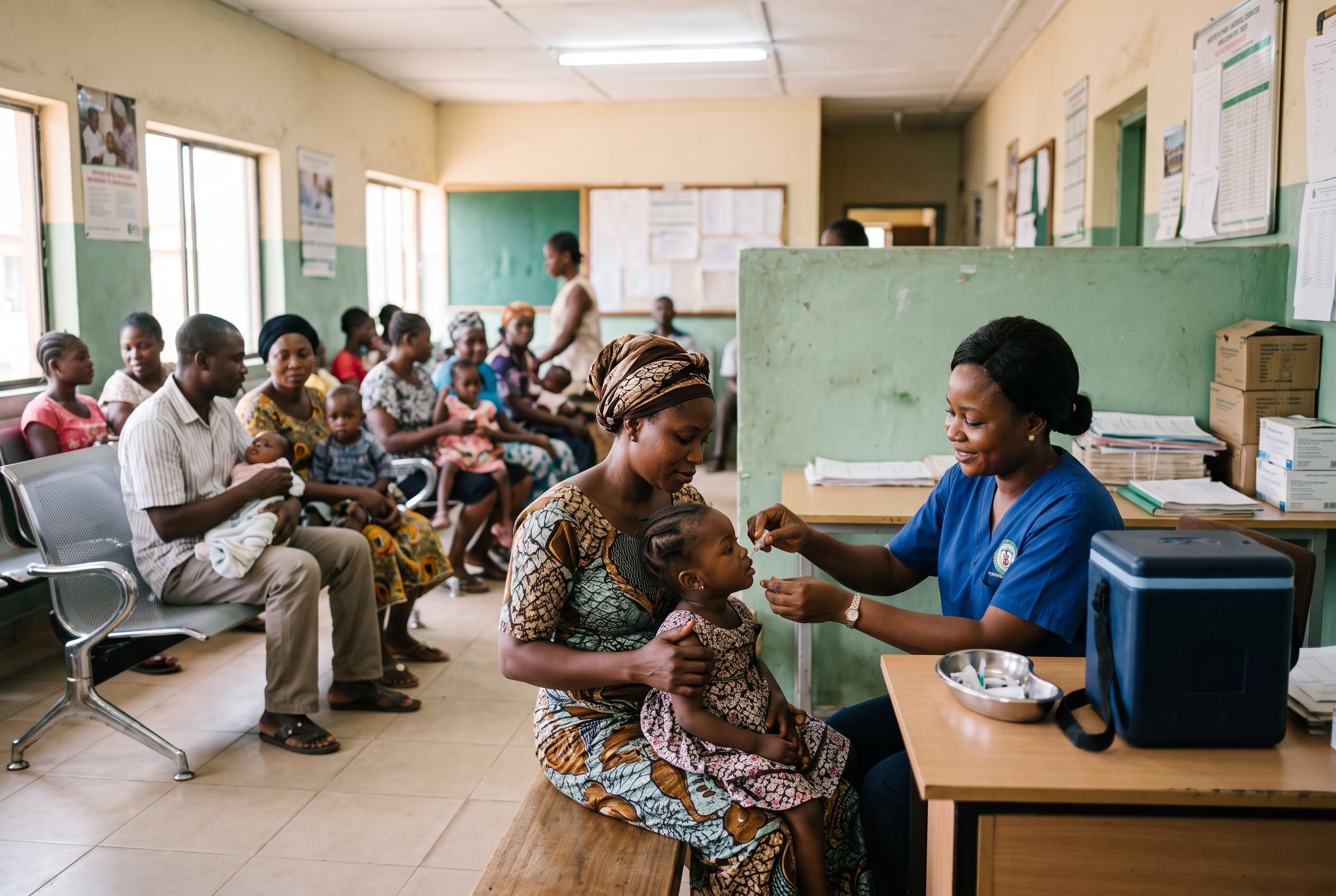

Nigeria has the world’s largest population of children who have received no DTP vaccine, exposing the weakness of routine services and the urgent need to strengthen local clinics.
Nigeria’s vast pool of unvaccinated children is more than a health statistic; it is a warning that the country’s routine immunisation system is still failing too many families. With 2.1 million children receiving no dose of the diphtheria-tetanus-pertussis vaccine, according to WHO and UNICEF estimates for 2024, Nigeria has the world’s largest zero-dose burden. National coverage for the third DTP dose stands at 67 per cent, while measles vaccination is at 57 per cent, leaving millions of children exposed to diseases that should be preventable.
That failure matters well beyond childhood illness. Diphtheria, which can spread rapidly in low-coverage communities, has underscored how easily gains can be lost when basic vaccination services are weak or hard to reach. Global data released by the World Health Organisation in July 2025 show that while 89 per cent of infants received at least one dose of DTP in 2024 and 85 per cent completed the series, nearly 20 million children worldwide still missed at least one dose, including 14.3 million who did not receive a single vaccine. Nigeria’s gap is therefore part of a wider global problem, but its scale is especially severe.
The practical answer is not vaccination campaigns alone, but working primary healthcare centres that can deliver routine services consistently. The Private Sector Health Alliance of Nigeria says its Adopt-A-Healthcare-Facility Programme is designed to help establish and rehabilitate primary healthcare facilities across all 774 local government areas, offering both new-build and upgrade models. The alliance says the programme is intended to improve service readiness, infrastructure, power supply, equipment and staff capacity, making the local clinic the central point for preventive care as well as treatment.
That approach reflects a broader policy reality: Nigeria’s immunisation challenge cannot be separated from the condition of its primary healthcare network. The article argues that government must remain in the lead, but also that businesses, philanthropies and foundations can help fill gaps in capital, management and technology. In that model, public programmes such as the Basic Health Care Provision Fund, the National Immunisation Policy and Primary Health Care Under One Roof would be strengthened by private investment aimed at specific facilities and measurable targets.
The point is not simply to spend more money, but to change what success looks like. The real tests are whether more children are fully vaccinated, whether zero-dose communities are being reached, whether local clinics remain functional and whether families trust the services available to them. The scale of Nigeria’s immunisation gap is alarming, but it also creates a clear opportunity: to build primary care that protects children before outbreaks begin, rather than trying to contain disease after it has already spread.
Disclaimer: This content is for informational purposes only and is not intended to be a substitute for professional medical judgment, advice, diagnosis, or treatment.



