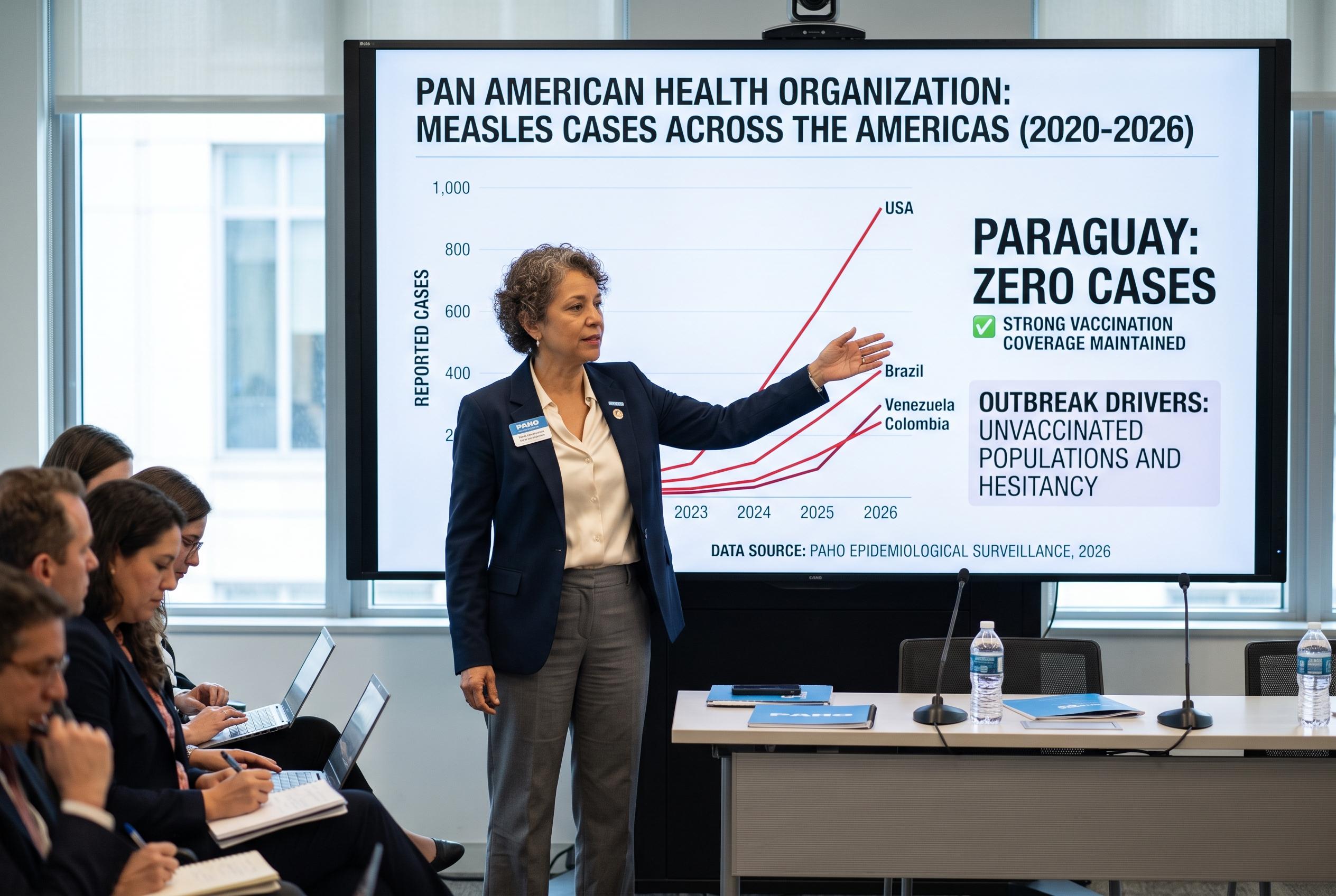

The Pan American Health Organisation issues an alert as measles cases surge in the Americas, driven by unvaccinated populations and ongoing transmission, with Paraguay maintaining zero cases. Experts stress the importance of immunisation and rapid response to prevent further spread.
The Pan American Health Organisation has issued an epidemiological alert over measles as infections continue to climb across the Americas in 2026, warning that mass gatherings and persistent transmission are raising the risk of further spread. Paraguay has not confirmed a case so far this year, but health authorities are urging the public to check whether they are up to date with the measles, rubella and mumps vaccine and to complete any missing doses.
According to PAHO, 47,459 measles cases and 44 deaths were reported in the region through epidemiological week 28, a sharp rise from the same period in 2025 and the highest regional total recorded since 2004. Guatemala and Mexico account for most of the cases, with the United States and Peru also reporting substantial numbers. PAHO said the outbreak has been driven largely by people who are unvaccinated or whose vaccination status is unknown, and that infants and young children remain especially vulnerable.
In Paraguay, the health ministry says the country has recorded no confirmed measles cases in 2026 through week 28. The last confirmed case was linked to an imported outbreak in 2025, when authorities recorded 50 cases. Even so, officials are using the regional surge to reinforce surveillance, rapid response and vaccination, saying coverage must stay at or above 95% nationwide if the country is to keep the virus out.
PAHO recommends that travellers heading to places with documented transmission receive a measles-rubella dose, preferably at least two weeks before departure, if they cannot show proof of two doses or immunity. The agency also advises countries to strengthen active case-finding and respond quickly to suspected infections. Health authorities say the simplest protection remains vaccination, with the first dose given at 12 months and the second at 18 months, and they are urging families to seek immunisation before the virus reaches them.
Disclaimer: This content is for informational purposes only and is not intended to be a substitute for professional medical judgment, advice, diagnosis, or treatment.