

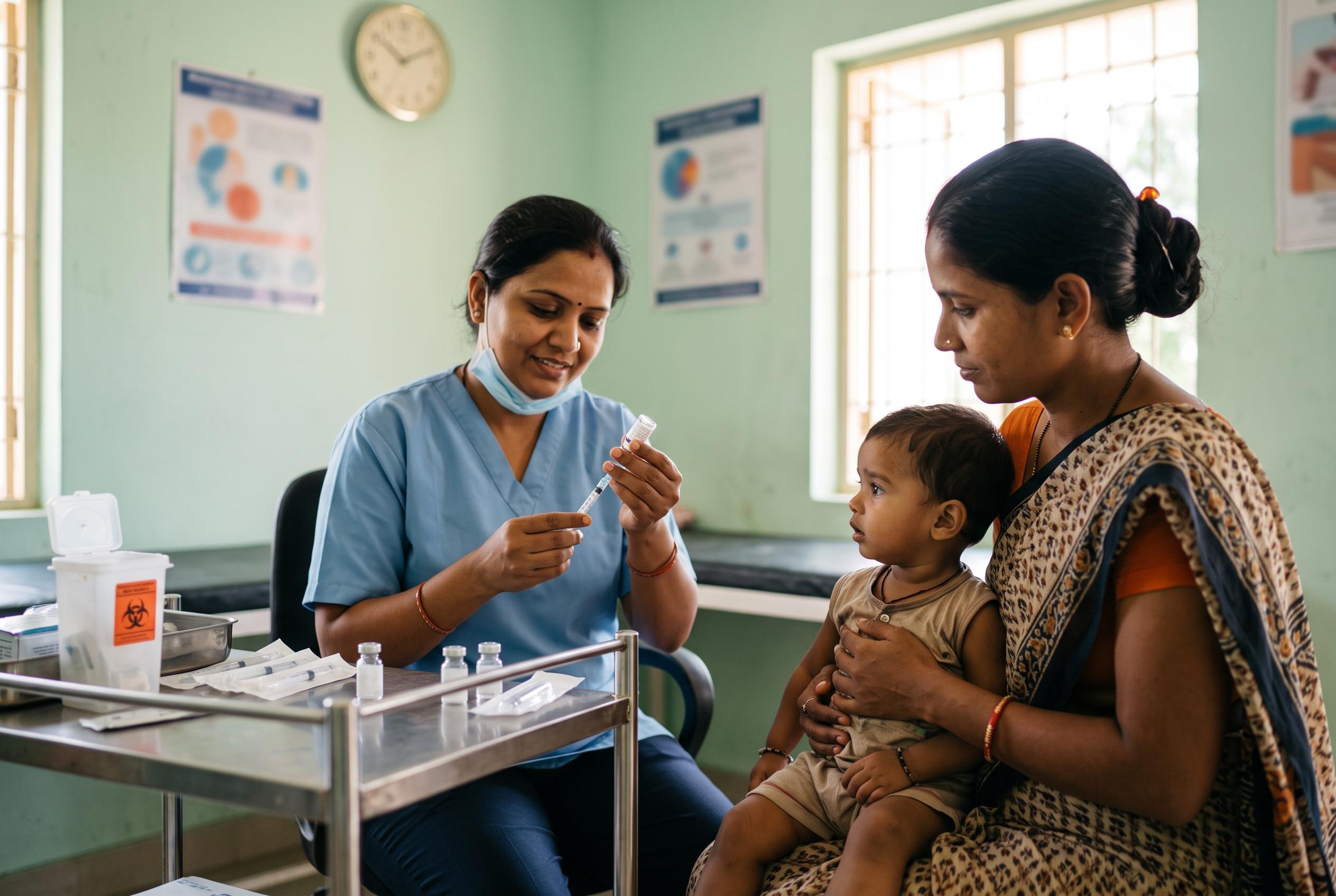

A phase four trial in India demonstrates that mixing domestically produced Japanese encephalitis vaccines during childhood immunisations is safe and effective, potentially easing vaccination logistics in endemic regions.
A large trial in India has found that two domestically produced Japanese encephalitis vaccines can be mixed within the childhood immunisation schedule without reducing protection or safety, easing a practical problem that often arises when families move or vaccine supplies change. The phase four study, published in eClinicalMedicine, involved more than 900 infants across five medical colleges and compared children who received the same vaccine for both doses with those who received one product for the first injection and the other for the second.
The finding matters because Japanese encephalitis remains a serious mosquito-borne illness in much of Asia, and childhood vaccination is central to prevention in endemic areas. In India, the Universal Immunisation Programme uses two inactivated vaccines: JENVAC, made by Bharat Biotech from an Indian strain, and JEEV, produced by Biological E from the SA 14-14-2 strain used in several other JE vaccines. Both are given as a two-dose course, but until now there had been no direct evidence that the products could be interchanged within the routine schedule.
The trial, conducted between November 2023 and September 2025 in Kolkata, Wardha, Bhubaneswar, Bibinagar and Patna, randomly assigned healthy infants aged nine to 12 months to one of four schedules: JENVAC followed by JEEV, JENVAC followed by JENVAC, JEEV followed by JENVAC, or JEEV followed by JEEV. Researchers collected blood samples before vaccination, after the first dose, before the second dose and again 28 days after completion of the series. The study was open label, but laboratory staff assessing immune responses were masked to treatment allocation.
The results showed that antibody responses after the second dose were statistically non-inferior in the mixed schedules compared with the same-product schedules. In the main analysis, seroconversion rates were close to 90% in all four groups, and neutralising antibody levels rose to similar ranges regardless of whether the vaccine product was switched. Responses among children who were initially seronegative were particularly strong, while those who already had antibodies at baseline mostly remained protected.
Safety findings were also reassuring. About a third of children in each group had a solicited adverse event within seven days of vaccination, most commonly fever, runny nose or cough, and nearly all reactions were mild and self-limiting. The trial recorded 23 serious adverse events during follow-up, but none was judged to be related to vaccination. A data and safety monitoring board oversaw the study, and parents or guardians gave written consent for every child.
One caution is that antibody levels had already fallen in many children by the time the second dose was due, roughly seven months after the first injection. Only about a third remained seroconverted at that point, which raises questions about the size of the protection gap before the booster dose. The study’s authors said the schedule still supports timely completion of both doses, but they also noted that longer-term immunity and age-specific risk during the interval need further examination.
Public health experts have long worried about what happens when a child returns for a second dose and the original product is unavailable. The new evidence should help immunisation managers avoid delaying or missing boosters when supply chains are disrupted, especially in districts where Japanese encephalitis is endemic. It also builds on earlier work showing that JENVAC performed well in children and on broader reviews suggesting that Japanese encephalitis booster strategies are generally effective, though data on interchangeability between newer vaccine platforms have been limited.
Disclaimer: This content is for informational purposes only and is not intended to be a substitute for professional medical judgment, advice, diagnosis, or treatment.



