

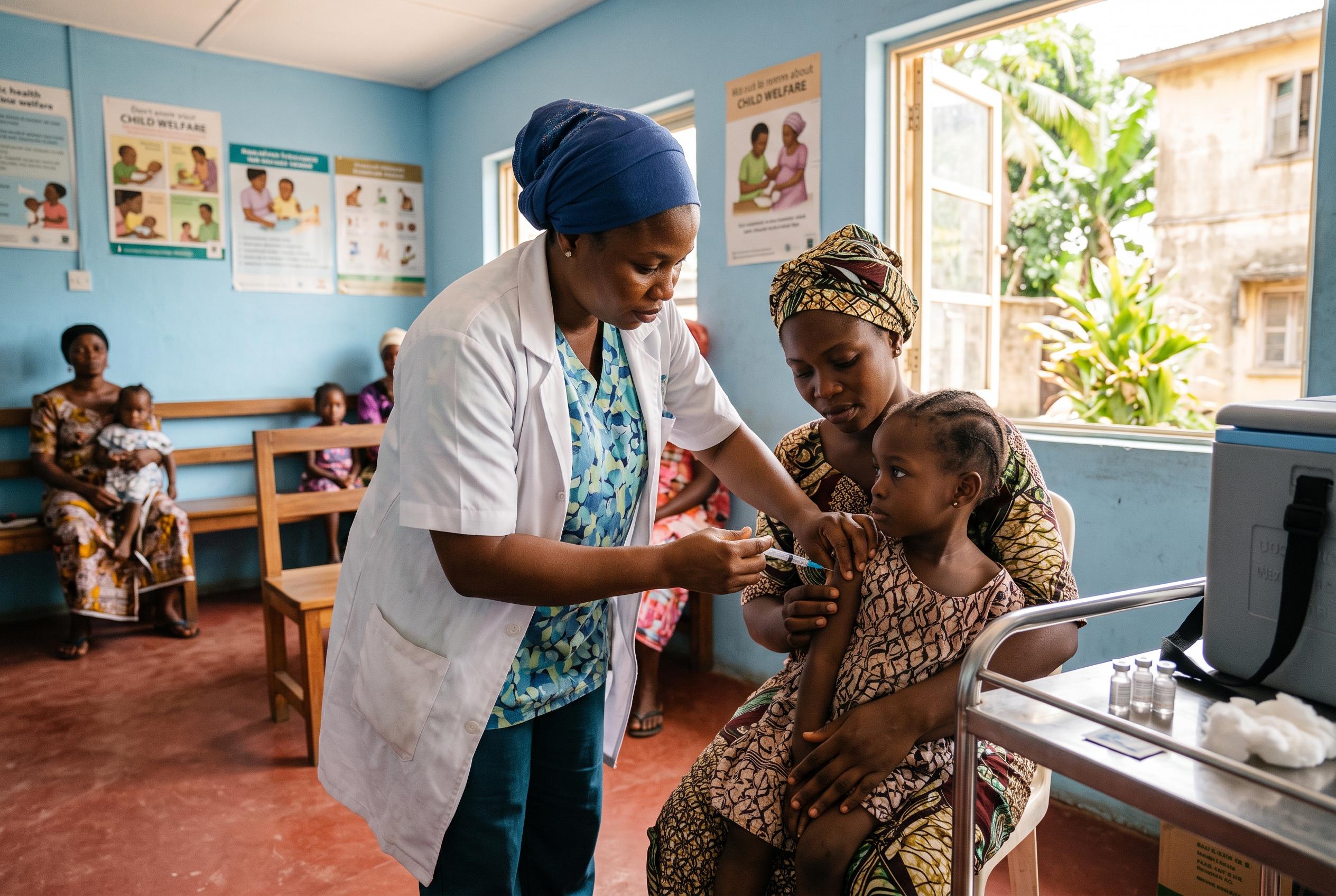

Health officials say about 93% of children affected in recent Nigerian diphtheria outbreaks had not completed their routine vaccinations, as the country records thousands of suspected cases and hundreds of deaths.
The National Primary Health Care Development Agency has said most children affected by recent diphtheria outbreaks in Nigeria had not completed the routine vaccine schedule, underscoring how fragile immunisation coverage remains in parts of the country. Dr Muyi Aina, the agency’s chief executive, said at a quarterly media briefing in Abuja that roughly 93% of the children involved in recent outbreaks had not received the full set of recommended doses.
Aina said some children had never been vaccinated, while others had received only part of the series needed for protection. He attributed the gap in part to misinformation and false rumours, arguing that vaccines are available but not always taken up when families are influenced by poor advice or community fear.
The warning comes against a backdrop of a prolonged national outbreak. The World Health Organization said Nigeria recorded 12,150 suspected diphtheria cases and 884 deaths between January and November 2025, with the illness spreading across 240 local government areas in 30 states. WHO said low vaccination coverage was a major factor in the outbreak, and that more than 2 million children were under-immunised, including many with no doses at all.
Evidence from earlier outbreaks points in the same direction. A retrospective study published on medRxiv found that during the 2023–24 epidemic in Kano State, the community burden was far higher than facility-based figures suggested, and that two-thirds of deaths occurred at home. The study also found that vaccination sharply reduced the risk of death, while delayed care-seeking was linked to much higher mortality.
Against that difficult backdrop, Aina said the agency has been trying to widen protection against several vaccine-preventable diseases. He said more than 18.3 million girls have now received the human papillomavirus vaccine, more than 102 million children aged nine months to 14 years have been reached with measles-rubella immunisation, and 882,000 children in Kebbi, Bayelsa, Ondo and Bauchi have received at least a first dose of malaria vaccine.
He also said the agency is working to reduce the number of children who have received no vaccines at all by identifying, counting and reaching them directly, particularly in underserved communities. The agency has said it plans to expand the Basic Health Care Provision Fund to more facilities, from 8,300 to 15,000, as part of efforts to improve access to routine care. For parents, caregivers and community leaders, the message from health officials is clear: falling behind on childhood vaccination leaves children exposed to diseases that can be prevented.
Disclaimer: This content is for informational purposes only and is not intended to be a substitute for professional medical judgment, advice, diagnosis, or treatment.



