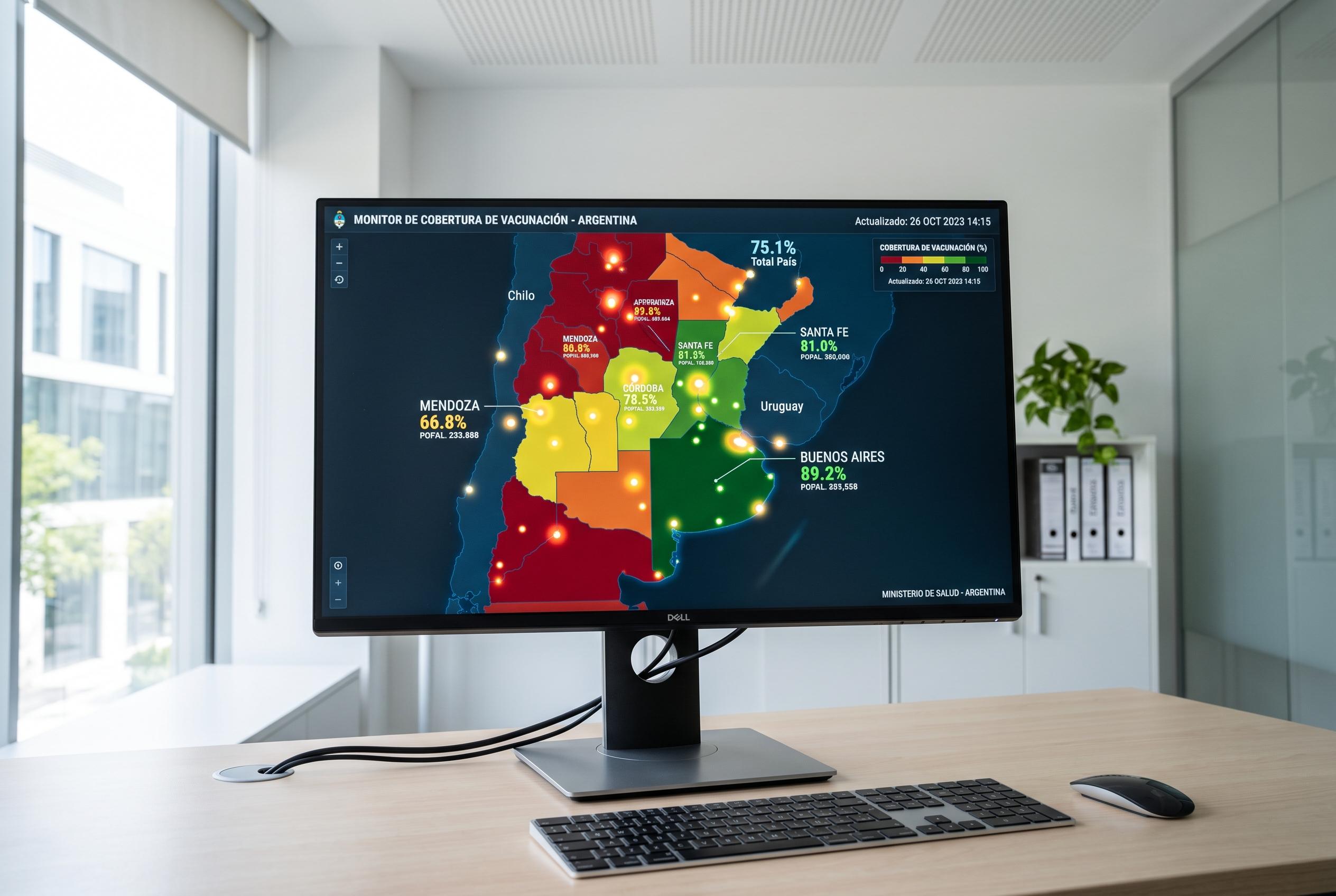

Argentina’s Health Ministry has introduced a public map providing near real-time data on vaccination coverage across provinces, aiming to enhance immunisation strategies and identify gaps.
Argentina’s Health Ministry has begun publishing a public map that lets people track vaccination coverage and the number of doses sent to each province, giving citizens a near real-time view of how immunisation is progressing across the country. The tool brings together two sides of the system that were previously harder to compare: doses distributed by the federal government and doses actually recorded as administered, according to Perfil and official health data.
The map covers 16 vaccines in the national schedule, including BCG, hepatitis B, pneumococcal, quintuple, polio, rotavirus, meningococcal, triple viral, chickenpox, hepatitis A, HPV and respiratory syncytial virus. It includes data for 2025 and for 2026 up to the latest closed month, drawing on the National Nominalised Vaccination Registry, known as NOMIVAC, and the ministry’s stock management system. Authorities say the display can be filtered by vaccine and year, with colour coding to highlight provincial gaps.
The ministry has paired the new map with broader vaccination reporting that showed Argentina reached its highest coverage levels in recent years in 2025, with five key vaccines all above 90%. Official information also says the national vaccination calendar covers every stage of life, from newborns to older adults, and that vaccines are offered free of charge at public health centres and hospitals throughout the country. The ministry began distributing the 2026 calendar’s vaccines in December 2025, sending more than 3.4 million doses to the provinces.
The government is also using the campaign data to track seasonal and targeted immunisation efforts. By July 2026, it said more than six million flu doses had been administered nationwide, while a separate strategy against respiratory syncytial virus began in January 2026 for pregnant women between 32 and 36 weeks of gestation. Even so, the new map is meant less as a ranking than as a planning tool, since lower coverage in one province does not on its own prove weaker management; geography, distance and delivery challenges can all affect access. Health Minister Mario Lugones said that better information would support better decisions and help identify the places where vaccination efforts need strengthening.
Disclaimer: This content is for informational purposes only and is not intended to be a substitute for professional medical judgment, advice, diagnosis, or treatment.