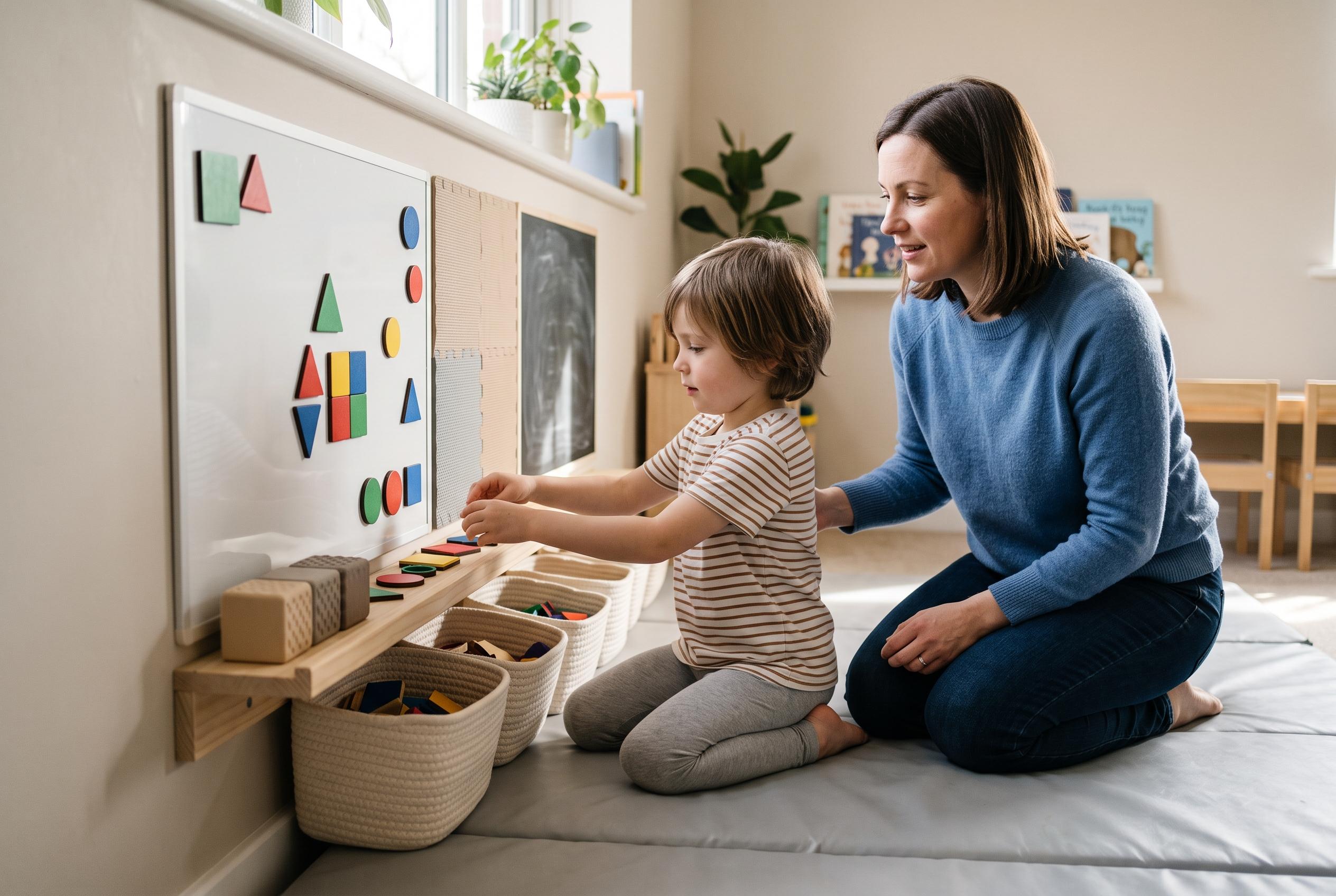

Transforming household walls into versatile play surfaces can improve physical skills, foster independence, and stimulate creativity in children of all ages, all while saving space.
Parents often devote serious attention to toy storage, only to overlook one of the most useful surfaces in the home: the wall. Vertical play turns that blank space into a place for drawing, sticking, tracing and building, giving children a way to move, reach and create without needing more furniture. What looks like a simple setup can support learning, independence and creativity at the same time.
Occupational therapists have long used upright surfaces because they ask more of a child’s body than a table does. According to the CTI Pediatrics article and the TLC Essex resource, activities on a wall or easel encourage better posture, stronger shoulders and a more stable core, while also helping with hand-eye coordination and wrist control. Those are the same foundations children later rely on for writing, dressing and other everyday tasks.
The appeal is not just physical. Working vertically also asks children to plan, adjust and solve problems as they go. The CTI Pediatrics piece says that upright play supports visual-motor integration and problem-solving, while the Green Child Magazine article notes that it can improve focus and confidence. That makes the wall a useful space for open-ended play, where a child can experiment without being told exactly what to make.
As children grow, the benefits shift. For toddlers, the main value is repetition: reaching up, pressing, peeling and placing pieces again and again. The TLC Essex resource suggests magnets, stickers and simple drawing as easy starting points. Preschool children can use the same space for tracing letters, matching shapes or building patterns, while older children may turn it into a planning board for stories, drawings or multi-step projects.
Practicality is one reason the idea has spread at home as well as in therapy rooms. The blog from Tix&Mix says vertical play can work well in a calm, screen-free routine, and it can be adapted with magnetic wall decals or similar surfaces that change as a child’s interests change. For families in smaller homes or flats, that can make a wall far more useful than another table or storage bin.
The best setups are simple, safe and easy to reach. Parents do not need a full playroom to make this work; a chalkboard, easel or magnetic panel is enough. What matters most is giving children a surface they can use on their own, without too much adult direction. In that sense, the hidden value of vertical play is not only that it saves space, but that it turns an overlooked part of the house into a place where children can practise being capable.
Disclaimer: This content is for informational purposes only and is not intended to be a substitute for professional medical judgment, advice, diagnosis, or treatment.