
Behind the seemingly simple tasks in a Montessori Children’s House is a carefully sequenced approach to building independence, concentration and early academic understanding.
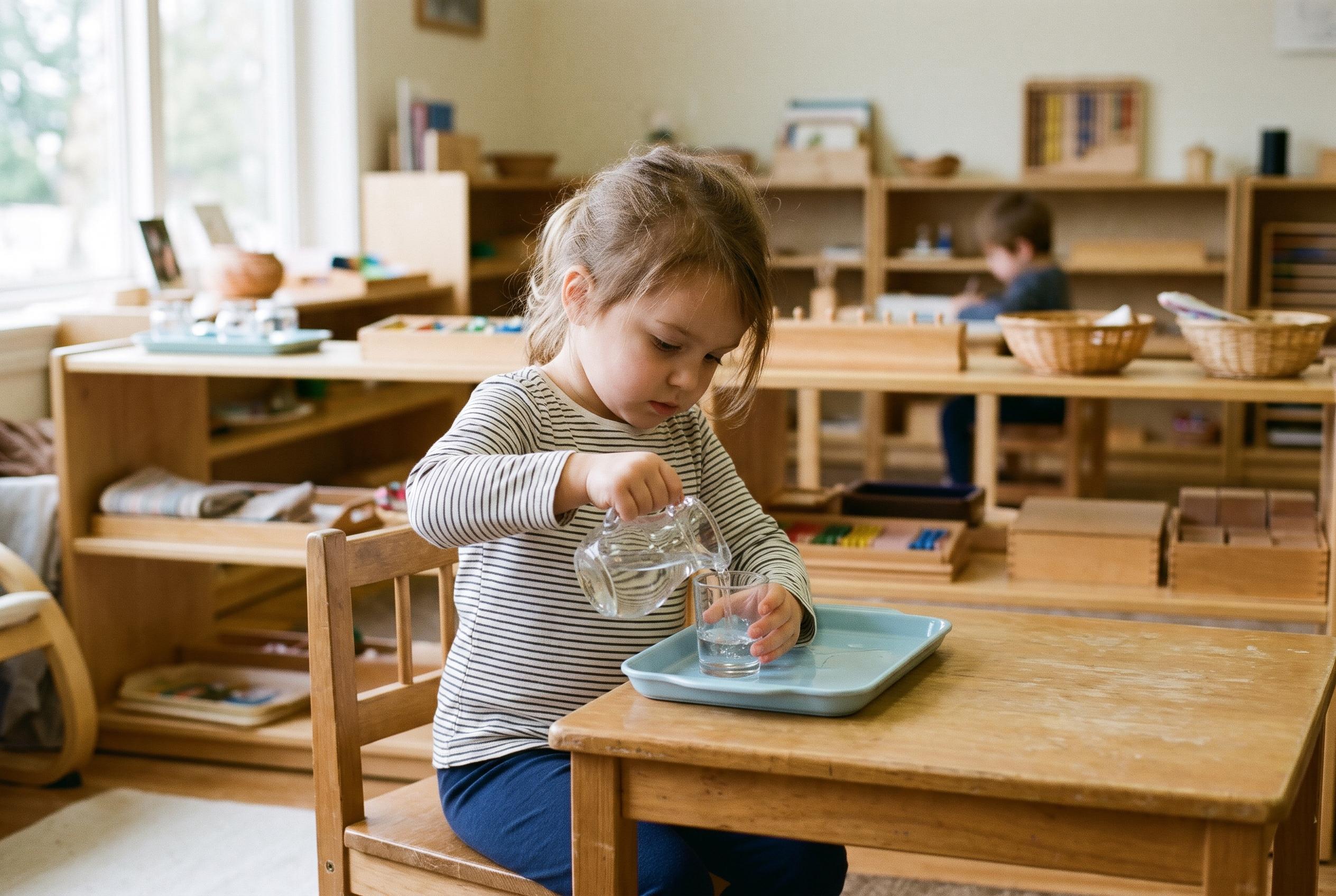
A Montessori Children’s House can look deceptively ordinary at first glance: a child may be pouring water, tracing a letter, lining up beads or carefully wiping a table. Yet, as Montessori schools explain, those tasks are not random busywork. They are part of a deliberately sequenced curriculum for children aged three to six, designed to build concentration, independence, coordination and an early grasp of language, mathematics and the wider world.
According to Montessori Children’s House programmes, the classroom is usually built around five linked areas: Practical Life, Sensorial, Language, Mathematics and Cultural Studies. The environment is child-sized, orderly and arranged so that children can choose work independently. Teachers do not stand at the front of the room directing everyone at once. Instead, they observe each child closely, introducing materials when a child appears ready and guiding the next step in learning.
Practical Life work is where much of that independence begins. Activities such as pouring, sweeping, polishing, caring for plants and preparing simple food are designed to help young children organise their movements, follow a sequence and complete a task from start to finish. Montessori organisations describe these exercises as a foundation for concentration, self-efficacy and social responsibility, because children are not merely practising a skill; they are learning how to manage themselves and contribute to the classroom community.
The Sensorial area sharpens perception through materials that isolate one quality at a time. Towers, rods, tablets and cylinders help children compare size, length, colour, weight, texture and sound. Montessori schools say this kind of concrete exploration strengthens observation and classification, which later supports more formal work in science, geometry and mathematics. What may appear to be a simple arrangement of blocks is often a child learning to notice patterns and relationships with great precision.
Language and mathematics follow the same principle of moving from concrete to abstract. Montessori materials introduce sounds, symbols and number concepts in a carefully ordered progression, beginning with spoken language and tactile letter work before moving towards writing and reading. In mathematics, children handle objects that make quantity visible, from counting rods and numeral cards to bead materials that illustrate the decimal system. The aim, according to Montessori educators, is not speed but understanding: children should know what a written word or number means before they are asked to manipulate it on paper alone.
The mixed-age structure of the Children’s House is another defining feature. Schools that follow the model say the age range, often spanning roughly three to six years, allows younger children to learn by watching older classmates and gives older children the chance to reinforce their own knowledge through help and leadership. That final year before primary school is often especially important, because children may be reading, writing, working with more advanced number concepts and taking on greater responsibility within the room. For parents, Montessori schools recommend looking beyond the appearance of the materials and asking what purpose each activity serves, because in a well-run Children’s House, purposeful work is the point of the lesson.
Disclaimer: This content is for informational purposes only and is not intended to be a substitute for professional medical judgment, advice, diagnosis, or treatment.