

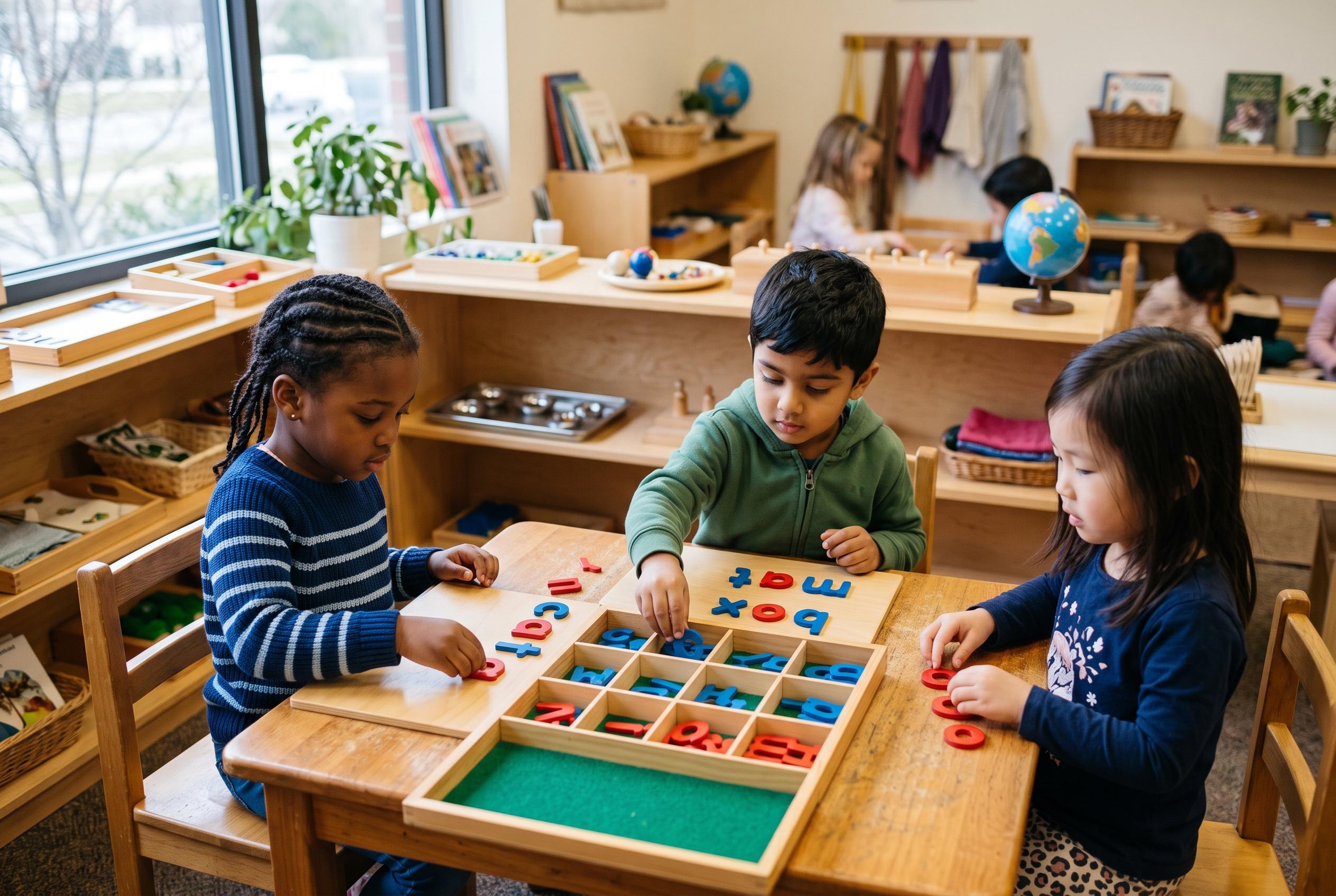

Montessori classrooms build literacy from spoken sounds, tactile letter work and movable alphabets, allowing children to compose words before handwriting is fully developed.
Montessori classrooms take a distinctly different route into literacy. Rather than starting with letter names, teachers first help children notice the sounds in spoken words, a sequence designed to support later decoding. As the Montessori organisation explains, this approach follows the way children already acquire speech: by listening, repeating, experimenting and gradually building meaning. In practice, that can look like a four-year-old arranging wooden letters on a rug and reading out a word long before handwriting feels secure.
The emphasis on sound awareness is central. Montessori teachers often use simple oral games to build what educators call phonemic awareness, the ability to hear the individual sounds within words. Children might be asked to identify the first sound in a word or to think of another word that begins with the same sound. According to Montessori guidance published by other schools and teaching resources, this early focus on sounds rather than letter names helps children link symbols to speech in a way that later supports reading.
One of the best-known classroom tools is the sandpaper letter. Nienhuis Montessori, a supplier of Montessori materials, describes these as textured letters mounted on a smooth board so children can trace each shape with two fingers while saying its sound. The tactile experience is deliberate: a child sees the form, hears the phoneme and feels the movement at the same time. Montessori’s own explanation of the method presents this as a way to build familiarity with letters through the body as well as the mind.
The next step is often writing before reading, which can surprise adults who learned literacy in the opposite order. The movable alphabet, another core Montessori material, lets children compose words with individual letters instead of relying on a pencil before their fine-motor skills are ready. Nienhuis Montessori says the material helps children build words and sentences after they have learned the sounds through sandpaper letters. That means a child can spell out a thought, even if handwriting still takes effort, and can experience written language as a tool for communication rather than merely an exercise in copying.
Handwriting itself is prepared carefully and gradually. Montessori classrooms typically combine practical life activities, tracing work and letter formation exercises so that children develop control, coordination and strength in the hand. The point is not simply neatness. It is to make writing physically manageable, so that a child’s ideas are not held back by the mechanics of holding a pencil or shaping letters.
Reading then grows from these earlier steps. Children begin with simple phonetic words, then move on to more complex spelling patterns and, eventually, books. Montessori resources describe this as a progression from sound to symbol to meaning, with teachers adjusting lessons to each child’s pace. That matters because reading is more than sounding out words. A child also needs vocabulary, background knowledge and curiosity, which is why Montessori language learning is spread across the wider curriculum rather than confined to reading lessons alone.
In elementary settings, that broader approach continues. Children use reading and writing to research topics, produce reports, learn grammar, explore word origins and present ideas. The Montessori organisation says the ultimate aim is not only fluent readers, but children who read because they are interested and write because they have something to say. For parents, the message is practical: talking, reading aloud, singing, telling stories and inviting children into everyday writing all strengthen the same foundation that Montessori schools are trying to build.
Disclaimer: This content is for informational purposes only and is not intended to be a substitute for professional medical judgment, advice, diagnosis, or treatment.



