

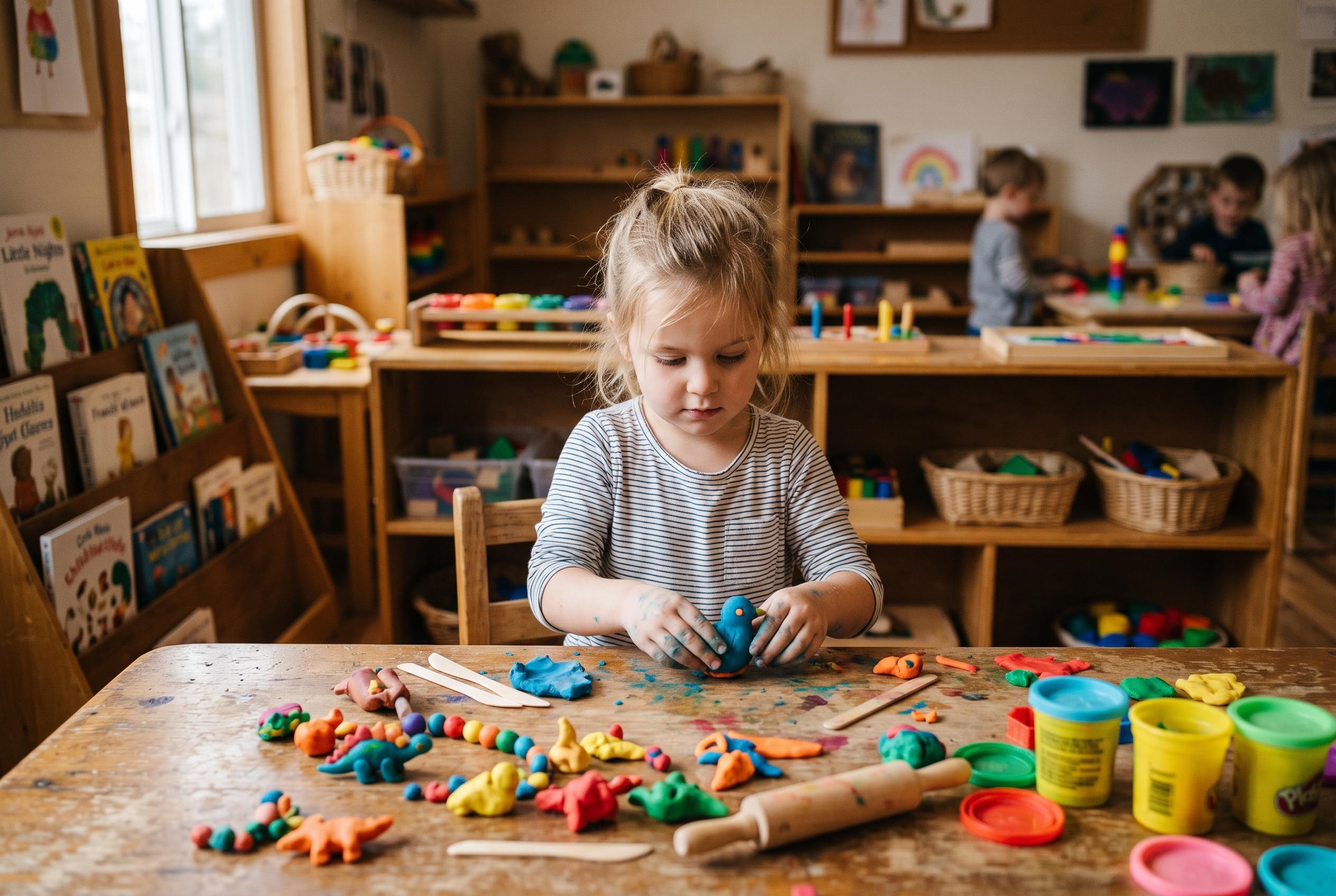

Regular clay play can build hand coordination, language, concentration and spatial awareness while helping children approach learning through creativity rather than rote practice.
Preparing a child for school does not have to begin with worksheets, textbooks or rote learning. For many children, hands-on play is a far more natural route into new skills, and modelling clay can turn that process into something engaging and low-pressure. According to 7days.ru, preschool educator Olga Sheeva and experts from Fix Price argue that the real value lies less in early academic drilling than in the capabilities children build while creating.
Working with modelling clay helps strengthen hand coordination, sustain attention and support speech development. Specialists cited by 7days.ru recommend wax-based clay because it is softer than standard material while still providing enough resistance to make the muscles in the hand work harder. That, they say, lays a foundation for tasks children will later need for writing, playing musical instruments and learning foreign languages.
The most effective activities depend on a child’s age and stage of development. Very young children do not need complex projects at the start. Simply squeezing, rolling and stretching the material allows them to explore its texture and build finger control without the pressure of producing a finished craft. As children grow older, they can move on to simple shapes and small story-based tasks, learning to attach parts, notice differences between them and describe what they have made. School-age children, by contrast, can be given more independent projects that contain more elements and require them to plan ahead.
The article also stresses the value of using both hands differently during play. One hand might steady the model while the other presses on a pattern or fixes on a piece, and switching roles helps avoid making one hand permanently dominant. This kind of coordination trains the brain to manage several actions at once. A simple test suggested by the educator is to draw a circle with one hand and a straight line with the other; if the line begins to curve, that can show the hands are still interfering with one another. Such coordination, the article notes, can matter later for musicians, dancers and athletes.
Beyond motor skills, clay play offers a chance to build language and spatial awareness. Adults can name colours, shapes and materials during the activity, ask children to describe what they are making and encourage them to talk through the steps. The article says that because the brain’s language areas and finger movement areas are closely linked, words connected with real objects and actions may be easier to remember. Modelling also introduces children to three-dimensional thinking, since an object can be examined from every side and compared in parts, proportions and connections. That, the article argues, is useful later in geometry, technical drawing, design and 3D modelling.
The time needed need not be long. Fifteen to 20 minutes is enough if the activity is done regularly, and adults are encouraged to praise effort and small improvements rather than judge the final result only by appearance. That approach, the article says, helps preserve enthusiasm and shows children that learning can be enjoyable as well as useful.
Disclaimer: This content is for informational purposes only and is not intended to be a substitute for professional medical judgment, advice, diagnosis, or treatment.



