

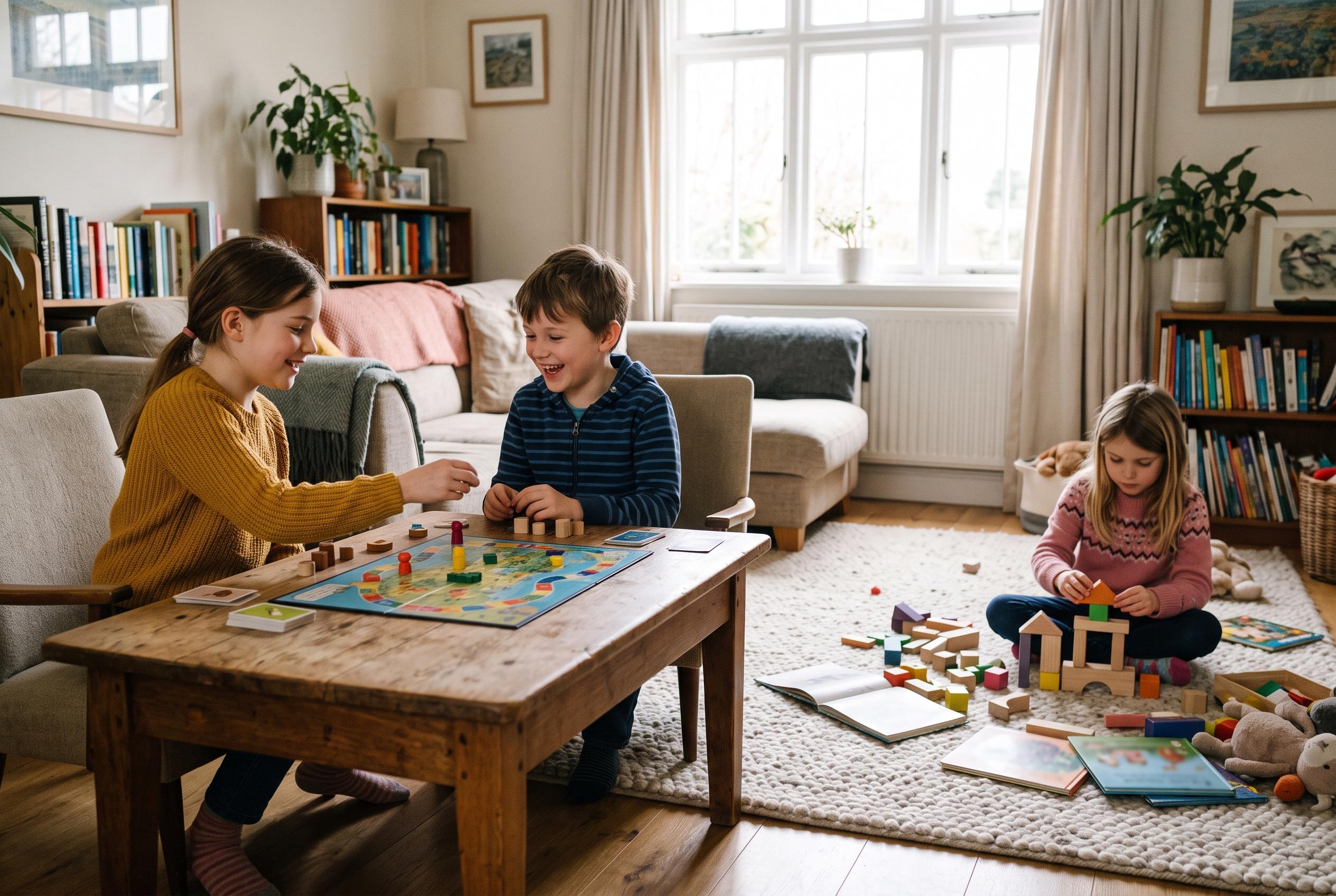

Co-operative play builds communication and social skills, while independent play helps children develop creativity, decision-making and resilience. Knowing when to offer each can support learning without taking over.
For many parents, the real question is not whether children should play with adults or on their own, but when each approach helps most. Cooperative play, in which a child and an adult or peers share an activity, can build language, turn-taking and problem-solving skills. Independent play gives children space to make decisions, test ideas and recover from small setbacks without someone stepping in at once. According to Healthline and WebMD, cooperative play is a more advanced form of social play, while independent play is child-led and does not require constant adult direction.
The difference matters because children learn different things from each setting. In co-play, an adult can offer a new word, model a next step or provide comfort when frustration rises. In independent play, the child is left to choose, adapt and persist. That balance is especially useful in early childhood, when many skills are still emerging and a child may need help one day and more room the next. Thrive ABA Therapy notes that both cooperative and independent play can support development, though they do so in different ways.
Developmentally, play usually unfolds along a broad path rather than a strict timetable. The Bump describes parallel play, when children play beside one another without truly collaborating, as an important bridge between solitary activity and fuller cooperation. That distinction helps explain why a child may be perfectly happy beside other children without yet being ready for shared goals or assigned roles. As children grow, they often move towards more organised joint play, but the pace varies widely.
Parents can make the most of co-play by joining in without taking over. A useful question, a small clue or a brief demonstration can keep a game moving while still leaving the child in charge. Healthline and WebMD both describe cooperative play as involving shared goals, agreed rules and role-sharing, which can be encouraged through activities such as board games, gardening or make-believe games that require children to listen, wait and respond. The point is not to direct every move, but to keep the exchange active and responsive.
Independent play has its own value. Playroom Chronicles says child-led play can strengthen self-regulation, problem-solving and creativity because children must keep going without constant adult input. That is also why a well-prepared environment matters: open-ended toys, a safe space and enough time can make it easier for a child to stay with an activity and explore it in their own way. In practice, independent play is less about isolation than about giving children room to lead.
Some of the most useful play sits between the two. A parent might set out materials, offer a light prompt and then step back as the child experiments. That approach can work well for children who are ready for more autonomy but still benefit from a nearby adult. Thrive ABA Therapy recommends setting up situations that invite collaboration when families want to encourage more cooperative play, especially for children who are more comfortable playing alone at first.
For families, the practical lesson is simple: watch the child, not just the clock. If a child is engaged and making choices, independent play may be exactly what is needed. If they invite you in, a shared game can deepen learning and connection. And if play starts with a parent’s help but later continues on its own, that is often a sign that both forms are doing their job.
Disclaimer: This content is for informational purposes only and is not intended to be a substitute for professional medical judgment, advice, diagnosis, or treatment.



