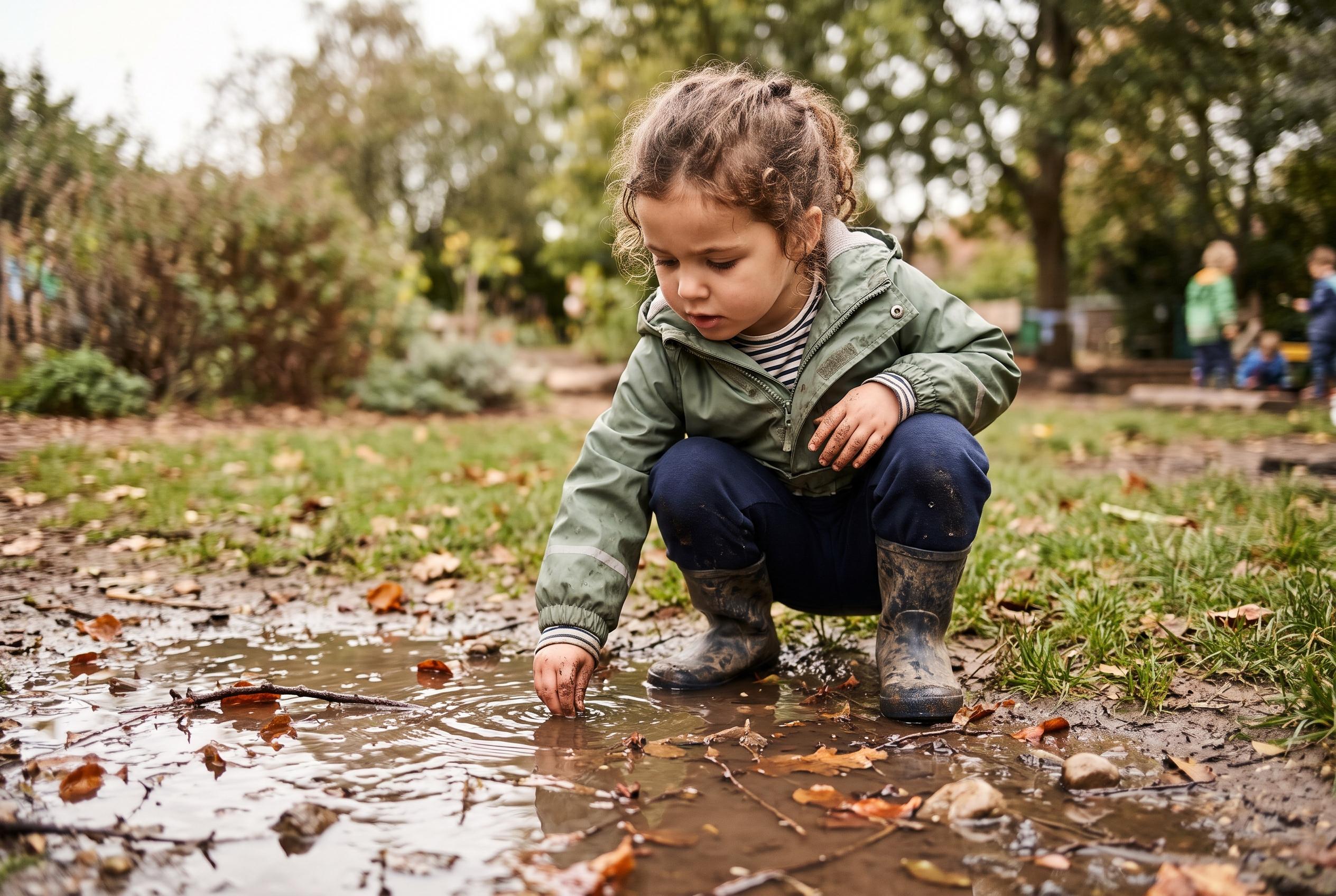

From mud and water to blocks and seeds, ordinary play is helping young children develop the curiosity, problem-solving and persistence that underpin STEM learning.
In kitchens, gardens and sandpits across Australia, young children are already doing the work of scientists. A puddle becomes a site of inquiry, a stick becomes a tool for testing, and a handful of mud turns into an experiment in texture, weight and movement. What can look like aimless play is often the earliest form of scientific thinking: observing, guessing, trying, adjusting and asking why.
That matters because research in early childhood education continues to show that play is not separate from STEM learning but central to it. A special issue on STEM in early childhood, published by the journal Education Sciences, argues that problem-solving and play-based exploration help children build the foundations of scientific understanding, while also shaping how confidently educators support that learning. Other recent reviews and university guidance point in the same direction, describing play as a practical way to develop early critical thinking, curiosity and persistence.
For preschoolers, the value of STEM is not in memorising facts or following a fixed lesson plan. It lies in repeated moments of discovery. A child who fills and empties containers is beginning to understand volume. A child who stacks blocks and watches them fall is learning about balance and structure. A child who plants seeds and checks them each day is building habits of observation and patience. These are not side effects of play; they are the learning itself, and they are exactly the kind of experiences that early childhood programmes are increasingly being encouraged to protect.
One reason play works so well is that it naturally supports the habits of mind that underlie STEM: noticing, predicting, testing and wondering. Children are especially good at spotting small changes in the world around them, whether it is a rock sinking, a shadow shifting or wet sand holding its shape more effectively than dry sand. They then form theories about what will happen next, try them out and often return with a new question. Monash University has written that play-based STEM approaches can deepen engagement and strengthen executive function, which is the set of mental skills children use to manage attention, remember instructions and control impulses.
Everyday materials are often better teachers than expensive products. Water supports lessons in flow, capacity, floating, sinking and cause and effect. Sand and mud invite children to think about materials, consistency and building. Sticks, shells, stones and leaves can become counting tools, pattern pieces, building supplies or loose parts for open-ended construction. In the home, ordinary kitchen objects can spark inquiry too: measuring cups introduce comparison and quantity, a ramp made from books and cardboard shows how slope affects movement, and a simple mix of vinegar and bicarbonate of soda demonstrates how one change can produce a visible reaction.
The adult’s role is not to take over the learning but to make it richer. That means asking open questions, narrating what a child is doing and making room for uncertainty. Education NSW says everyday routines and play experiences offer repeated opportunities to explore STEM ideas, while university guidance on play-based STEM stresses that educators improve learning most when they extend children’s thinking rather than deliver neat answers too quickly. A simple phrase such as “What do you think will happen?” can do more to build scientific reasoning than a long explanation.
The learning environment matters just as much as the language. A strong early childhood setting gives children room to dig, pour, build, sort and investigate. It includes natural materials, long stretches of uninterrupted play and space for projects to continue over time. That approach is reflected in the Reggio Emilia tradition, which treats the environment as a “third teacher”, and in the National Quality Standard’s focus on the physical environment as a key part of quality early education. Open-ended spaces create more thinking than tightly prescribed activities because they leave room for children to direct their own experiments.
At Okinja Early Learning Centre, that philosophy is built into the daily programme. The centre says its curriculum is play-based, shaped by children’s interests and supported by natural and sustainable materials. It describes its indoor and outdoor spaces as places designed to prompt curiosity, conversation and collaboration, while also helping children notice the world around them. That emphasis aligns with broader evidence that early STEM learning works best when it is integrated into ordinary play rather than separated into a specialist subject.
The larger point is simple: the preschool years are not a waiting room for “real” learning later on. They are a critical period in which children develop curiosity, confidence and the early habits of reasoning that support later success in science, technology, engineering and mathematics. For parents, that means there is no need to chase the latest toy or worksheet. A child, a puddle and a patient adult beside them are often enough.
Disclaimer: This content is for informational purposes only and is not intended to be a substitute for professional medical judgment, advice, diagnosis, or treatment.