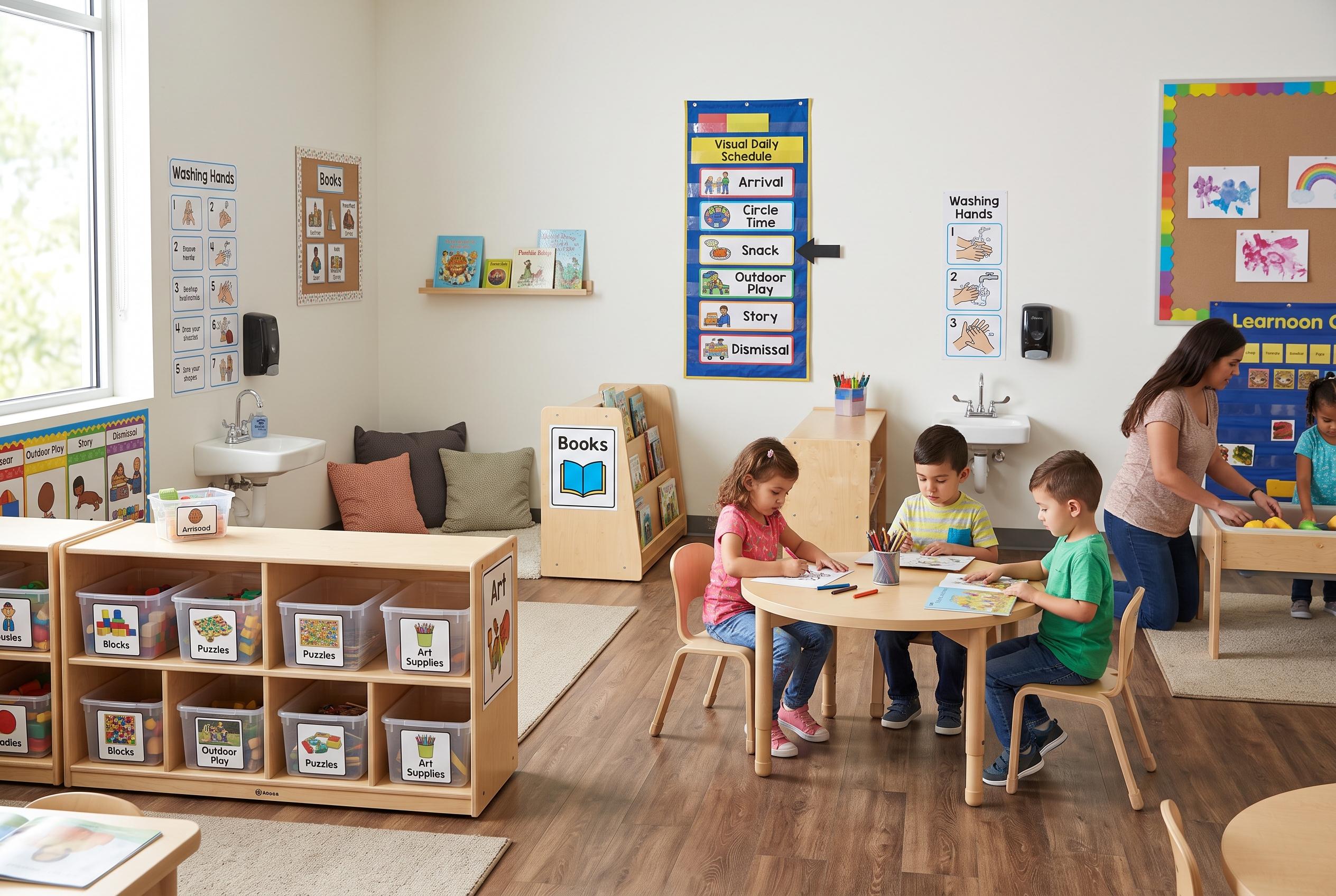

Implementing visual supports in preschool settings can make routines clearer, facilitate learning, and create a calmer, more organised environment for young children as they develop essential skills.
Visual supports can make a preschool classroom easier to navigate, calmer and more engaging for young children who are not yet reading fluently. The central idea is simple: when children can see what is expected, what is happening next and how to take part, they are less likely to feel lost and more likely to settle into the day.
That approach is especially useful from the first day of term. According to research on preschool speech perception, 3- and 4-year-olds can make better sense of spoken language when visual cues are paired with audio, which helps explain why pictures, gestures and other prompts are so effective in early years settings. Work on embedded visual teaching aids also suggests that image-based supports can strengthen cognitive and fine motor development, while studies on classroom design show that visuals need to be carefully chosen because too much stimulation can distract children rather than help them.
One of the most practical uses is to post clear classroom rules and routines in pictures. Instead of expecting children to remember instructions, teachers can point to visual reminders for listening, lining up or keeping hands to themselves. These cues can be reinforced during circle time, morning meeting and transitions, and they are often useful on desks, in play areas and at specific learning centres such as a sensory table.
Visuals can also reinforce early academic learning. Letters, numbers, shapes and colours can all be displayed around the room and revisited in songs, pointing games and guided practice. Some classrooms also add sign language visuals so children who are not yet verbal, or those learning the signs as an added skill, can participate more fully. Art activities can complement this approach by building attention, fine motor control and an understanding of patterns and shapes, according to early childhood education writing cited by Rasmussen University.
Schedules are another area where pictures can make a major difference. Individual visual schedules can help children understand the flow of the day, especially when speech therapy, occupational therapy or other services mean their routines differ slightly. A simple “to do” and “done” board can support independence and reduce uncertainty, while a whole-class schedule helps everyone see the overall sequence of the day, from centres and snack to nap and outdoor play. Guidance on preschool routines from childcare educators and furniture specialists similarly notes that picture schedules can reduce anxiety, support calm transitions and encourage children to do more on their own.
Behaviour supports can also be made visual, using tools such as first/then boards, token boards and social stories. These can be tailored to a child’s interests, which may improve motivation and follow-through. More broadly, visual supports do not have to be reserved for children with individual education plans. They can help an entire class run more smoothly, make the room feel welcoming and give teachers a flexible system they can expand over the year as children grow into new skills and routines.
Disclaimer: This content is for informational purposes only and is not intended to be a substitute for professional medical judgment, advice, diagnosis, or treatment.