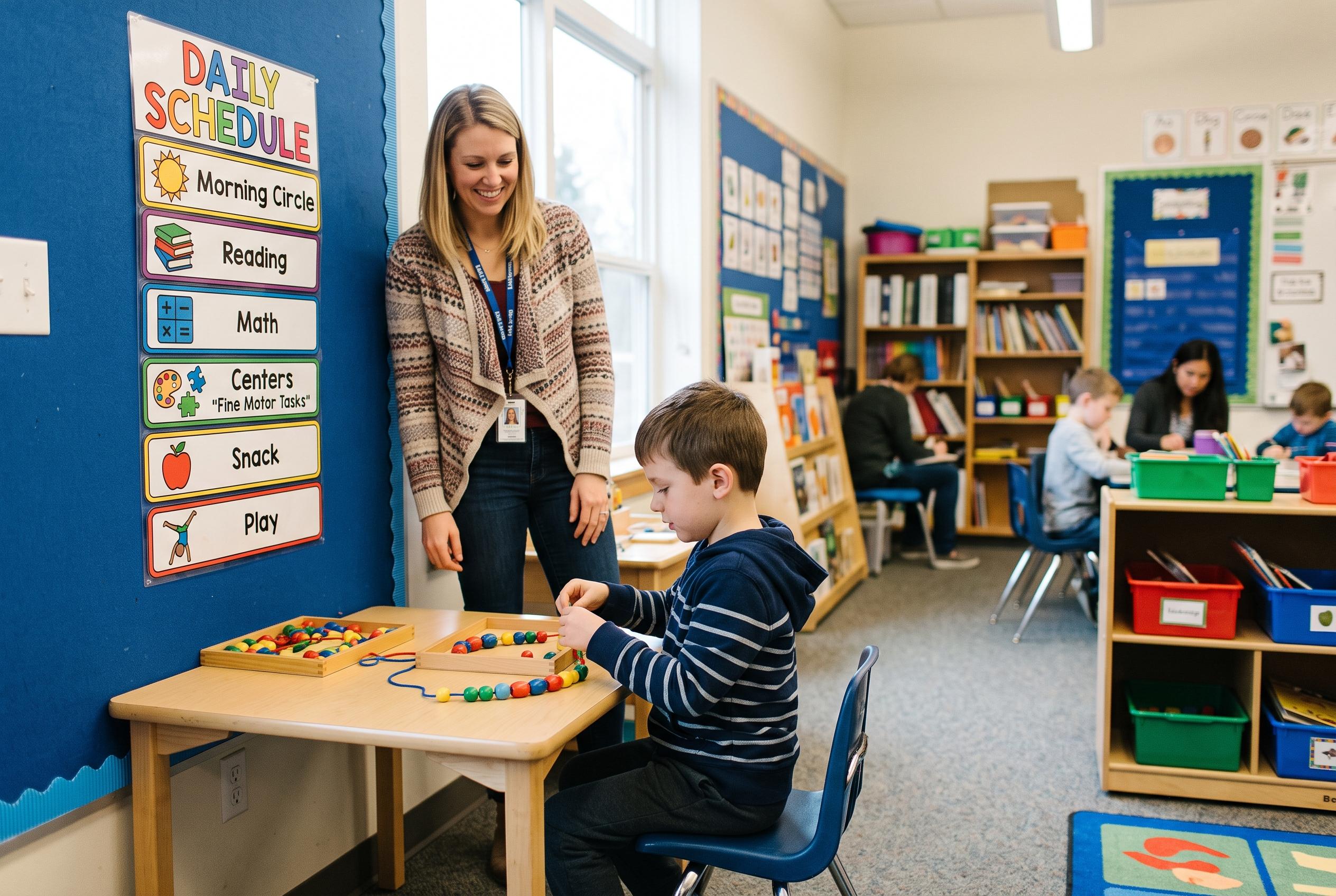

Effective use of visual schedules and consistent routines can significantly improve centre rotations, fostering independence and reducing stress for students and educators in special education settings.
For many special education teachers, centre rotations can be the difference between a classroom that feels scattered and one that runs with purpose. The approach can work in early childhood settings, severe autism classrooms, life skills programmes and resource rooms, but it has to be shaped around students’ needs rather than copied from a generic template. Guidance from classroom resources and special education practitioners consistently points to the same foundation: students do better when they can see what comes next, understand the routine and move through the day with fewer verbal prompts.
That is why visual schedules sit at the heart of successful rotations. In practice, that can mean a small, portable schedule a student carries from station to station, or a larger display on a board or presentation slide for students who are ready for a less hands-on format. Specialist resources say visual schedules help reduce dependence on adult prompting while improving independence and smoother transitions. The key is making the system easy to follow, whether that means using colours, shapes, numbers or themed labels such as animals to match stations and student schedules.
Planning matters just as much as the visuals. Centre rotations work best when the structure is decided early and then held steady long enough for students to learn it. That includes deciding which centres will run, where materials will be stored, how long each station will last and how transitions will be signalled. Resources on academic centres in special education stress that consistency is especially important because it gives students repeated opportunities to practise the routine without constantly adapting to a new version of it.
Behaviour supports should be built into the system from the start, not added only after problems appear. Teachers who run effective rotations typically keep communication boards, break cards, fidgets and other supports at each station so students do not have to leave the area to find help. Individualised tools can travel with the student in a small bag, including token boards, first-then boards, reinforcement visuals and social stories. A study in a special education classroom found that staff training and coaching improved fidelity in station rotations, underscoring the value of teaching adults how to use the system as carefully as students are taught to use it.
Support staff are another central piece of the puzzle. The article’s advice is to know each paraprofessional’s strengths, place them deliberately and make sure everyone understands not only where they will be but what they are responsible for during each rotation. Research on staff training in special education supports that approach, showing that educators are more successful with station-based instruction when they receive clear training and ongoing coaching. In some classrooms, paras may keep the same centre all year so students know who to expect; in others, they may be assigned by the teacher after training, especially if the team needs tighter control over workflow.
Even with strong planning, centre rotations rarely unfold exactly as expected, and that is normal. A smart board may fail, staffing may shift or a student may need more support than usual. The article’s central message is not that teachers should aim for perfection, but that they should build a routine sturdy enough to absorb the unexpected. If the room stays calm, students stay safe and the team debriefs afterwards, the system becomes easier to improve over time. Centres are not a one-size-fits-all model, but with visual structure, steady routines and thoughtful staffing, they can become a reliable part of almost any special education classroom.
Disclaimer: This content is for informational purposes only and is not intended to be a substitute for professional medical judgment, advice, diagnosis, or treatment.