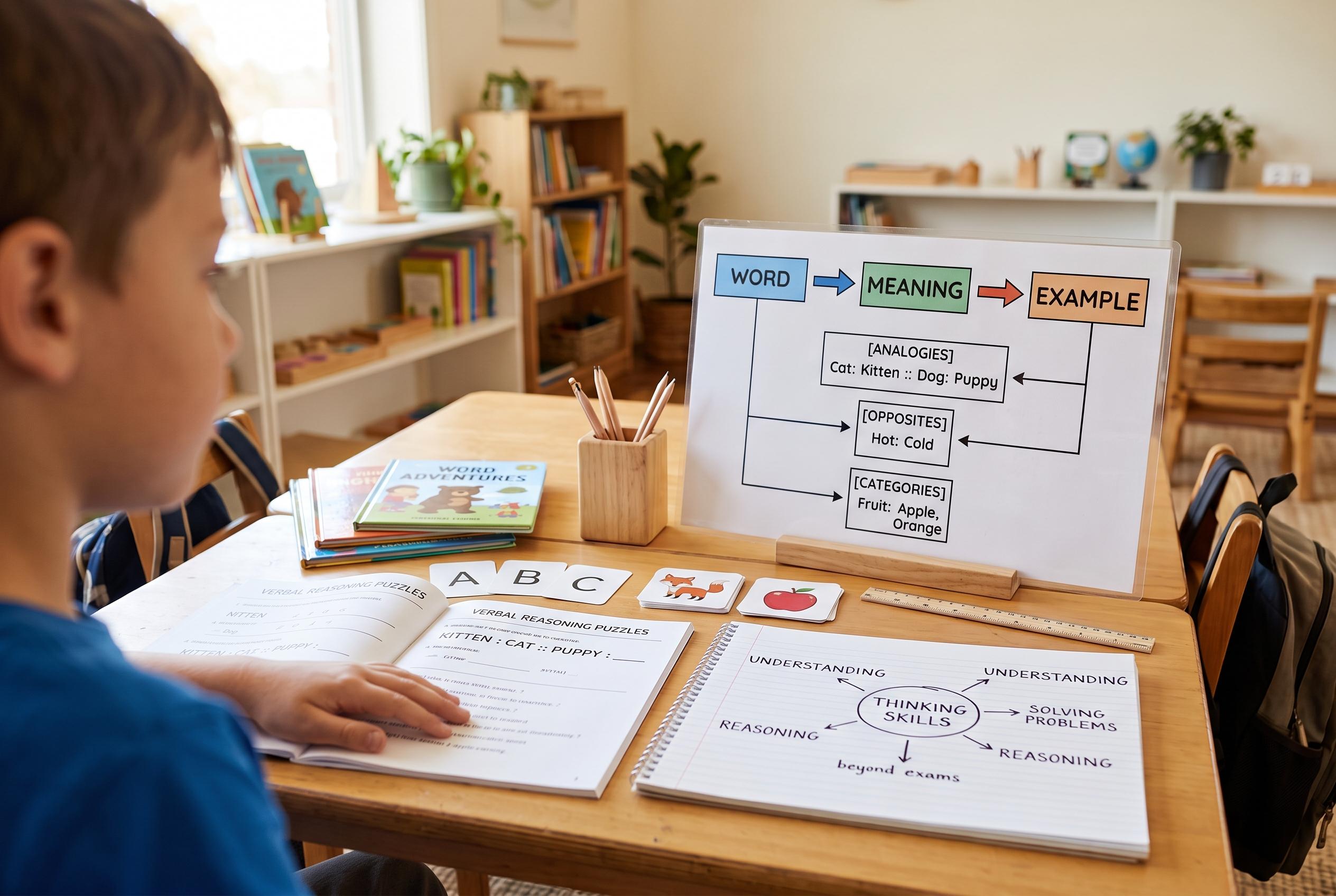

A new review highlights the importance of verbal reasoning in children’s learning, emphasising its role in reasoning, understanding, and applying knowledge across various settings, with implications for assessment and teaching strategies.
Verbal reasoning sits at the centre of how children learn to use language as a tool for thinking. According to the source article, it develops alongside vocabulary, oral language, reading and wider conceptual knowledge, helping pupils organise ideas, compare concepts and infer relationships. That matters well beyond any single exam, because these skills also help children take in new information and apply it in unfamiliar settings.
In the CAT4 assessment, verbal reasoning is one of four broad batteries, alongside quantitative reasoning, non-verbal thinking and spatial ability, as described by GL Education and other test-preparation guides. Within the verbal section, pupils are commonly asked to complete tasks such as verbal analogies and verbal classification, which test whether they can spot links between words, identify patterns and extract a general rule from examples. Testing Mom says these question types are designed to measure conceptual understanding rather than rote learning.
That distinction is important for parents and schools alike. Many-Tests notes that CAT4 is intended to assess underlying reasoning ability without relying heavily on advanced arithmetic or detailed text analysis, while schools use the results to inform individual education planning. In practice, that means a child’s performance can reveal how they approach problems, not simply how much content they have memorised.
The broader message is that verbal reasoning should not be treated as a fixed trait. The source article stresses that development is shaped by learning opportunities, experience and other cognitive skills, which means progress is possible and practice can help. CAT4-prep sites also reflect that view by offering worked examples, instant feedback and level-matched practice tests, suggesting that familiarisation with the format can reduce anxiety and help pupils show what they can do.
Disclaimer: This content is for informational purposes only and is not intended to be a substitute for professional medical judgment, advice, diagnosis, or treatment.