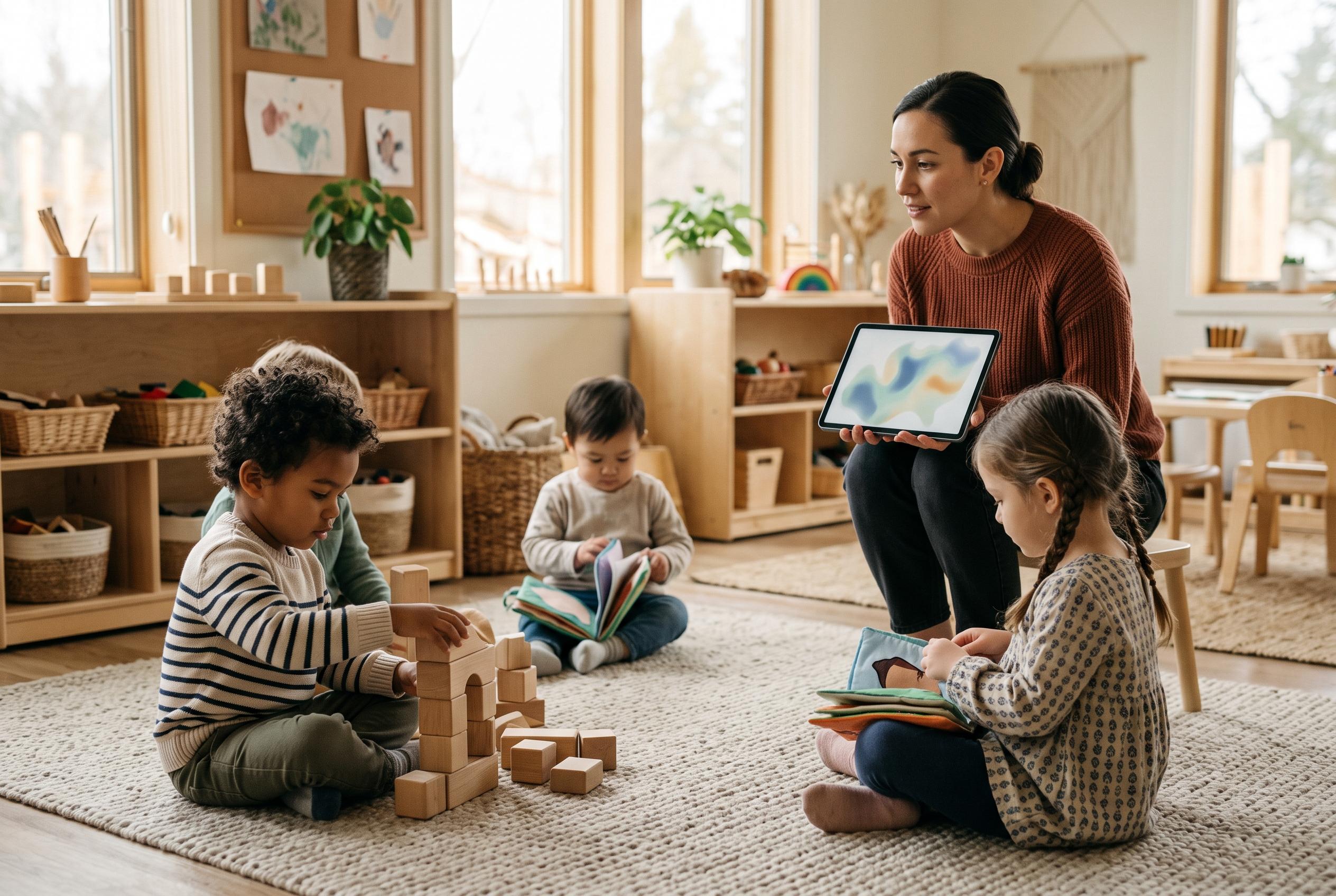

Research reveals that children’s non-engagement and silence in activities offer crucial insights into their learning, with AI tools potentially enhancing educators’ ability to interpret natural behaviour without assumption.
A quiet table is not proof that the idea failed. In early childhood settings, children often tell educators more by where they go than by what they touch, and a discarded invitation can be a useful signal rather than a setback. Observational research has long treated play in natural settings as a key source of evidence, because it shows what children actually choose, repeat and combine in real time.
That was the lesson Jodie carried from a toddler activity she prepared for a training assessment in the early 1990s. She had made wooden stampers, set out paint and covered the table with paper, only to watch children ignore the tools she expected them to use. Some pressed their hands into the paint instead, while others drifted to sand and water play. What felt, at the time, like a public failure later read as richer evidence of transport play, sensory exploration, mark-making and social negotiation.
The important distinction is between what can be seen and what is guessed. Saying children were bored is an interpretation; noting that most walked past the table and no child stayed for more than a minute is an observation. Studies of classroom observation, including work on the Optimising Learning Opportunities for Students system, have shown that structured evidence-gathering can help educators understand what opportunities children are actually taking up, rather than what adults hoped they would take up.
That is also where artificial intelligence can help, if it is used carefully. An AI tool cannot know a child’s motive, but it can help an educator separate visible evidence from assumption, list possible explanations and suggest a small test. The boundary matters: names, family details and identifying service information should stay out of general-purpose tools, and any suggestion should be checked against what the educator has directly seen.
A useful next step is often modest. Instead of adding more props, themed figures or extra adult direction, an educator might change one condition and watch again. In one example from the article, that could mean removing sorting cards and bowls, simplifying the materials and placing them nearer to the play that already has momentum. The point is not to make the scene busier, but to find out what, if anything, changes in the children’s response.
Across settings, the same principle holds. The CDC notes that ignoring is an active parenting strategy when used deliberately, but in early learning the lesson is different: silence or non-use is not a verdict, and a child’s choice to leave an activity alone should be read as information. Whether in a toddler room, family day care or outside school hours care, educators get closer to the truth when they write down what happened, watch what children moved towards instead and let the next decision rest on evidence rather than disappointment.
Disclaimer: This content is for informational purposes only and is not intended to be a substitute for professional medical judgment, advice, diagnosis, or treatment.