
Children often skip numbers during early counting not out of failure, but as a sign of developing understanding. Practical, hands-on approaches and patience help nurture their number skills effectively.
Children who skip numbers while counting are usually showing a normal stage in early number development, not a failure to learn. In many preschoolers, counting begins as a memorised sequence, more like reciting a rhyme than understanding quantity. As a result, a child may say the right rhythm of numbers while missing one in the middle, especially when they are moving quickly or trying to keep track of real objects at the same time. Educational guidance from child-development educators and counting resources such as Mathnasium and Grow Into Math points to one-to-one correspondence as the key skill: each spoken number must match one and only one object.
The most common reason for skipped numbers is that young children are still building the mental machinery behind counting. Their working memory is limited, so holding the number sequence in mind while also pointing at toys, blocks or fingers can be demanding. That is why a child may count smoothly in the abstract but lose their place when the task becomes physical. Distraction makes the problem worse, because even a brief interruption can break the rhythm. In practice, this means counting works best in a quiet setting, at a slow pace, with an adult who models the sequence clearly.
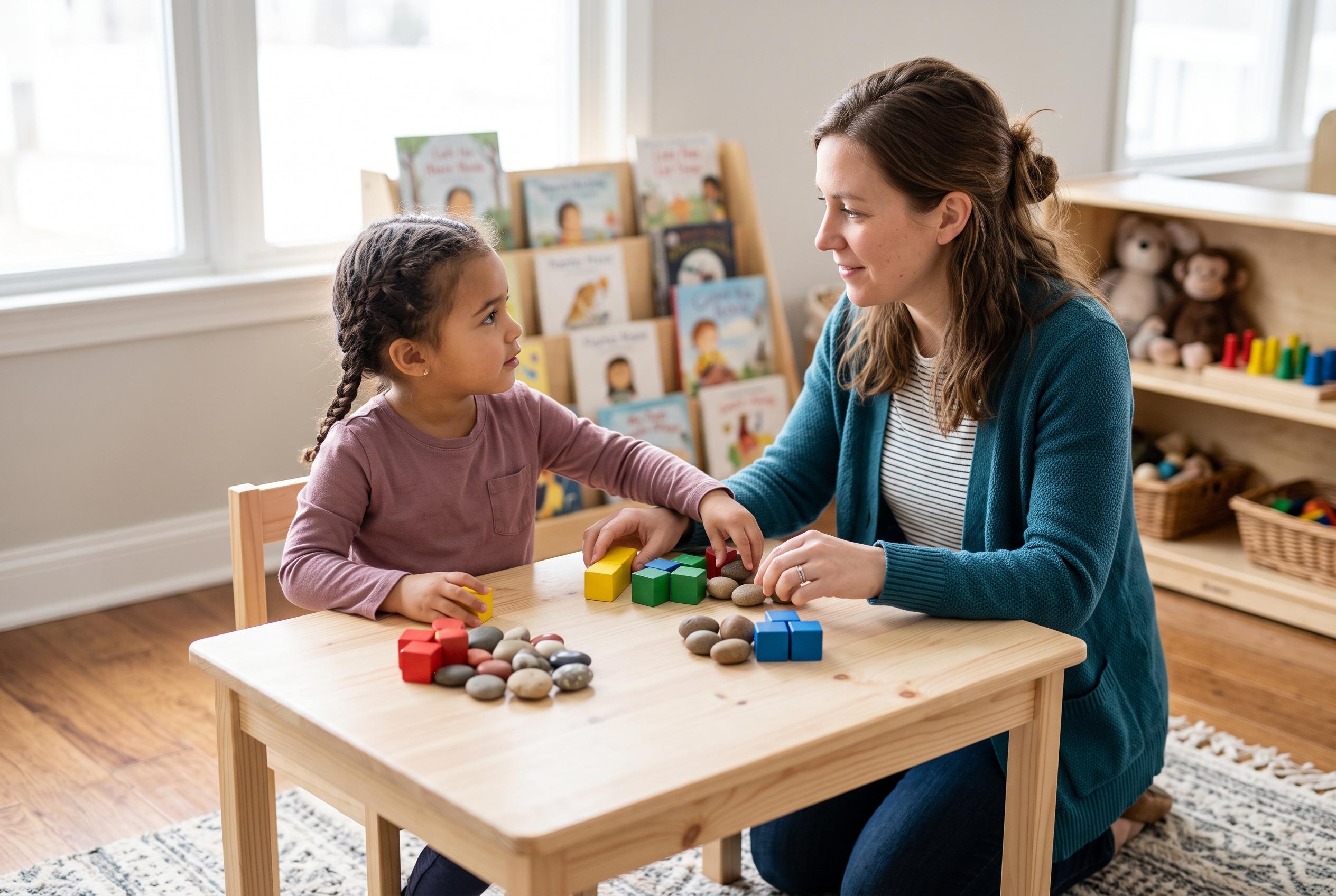
The most effective fix is to make counting concrete. Math is Fun, Mathnasium and Grow Into Math all emphasise the value of hands-on practice, whether that means counting buttons, cubes or socks, or using number lines and other visual supports. When children can touch or move objects as they count, the link between words and quantities becomes easier to grasp. Parents can also improve accuracy by clapping, tapping or marching along with the count, since movement gives children a steady beat and helps speech and action stay aligned. Short, repeated practice is usually more useful than long sessions that leave a child frustrated or distracted.
It also helps to begin with small collections and familiar patterns. Counting to five or ten with real objects is often enough for a young child to feel successful before moving on to larger sets. Once that is secure, skip counting by twos, fives or tens can strengthen pattern recognition and prepare children for multiplication later on. Mathnasium notes that skip counting is one of the first structured counting skills children meet in the early primary years, while Math is Fun presents it as a practical bridge to quicker counting and early multiplication facts. The point is not speed for its own sake, but fluency and confidence.
Parents do not need to panic if a child occasionally misses a number, especially in the preschool years. What matters more is whether the child is gradually improving and beginning to match each number to each object with less prompting. If skipping numbers continues well beyond the early years, or if a child seems unable to count in a reliable way despite regular practice, it may be worth speaking with a teacher about whether extra support would help. For most children, though, the answer is patience, repetition and play: the counting skill is still forming, and it grows stronger with everyday practice.
Disclaimer: This content is for informational purposes only and is not intended to be a substitute for professional medical judgment, advice, diagnosis, or treatment.