

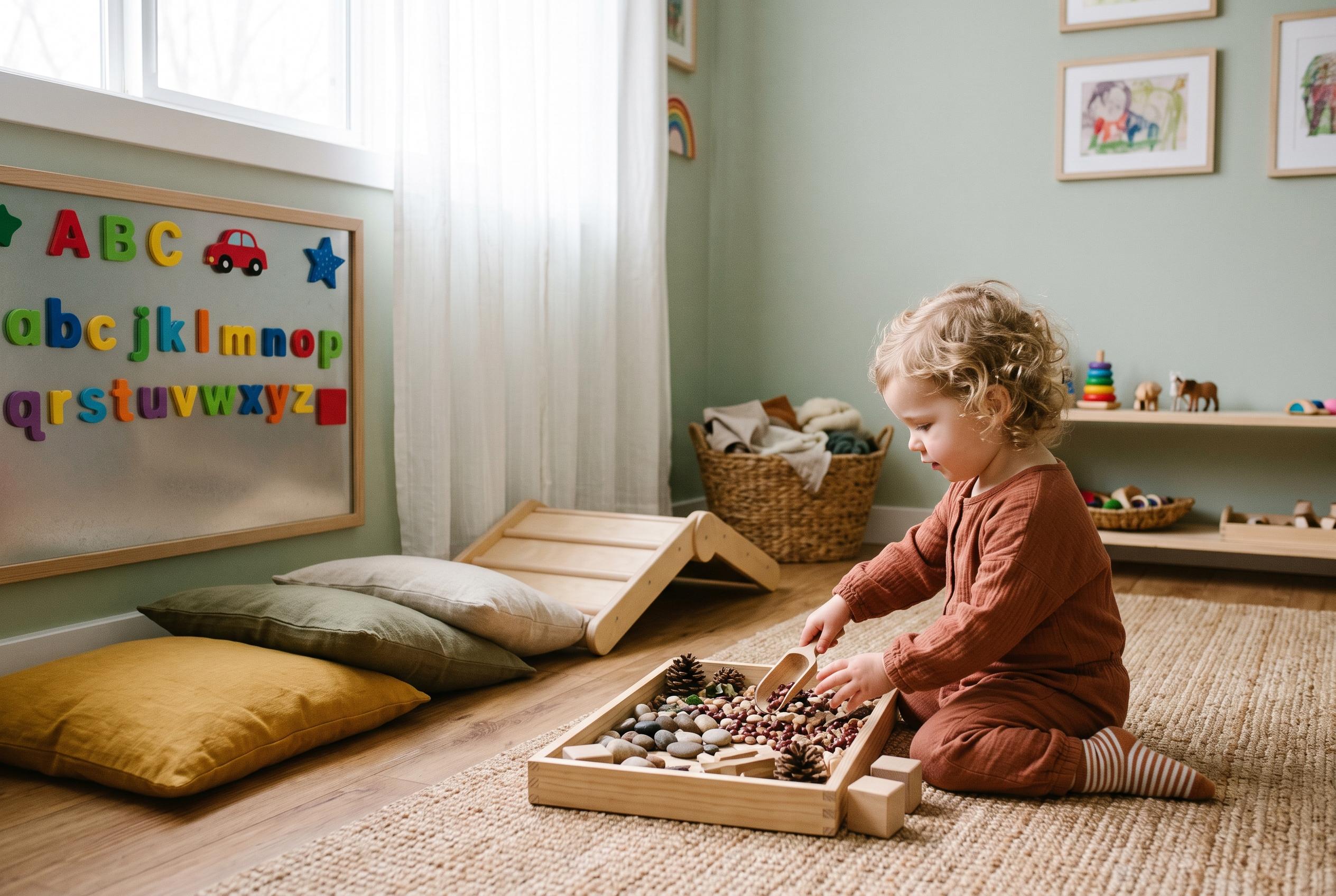

From sensory trays and magnetic boards to cushion courses and treasure baskets, simple hands-on activities can help toddlers explore, move and play independently without making screens the default.
Parents of toddlers know that boredom rarely arrives quietly. More often, it turns up as a chorus of demands for attention, distraction or a quick fix. The challenge is not simply keeping children occupied, but finding activities that hold their interest without reaching for a screen. Screen-free play can do that with surprisingly little preparation: a tray, a few household objects, a bit of movement, and enough repetition to let a child return to the same idea in new ways.
The case for more hands-on play is strong. Childcare.gov says play is the main way young children learn, and that unstructured play in particular gives children room to explore interests, use their imaginations and develop physical, social and intellectual skills. HealthyChildren.org adds that toddlers learn by trying, repeating and experimenting, which is why ordinary playtime often does more developmental work than a child ever realises. The point is not to ban screens altogether, but to make sure they are not the default answer every time a child wants something to do.
The simplest place to start is with what is already in the house. A low cupboard stocked with safe items such as plastic bowls, wooden spoons, cups and a colander can become a scooping and pouring station. A shallow tray filled with oats, rice or cooked pasta can keep a toddler busy with cups, scoops and small toys. For babies and younger toddlers, a treasure basket of objects with different textures can be just as absorbing. These kinds of activities work because they are open-ended: there is no single correct outcome, only repeated experimenting and discovery.
Sensory play is especially useful in the early years. Cleveland Clinic says that activities engaging the senses can support language development, motor skills, cognitive growth and social interaction. That helps explain why a child may spend so long tipping, sorting, filling or patting, even when the materials seem simple to an adult. Sensory play also gives children a chance to process what they are feeling and seeing, which can make it easier for them to settle afterwards.
Movement matters too. Quiet play is important, but toddlers also need outlets for energy, especially on days when they are indoors. An obstacle course made from cushions, a line of masking tape to balance along, a blanket tunnel or a short dance-and-freeze game can reset the mood of the whole afternoon. Even a brief burst of active play can make a later quiet activity easier to manage, particularly for children who struggle to sit still for long.
Magnetic play is one of the more versatile options for small children. Pieces can be moved, rearranged and matched without collapsing into a heap, which makes the activity less frustrating than stacking blocks for some toddlers. A magnetic board also gives children a vertical surface to work on, which can help develop shoulder and wrist strength while moving drawing or storytelling off the table. Themed sets with animals, numbers or letters can grow with a child, shifting from simple matching to early counting and word recognition over time.
If parents are buying toys or play sets, the details matter. Thicker pieces are usually easier for small hands to grip and place, while very thin pieces can be fiddly and quickly lose a child’s interest. Wood remains popular because it is durable and pleasant to handle, but whatever the material, finishes should be non-toxic, especially for children who still put objects in their mouths. In the UK, CE or UKCA marks and EN 71 testing offer reassurance that a toy has been assessed for safety, and magnets should always be securely enclosed and used according to the age guidance on the box. Storage is part of the equation too: a toy with many pieces is much more likely to stay in use if it has a box or bag of its own.
The other half of successful screen-free play is setting it up so it feels easy to begin. Rather than announcing an activity, it can help to place a tray, board or basket where a child will notice it and wander over. Rotating toys every week or two keeps familiar items feeling fresh, and that can encourage longer stretches of concentration. It also helps to keep expectations realistic. A two-year-old may focus for only five to ten minutes, and that is entirely normal. What matters is not how long a child sits still, but whether they are absorbed enough to return again tomorrow.
Screens do not need to disappear from family life for these ideas to work. Many parents use them sensibly for a video call, a long journey or a moment when the day simply needs to be easier. The aim is more modest than perfection: to have enough alternatives that screens become one option among many, rather than the first reflex when boredom appears. A short list of go-to activities can make that much simpler, from a vertical drawing surface and a sensory tray to water play, music, pretend shops and doctor’s kits, or a blanket den with books and a torch. Over time, those repeated small moments of hands-on play help children build confidence, curiosity and the beginnings of independent play.
Disclaimer: This content is for informational purposes only and is not intended to be a substitute for professional medical judgment, advice, diagnosis, or treatment.



