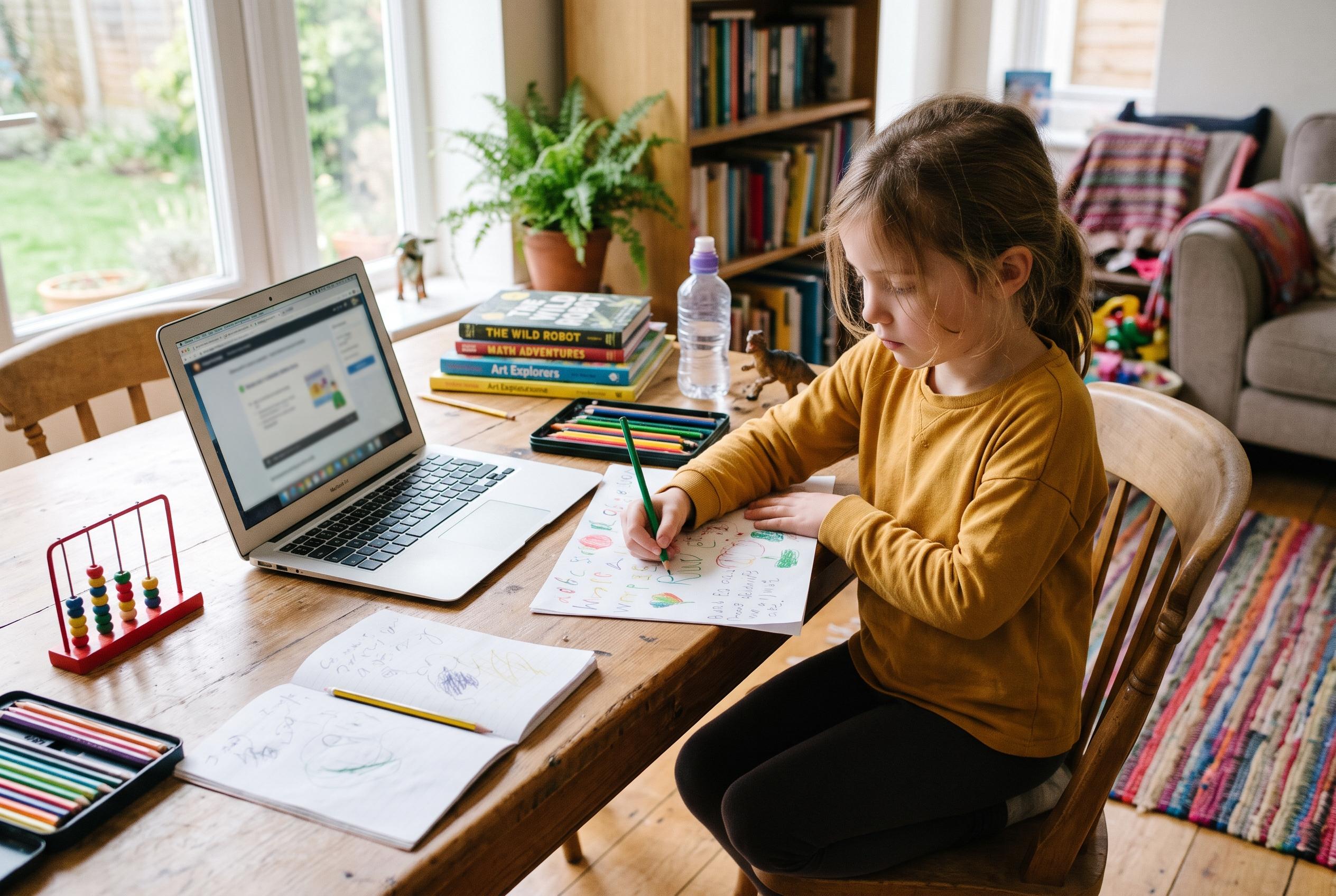

The best online primary programmes combine live digital teaching with reading, handwriting, practical tasks, movement and play away from the screen.
An online primary school can only work well if the screen is treated as a tool, not the whole lesson. For younger children in particular, reading aloud, writing by hand, counting real objects, drawing, building, moving and talking through ideas remain essential parts of learning. The strongest programmes do not keep a child fixed in front of a laptop for hours; they move learning between digital instruction and offline activity so that the device supports teaching rather than replacing it.
That balance matters because screen time by itself tells parents very little about the quality of a lesson. Twenty minutes spent listening to a teacher, sounding out words or solving a mathematics problem is not the same as twenty minutes of passive viewing. In a well-designed online primary school, the laptop may open the lesson, but the learning continues with paper, books, household objects, discussion and guided practice away from the screen.
CambriLearn’s primary programme offers one example of that approach. The school says learners in Grade RR through Grade 3 typically spend about two to three hours a day in active screen-based learning, with the rest of the day made up of printed workbooks, hands-on tasks, art, reading and physical play. Lessons are organised in shorter blocks with breaks and changes of activity, a structure that reflects the shorter attention spans and more physical learning needs of younger children.
Early literacy shows why this matters. A child may learn a sound from a video, practise it with interactive material and see it demonstrated by a teacher, but the real test is still whether the child can read. CambriLearn says its Foundation Phase reading includes phonics, printable readers and practice material, with a parent or learning coach helping to listen, prompt and support. The same principle applies in mathematics, where counters, blocks, coins, measuring tools and other objects can make abstract ideas easier to grasp before a child writes anything down.
Parents should also expect the adult role at home to change as children get older. A six-year-old usually needs more hands-on help organising materials, following routines and completing practical tasks than a twelve-year-old does. CambriLearn says screen time rises to around three to four hours a day for Grades 4 to 7, but the emphasis should increasingly shift towards independent work, offline assignments and projects. The wider case for this balance is echoed by parenting guides that highlight the value of screen-free activity for social development, focus, creativity and physical movement.
For families considering an online primary school, the most useful questions are often the simplest ones: how much active screen time is expected, how long are learning blocks, how much is done on paper, what physical or creative work is included and how much help will the parent need to provide each day? CambriLearn says its online school spans Grade RR to Grade 7 and offers live lessons with qualified teachers across several curriculum options, including South African, British and American pathways. Whatever the provider, parents should look for a programme that uses technology to connect the child with teaching and resources, while preserving the off-screen activities that make early learning work.
Disclaimer: This content is for informational purposes only and is not intended to be a substitute for professional medical judgment, advice, diagnosis, or treatment.