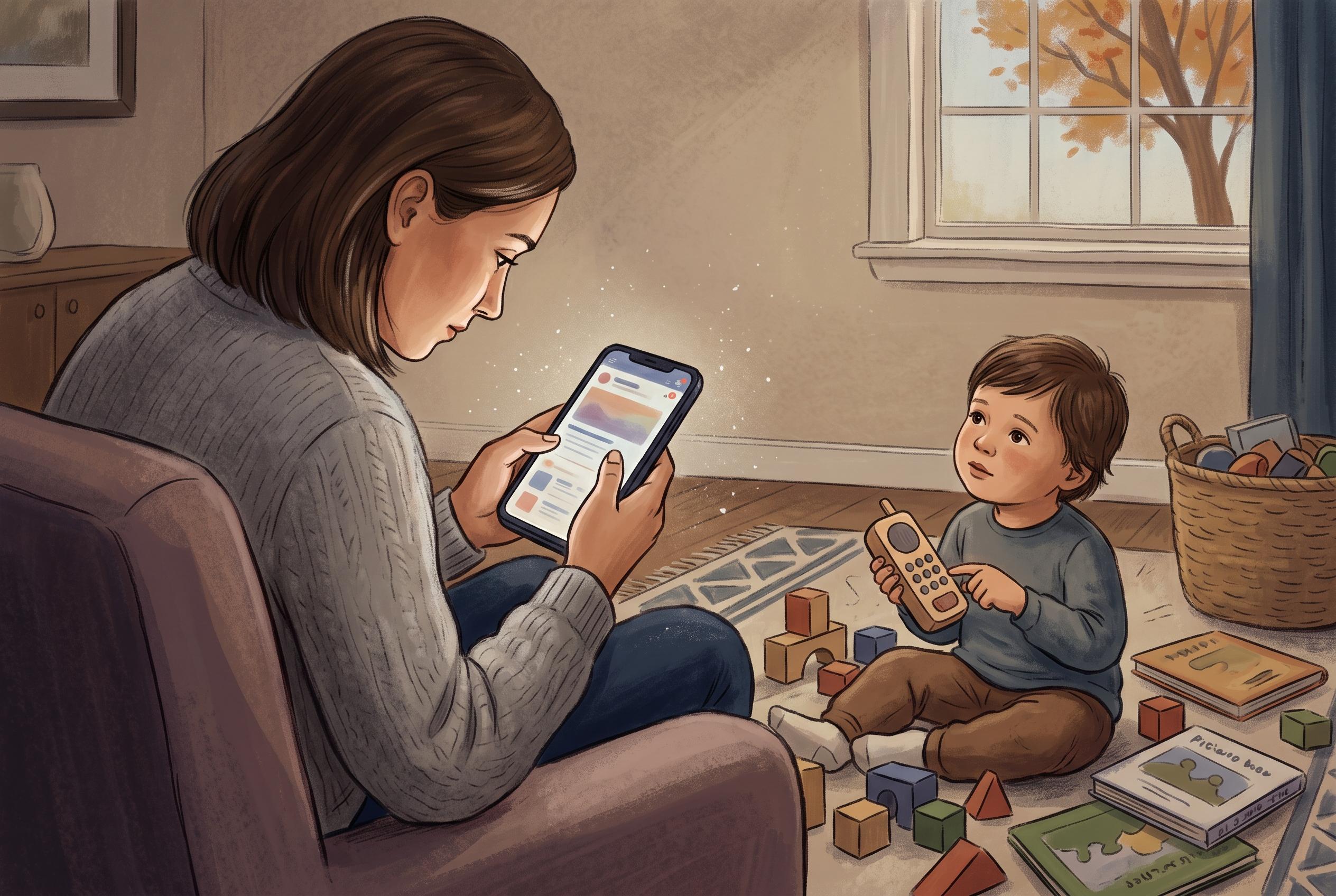

A Norwegian study suggests that a parent’s smartphone use may influence a child’s language skills more than the child’s own screen time, emphasising the importance of family media habits.
A new study from Norway suggests that a parent’s own phone habits may matter more for a young child’s language development than the child’s screen time alone. Researchers followed 747 children from about age five to age seven and found that heavier smartphone use by the child’s primary parent was linked with slower gains in receptive vocabulary, the part of language that involves understanding words. The study, published in JAMA Pediatrics, also found that children who already owned a digital device at ages four to five started out with slightly lower vocabulary and grammar scores.
The association was modest but measurable. According to the researchers, each extra hour of daily smartphone use by the primary parent corresponded to 0.42 fewer points in a child’s yearly growth in receptive-vocabulary raw scores. Children who owned a device at the start of the study scored, on average, 5.13 points lower in receptive vocabulary and 4.56 points lower in receptive grammar than children who did not. The investigators adjusted for parental education and household income, and used annual language assessments to separate starting differences from later changes over time.
Still, the findings do not show that phones or tablets directly cause language problems. Most of the screen-use measures in the study were not linked to language growth, and the researchers said they did not measure what children were doing on their screens, whether they were using devices with an adult, or why parents were using their own phones. In comments reported by FOX Local, study author Øistein Anmarkrud said the results were somewhat weaker than some previous research had suggested and urged caution about drawing firm conclusions from a single study.
The new work adds a more detailed layer to earlier research on screens and childhood development. A previous systematic review and meta-analysis in JAMA Pediatrics found that higher screen time was associated with poorer language outcomes in children, while other JAMA Pediatrics studies have linked heavier mobile device use in young children to weaker self-regulation and more emotional reactivity. Taken together, the evidence points less to a simple rule about screen time and more to the importance of context, including when a child gets a device, how it is used and how much adults model phone use at home. Anmarkrud said family-level screen habits may be a useful signal for parents and clinicians watching language development.
Disclaimer: This content is for informational purposes only and is not intended to be a substitute for professional medical judgment, advice, diagnosis, or treatment.