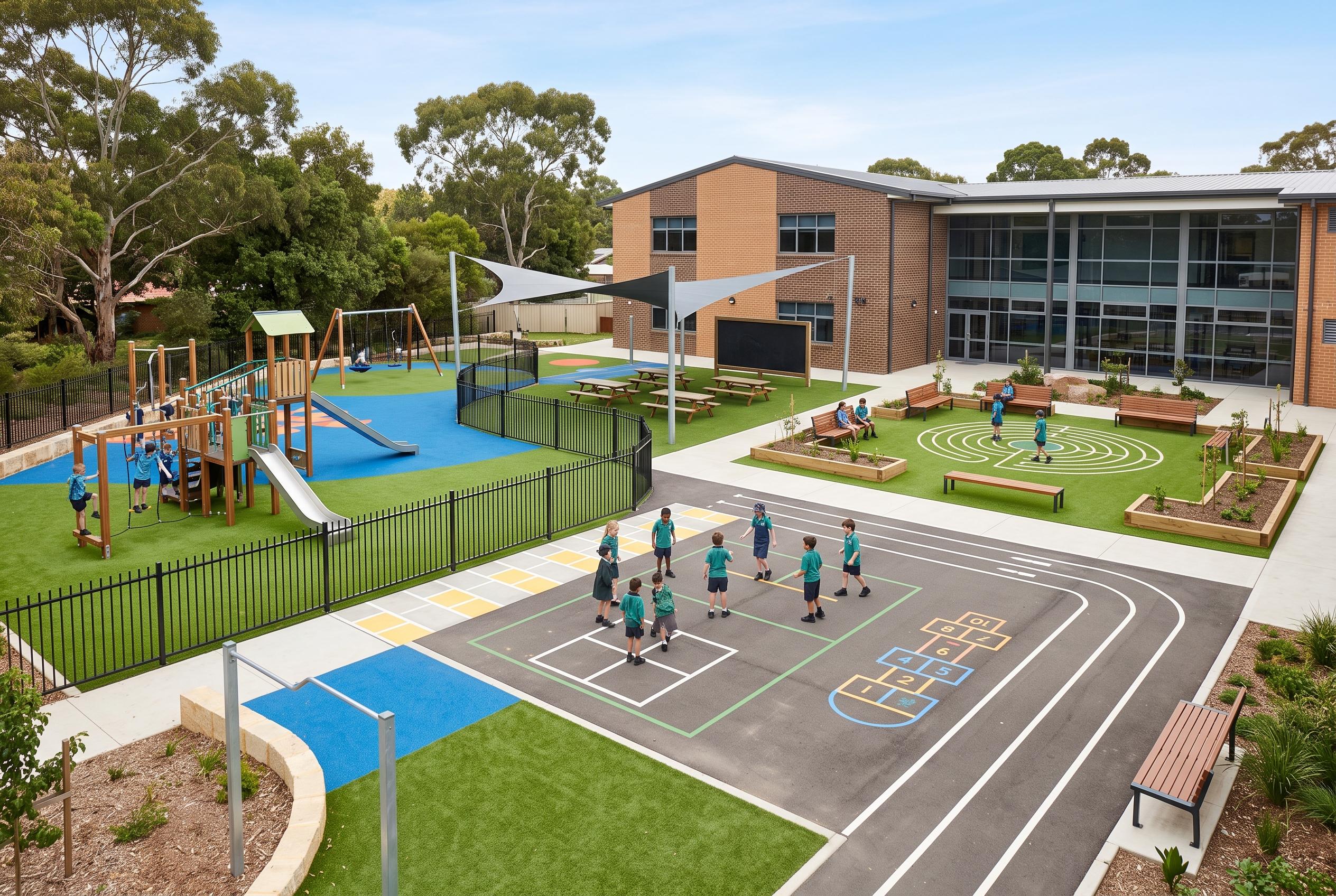

Emerging guidance suggests that enhancing playgrounds with purposeful zones, clear markings, and structured activities can significantly improve behaviour and reduce conflict among students, offering a cost-effective alternative to increasing staff supervision.
Schools looking for calmer break times do not necessarily need more staff on duty. A growing body of guidance on playground design suggests that behaviour often improves when children are given more structure, clearer choices and spaces that invite purposeful play rather than idle wandering. Jess Sparks argues that the real issue is often not supervision alone but boredom, with children more likely to argue, rough-house or drift into low-level disruption when there is little to do.
That idea is echoed by wider research into playground conflict. The KOMPAN Play Institute says well-designed play spaces can reduce disputes by encouraging active social play and giving children places to retreat without leaving the action entirely. A study in the Journal of Environmental Psychology likewise found that outdoor school layouts shape the way children play and that separate zones for gross motor activity can help avoid clashes over space and activity.
One of the clearest recommendations is to introduce more structure. Peaceful Playgrounds, which promotes marked games and organised recess activities, says clearly defined play options can channel children into purposeful movement and reduce confrontation. Its approach relies on visible markings and simple rules, making it easier for children to join in quickly and stay engaged. The same principle appears throughout the Fun Play guide, which points to trails, wall games and marked activities as ways to give playtimes a shared framework.
Zoning is another recurring theme. Rather than treating the playground as a single open area, schools can divide it into active, social and learning spaces. The research from the Journal of Environmental Psychology supports that approach, noting that multiple distinct areas for energetic play reduce the kinds of clashes that arise when too many children compete for the same ground. Quiet seating, sensory features and communication games can also help pupils who prefer a slower pace or become overwhelmed in crowded spaces.
The wider point is that better behaviour often follows better design. Thoughtfully placed equipment can reduce queues, distribute children more evenly across the site and lower the chances of disputes over popular resources. High-capacity equipment, clear pathways and informal gathering spots are all commonly recommended by playground specialists as ways to improve flow and cut friction. For schools working within tight budgets, the appeal is obvious: small changes can have an outsized effect.
In practical terms, that may mean starting with a trim trail, a sports wall or a set of curriculum-linked markings and building from there. The aim is not to replace adult supervision, but to support it with an environment that gives children more independence, more movement and more reasons to cooperate. Done well, the playground becomes less of a flashpoint and more of a setting for calmer, healthier break times.
Disclaimer: This content is for informational purposes only and is not intended to be a substitute for professional medical judgment, advice, diagnosis, or treatment.