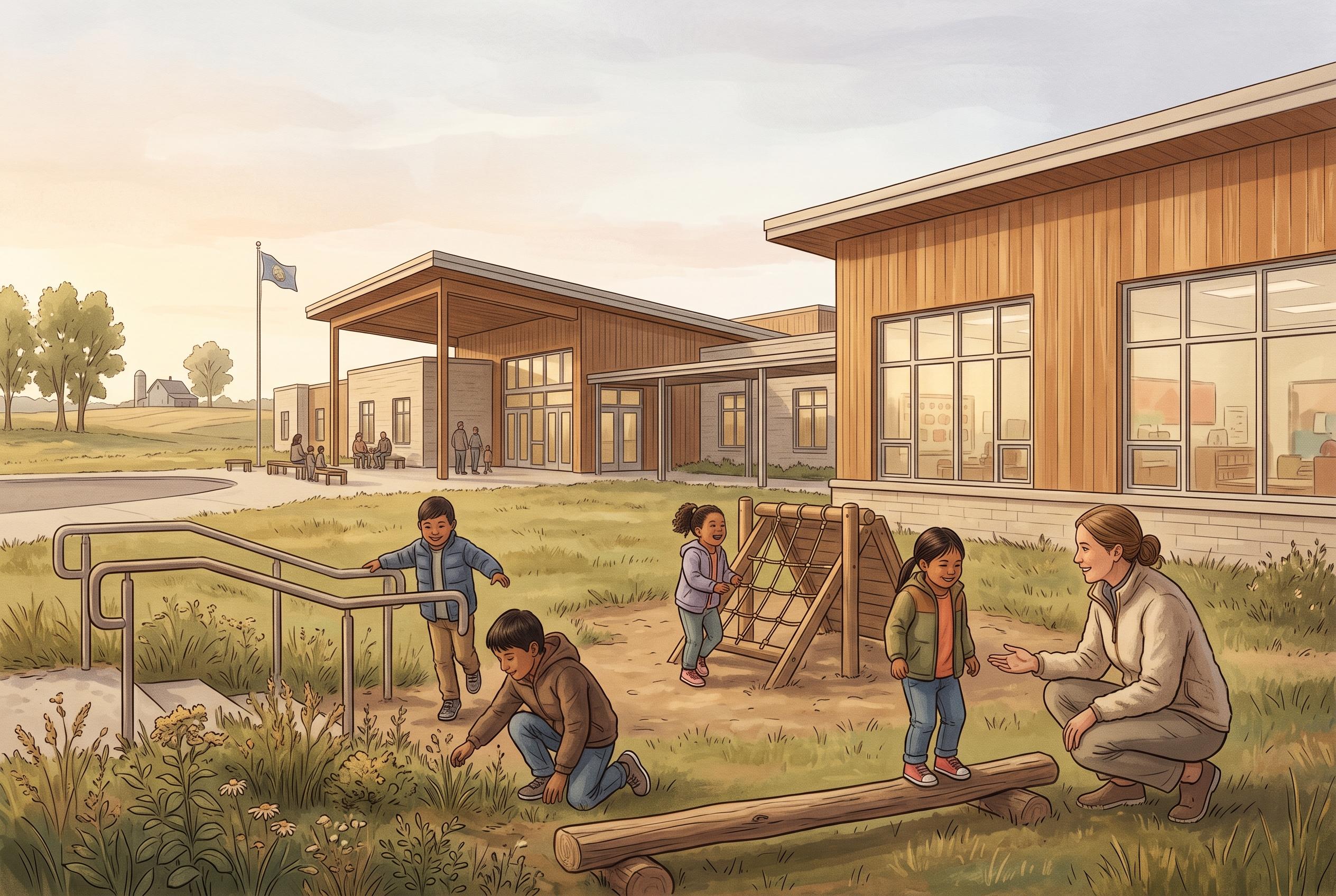

A new elementary campus in South Dakota demonstrates how thoughtful architecture can support learning and community identity, particularly benefiting disadvantaged and Native American pupils in rural areas.
Rural districts are often expected to do more with less: close readiness gaps, meet the needs of children affected by poverty and distance, and offer opportunities that may not exist elsewhere. In South Dakota, one elementary school district decided that the building itself should be part of the answer.
The district replaced an older, four-storey school with a 108,000-square-foot elementary campus serving about 900 pupils spread across 932 square miles. Drawing on the Opportunity-by-Design Framework, leaders and CMBA Architects set out to create a space that would support instruction, access and belonging, rather than merely house classrooms. Since the campus opened in 2024, results have been mixed overall, but the clearest gains have come among students most likely to face barriers early in life, including those from low-income households and children affected by limited preschool access.
That approach reflects a growing body of research suggesting that school design can influence learning in practical ways. Studies in the UK have found that classroom features such as light, flexibility, colour and connection can affect pupil progress, while other research has linked thoughtful layouts to attention, self-regulation and reading, writing and maths outcomes. The South Dakota district’s experience adds a rural American example to that evidence, showing how design can shape the daily conditions under which teaching happens.
In the old building, young children had to climb stairs repeatedly to reach recess, special services and other activities. Teachers said the new layout recovered time that used to be lost to transitions, giving kindergarten classrooms more room for instruction and routine. The school also added mobile furniture, flexible seating and spaces that can shift quickly between whole-class lessons, small groups, independent work and intervention. For younger pupils, that kind of adaptability can matter as much as aesthetics.
The building was also designed to speak to the community it serves. Murals and visual elements reflect South Dakota history, geography, wildlife, agriculture and words from the Dakota language. In a district with a significant Native American student population, that choice carries symbolic weight as well as educational value. The halls act as learning spaces of their own, reinforcing local identity and background knowledge before formal lessons begin.
Early data suggest the investment has had its strongest effect where it was needed most. The district reported improved benchmark reading results for kindergarten through grade two, with the share of pupils at or above benchmark rising from 61.8% before the move to 67.9% afterwards. Scores for other students were largely steady. In grades three through five, state testing also showed gains, especially for pupils eligible for free or reduced-price meals and for American Indian and Alaska Native students in English language arts.
The numbers do not prove that the building alone caused the improvement. Curriculum, teaching, leadership, attendance, family engagement and student mobility still matter. But the South Dakota case suggests that architecture is not just a matter of walls and wiring. In the right context, a school building can become part of the instructional system itself.
Disclaimer: This content is for informational purposes only and is not intended to be a substitute for professional medical judgment, advice, diagnosis, or treatment.