

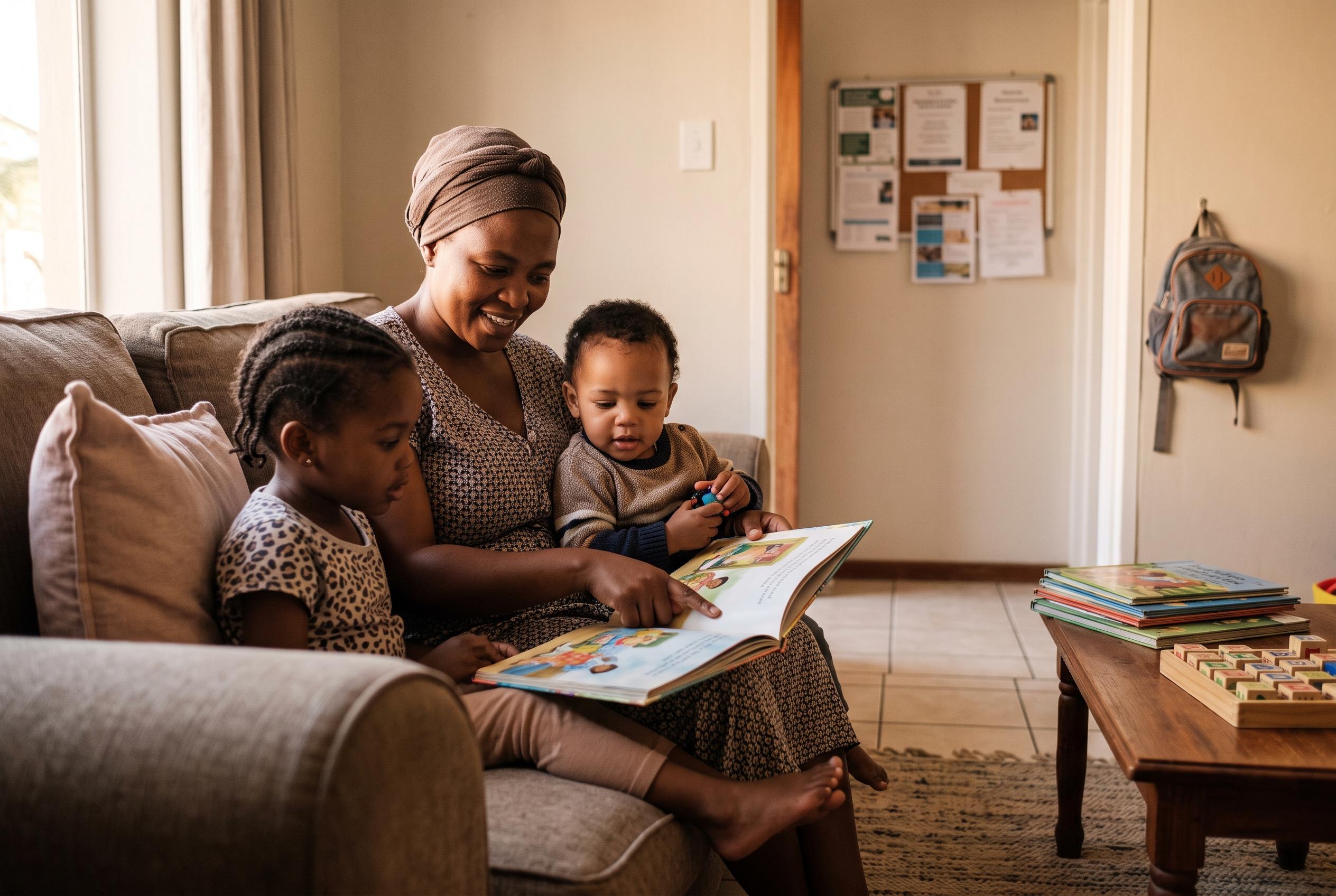

South Africa’s literacy crisis begins before children learn to read, emphasising the importance of family, community, and policy support to foster language-rich environments and early learning.
South Africa’s literacy challenge begins far earlier than many parents and policymakers might think. Before a child can recognise letters or sit through a reading lesson, they are already building the skills that make reading possible: listening, speaking, remembering sounds, understanding meaning and using language to connect with other people. Mari Payne, deputy managing director and senior director for education and programmes at Sesame Workshop South Africa, argues that these earliest exchanges are not a side note to literacy, but its foundation.
That starts with the ordinary moments of family life: a baby turning towards a familiar voice, a toddler naming what they see from a taxi window, a child asking for the same song again, or inventing a story with a spoon and a box. These experiences may seem simple, yet they help form the brain pathways that support later learning. In this view, literacy month should not be limited to bookshelves and classrooms. It should also be a reminder that the route to reading often runs through conversation, play and affection.
The scale of South Africa’s challenge helps explain why this broader view matters. The Department of Basic Education’s Funda Uphumelele National Survey found that only 31% of Grade 1 learners reached the home-language reading benchmark, while just over 30% met the benchmark in Grades 2 and 3. Earlier findings from the Thrive by Five Index showed that 65% of children assessed were not thriving in early learning and physical growth, and the 2024 update found that only 42% of four-year-olds were on track in early learning. The same 2024 report also said 53% were on track in emergent literacy and language, suggesting that many children are gaining some of the building blocks of reading even if they are not yet where they need to be overall.
Those numbers do not support a simple call to push formal reading instruction earlier and earlier. Instead, they point to the importance of quality early childhood development, stronger caregiver support and more accessible learning environments. Reading aloud remains valuable, because it introduces children to language they may not hear in everyday conversation and opens space to talk about pictures, feelings and ideas. But the broader lesson is that literacy does not depend only on whether a home has books. It depends on whether children are surrounded by language, repetition, interaction and care.
That is why Sesame Workshop South Africa is urging parents, caregivers, educators, community leaders and policymakers to treat early literacy as a shared responsibility. Families are already carrying heavy pressures, from work and transport to financial strain, so the answer cannot be to place more responsibility on them without adding support. Early learning programmes, libraries, reading corners and community initiatives can all help make books and storytelling more available. Just as important, children should be able to learn in their home languages, which UNESCO has described as a strong base for later bilingual and multilingual development. If South Africa wants more children to become confident readers, the work must begin long before formal reading starts.
Disclaimer: This content is for informational purposes only and is not intended to be a substitute for professional medical judgment, advice, diagnosis, or treatment.



