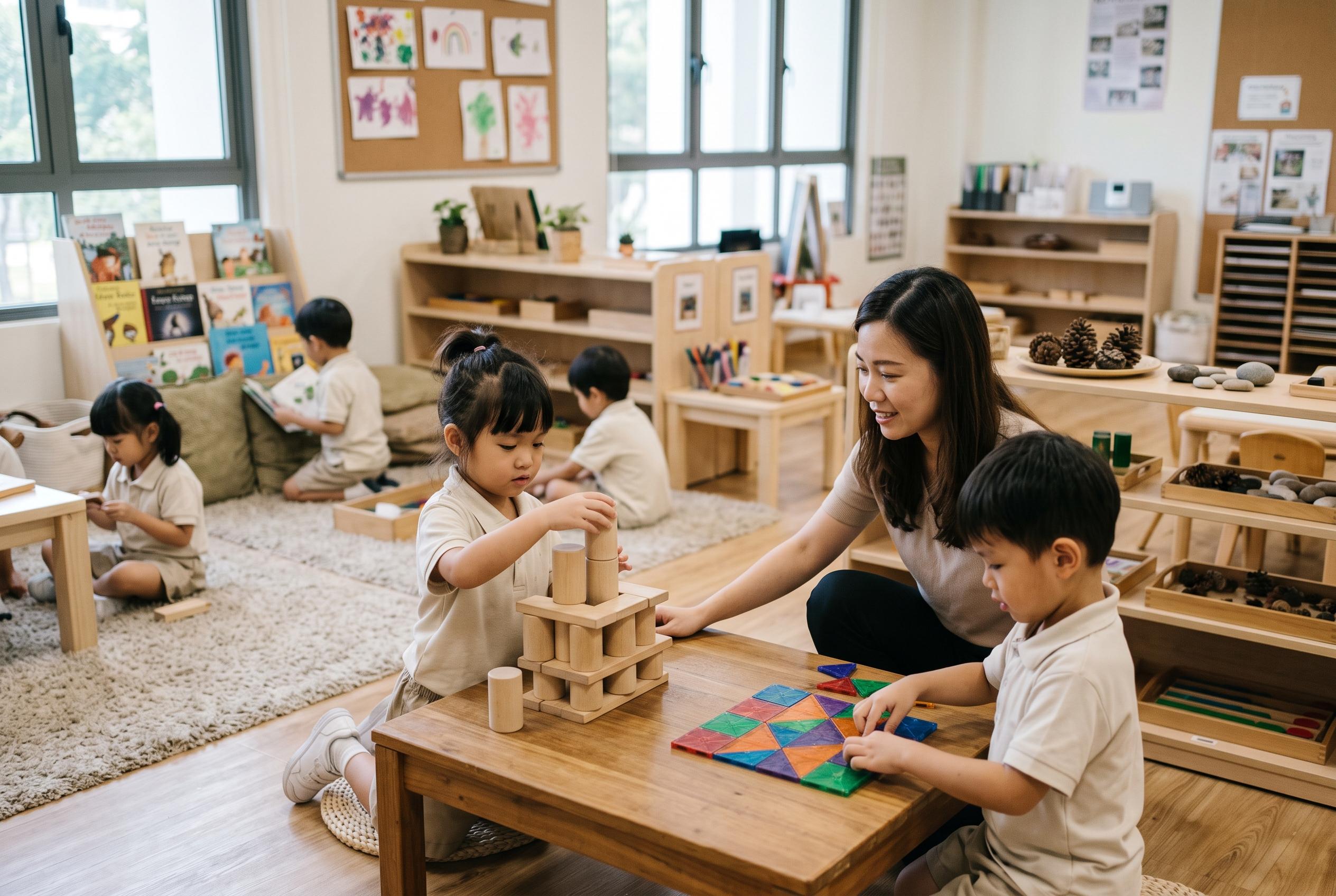

Singaporean preschools are adopting hybrid models that integrate structured guidance with child-led exploration, reflecting a shift towards fostering curiosity, resilience, and social skills alongside academic development.
Choosing a preschool in Singapore often comes down to one question: how much structure does a child need, and how much room should there be for play-led discovery? The wider picture, as described in Expat Living’s roundup of local preschools, is not a simple either-or choice. Instead, many schools are trying to combine guided learning with hands-on exploration so children build early literacy, numeracy and social skills without losing their natural curiosity.
Kinderland says its approach is designed to prepare children to become lifelong learners and thoughtful global citizens. The school describes a curriculum that blends teacher-led lessons with child-initiated activity, supported by programmes such as STREAM, KinderFit, its Children’s Music Programme and character-building work. Kinderland says this helps children develop not only early academic skills but also resilience, empathy, confidence and problem-solving. On its own website, the preschool also says its curriculum is aligned with Singapore’s Early Years Development Framework and Nurturing Early Learners framework, and that it serves children from two months to six years old.
At Mosaic Preschool, the emphasis is similarly on balance, but with play at the centre of the experience. Director Huseyin Turgu says the school uses a milestone-based framework while allowing children’s interests to shape the direction of learning. In one example described by the school, children’s fascination with shadows led teachers to introduce mirrors, translucent film and light prisms, turning an everyday moment outdoors into a longer exploration of light and reflection. Mosaic says its bilingual classes use meaningful play to weave together language, numeracy, science and social-emotional learning, with the aim of building confidence and easing the move to primary school.
Taken together, the schools reflect a broader trend in early childhood education: parents are being offered programmes that are neither rigidly academic nor wholly free-form. The most practical choice may depend less on labels such as “structured” or “unstructured” than on how a child responds to routine, inquiry and sensory learning. For families weighing options, the key question is whether a preschool’s daily rhythm gives children enough guidance to feel secure while still leaving space for them to ask questions, experiment and learn through play.
Disclaimer: This content is for informational purposes only and is not intended to be a substitute for professional medical judgment, advice, diagnosis, or treatment.