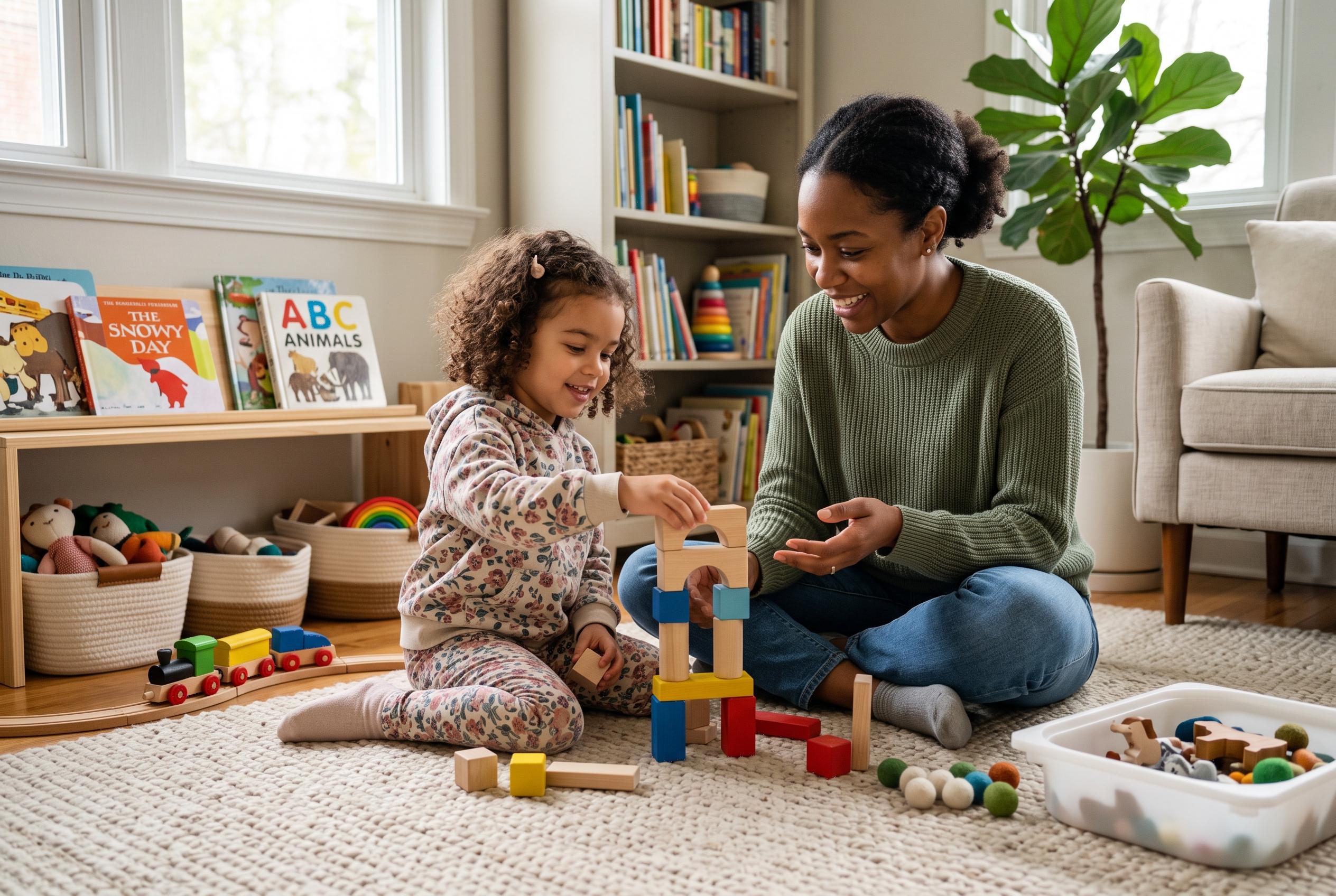

Research from leading health and childcare organisations highlights the importance of both structured and unstructured play for children’s growth. Organised activities, along with simple, imaginative, and sensory play, support language, movement, emotional regulation, and social skills, offering parents practical ways to enrich everyday life with minimal effort.
Creative play does more than keep children busy. It helps them practise language, movement, problem-solving, social skills and emotional control, while also giving parents a practical way to bring a bit more order into the day. Child development resources from Healthline, Childcare.gov and the American Academy of Pediatrics all point to the same basic truth: both structured and unstructured play matter, and children benefit most when adults provide a safe setting, simple materials and enough freedom to take the lead.
The best play ideas are often the simplest. A cardboard box, a few cushions, some old clothes for dressing up or a handful of household objects can open the door to imaginative play that strengthens communication, confidence and resilience. Healthline notes that pretend play can support social bonds and emotional regulation, while Childcare.gov says child-led play encourages exploration and imagination. In practice, that means a living room can become a shop, a spaceship or a hospital with very little preparation.
For younger children, sensory play is especially valuable. Activities that involve touch, sound, movement and simple repetition can support language development, fine and gross motor skills and cognitive growth. Cleveland Clinic says sensory play can also help children regulate emotions and solve problems. That is why familiar favourites such as water pouring, texture bins, music games and simple movement songs remain so effective for toddlers and preschoolers.
As children grow, their play becomes more social and more inventive. The American Academy of Pediatrics says undirected play helps children practise decision-making, cooperation and conflict resolution, while Healthline highlights the role of imaginative play in building communication and academic readiness. Older children often enjoy games with rules, challenges and clear outcomes, such as memory games, scavenger hunts, homemade board games, story-building exercises or projects that end with something they can show off to others.
Structured play and free play each serve a different purpose. Childcare.gov advises parents to offer both: adult-led activities can introduce rules, goals and routine, while open-ended play gives children room to experiment and invent. That balance matters at home as well as outside it. A small designated play area, age-appropriate materials and a few flexible household items can make it easier for children to move between guided activities and self-directed play without constant adult intervention.
The wider message from child-health experts is reassuring for parents who worry they are not doing enough. Play does not need to be elaborate, expensive or carefully scheduled to be worthwhile. What matters most is that it is regular, age-appropriate and responsive to the child in front of you. In that sense, the most useful play ideas are rarely the fanciest ones; they are the ones children return to because they feel free, safe and fun.
Disclaimer: This content is for informational purposes only and is not intended to be a substitute for professional medical judgment, advice, diagnosis, or treatment.