

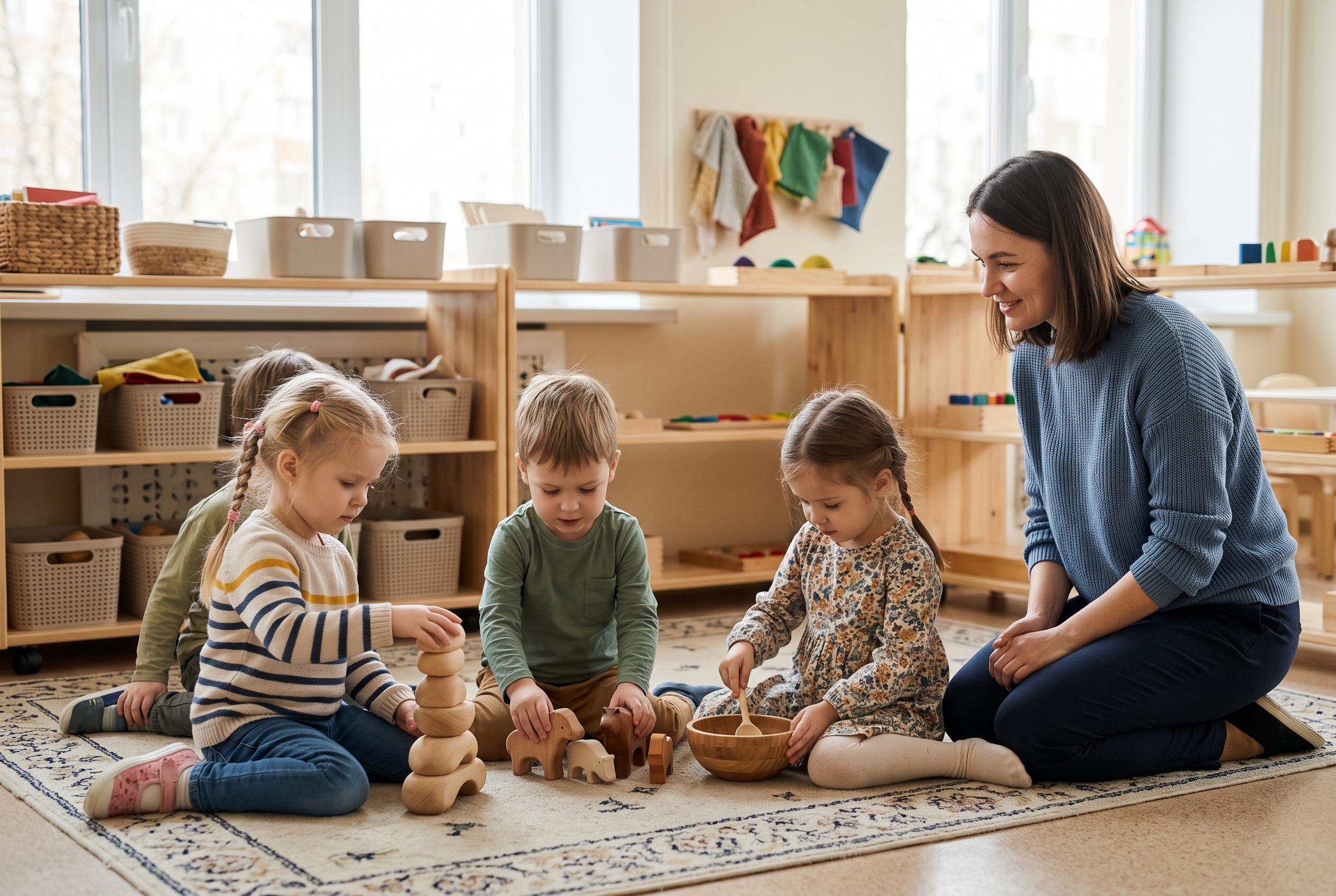

Russia’s education ministry plans to modify how early learning is integrated into kindergarten classrooms, emphasising age-appropriate play and natural development, while strengthening educational components ahead of 2026 updates.
Russia’s education ministry says it is not removing the learning element from its new preschool standards, but is instead reshaping how it appears in kindergarten classrooms. The focus, officials say, will remain on age-appropriate teaching through play, with children continuing to develop early skills such as counting, comparing, observing and preparing their hands for writing.
Natalia Somova, an expert at the ministry and an associate professor at the Herzen State Pedagogical University in St Petersburg, told RIA Novosti that kindergarten is not only a place for play and friendship, but also for early learning. She said the key is that this should happen in forms natural to young children, adding that education and upbringing can and should take place together rather than being treated as separate tasks.
That position fits with the ministry’s broader approach in recent years. In 2022, it introduced a federal preschool education programme designed to give kindergartens a common framework for content, expected outcomes and values. The programme emphasised Russian spiritual, moral and socio-cultural values, alongside respect for family and homeland, and applied to preschool provision nationwide from September 2023.
More changes are already in train. In February and June 2026, the ministry set out plans to update the Federal State Educational Standard for preschool education as part of the country’s Year of Preschool Education. Those updates are expected to strengthen the educational component, add guidance on learning activities and minimum educational materials, and improve the design of kindergarten spaces, including provision for children with disabilities. The ministry has also backed projects such as “Good Games”, a pilot scheme that uses conversation, play, creative tasks and reading to teach values such as friendship, mutual help and respect.
Disclaimer: This content is for informational purposes only and is not intended to be a substitute for professional medical judgment, advice, diagnosis, or treatment.



