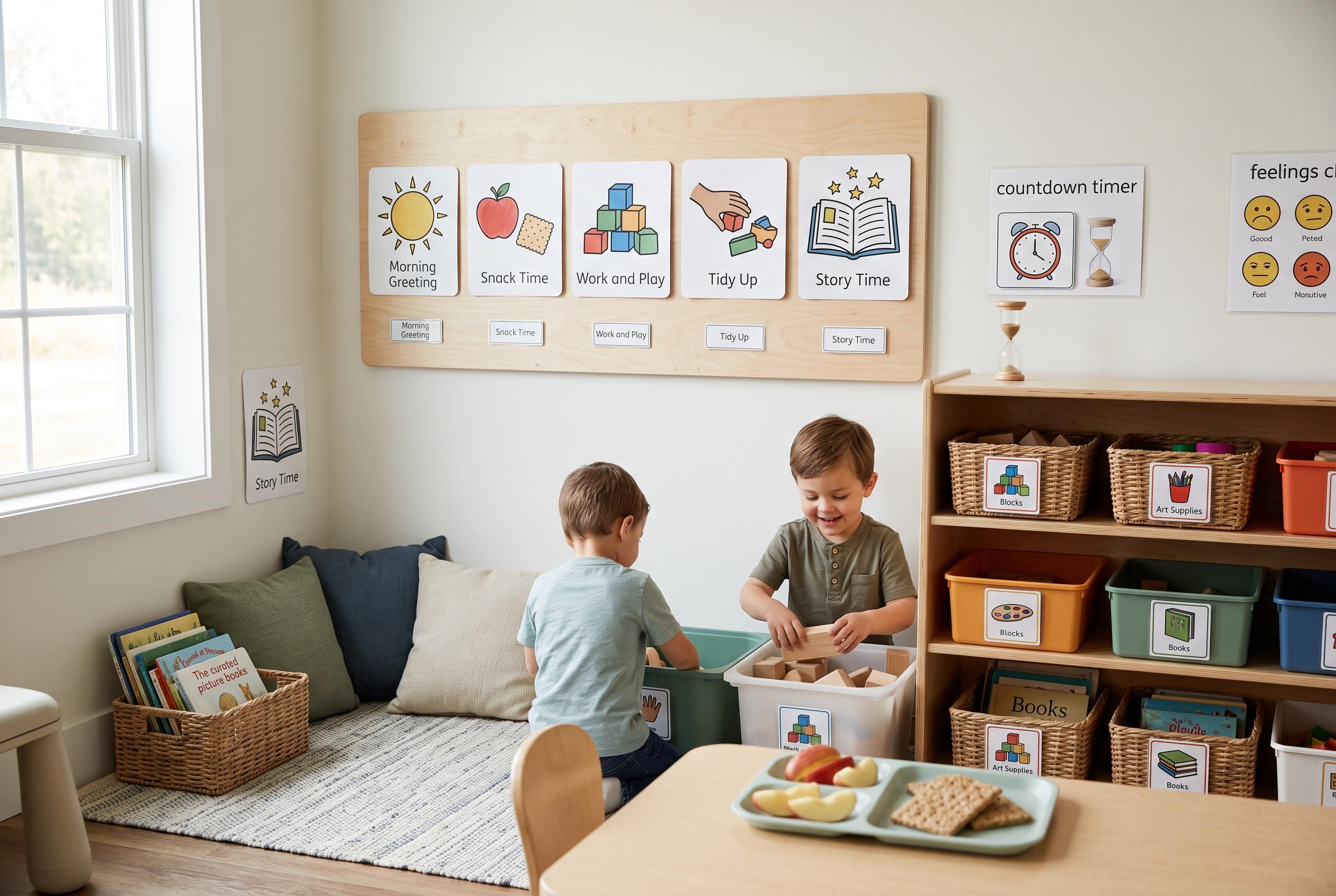

Research and experts emphasise that predictable routines and visual cues are crucial in supporting children’s emotional regulation, especially for neurodivergent children and those with developmental delays, by easing cognitive demands and reducing stress at home and in early education settings.
Children’s meltdowns are often read as a moral failing, but the better explanation is usually simpler: the child has run out of capacity. Researchers and early years practitioners have long found that young children cope best when the day is predictable, choices are limited and adults do more of the organising for them. A 2008 study in ScienceDirect found that simply labelling did not improve preschoolers’ performance on a task measuring flexible rule use, while childcare guidance and early learning commentary both point to routines and clear structure as a way to reduce stress and make behaviour easier to manage.
That idea matters because a child’s brain is still learning how to sort demands, switch between tasks and regulate emotion. A post from Total Communication in Singapore argues that predictable routines lower the mental effort required for transitions and daily decisions, while also supporting executive function and emotional regulation, particularly for neurodivergent children. In practice, that means a familiar breakfast, a set order for getting dressed and a clear sequence for leaving the house can be more effective than repeated reminders or arguments.
The case for routine is strengthened by research on families facing developmental delays. A 2024 paper on PubMed Central found routines could act as a protective factor for emerging mental health and behaviour problems in children with neurodevelopmental delays, while also easing parental stress. That does not mean structure solves every difficulty, but it does suggest that predictable habits can reduce friction at home and create more space for learning, especially when children are already under strain.
Some of the most practical advice is also the least glamorous. Childcare educators recommend keeping materials visible, using labels where helpful and relying on consistent daily rhythms so children do not have to remember everything at once. Visual cues such as pictures, colours and stickers can support sorting, planning and follow-through, while reducing the burden on working memory. Taken together, the evidence points to a straightforward conclusion: when adults build the system, children do not have to spend so much energy surviving it.
Disclaimer: This content is for informational purposes only and is not intended to be a substitute for professional medical judgment, advice, diagnosis, or treatment.