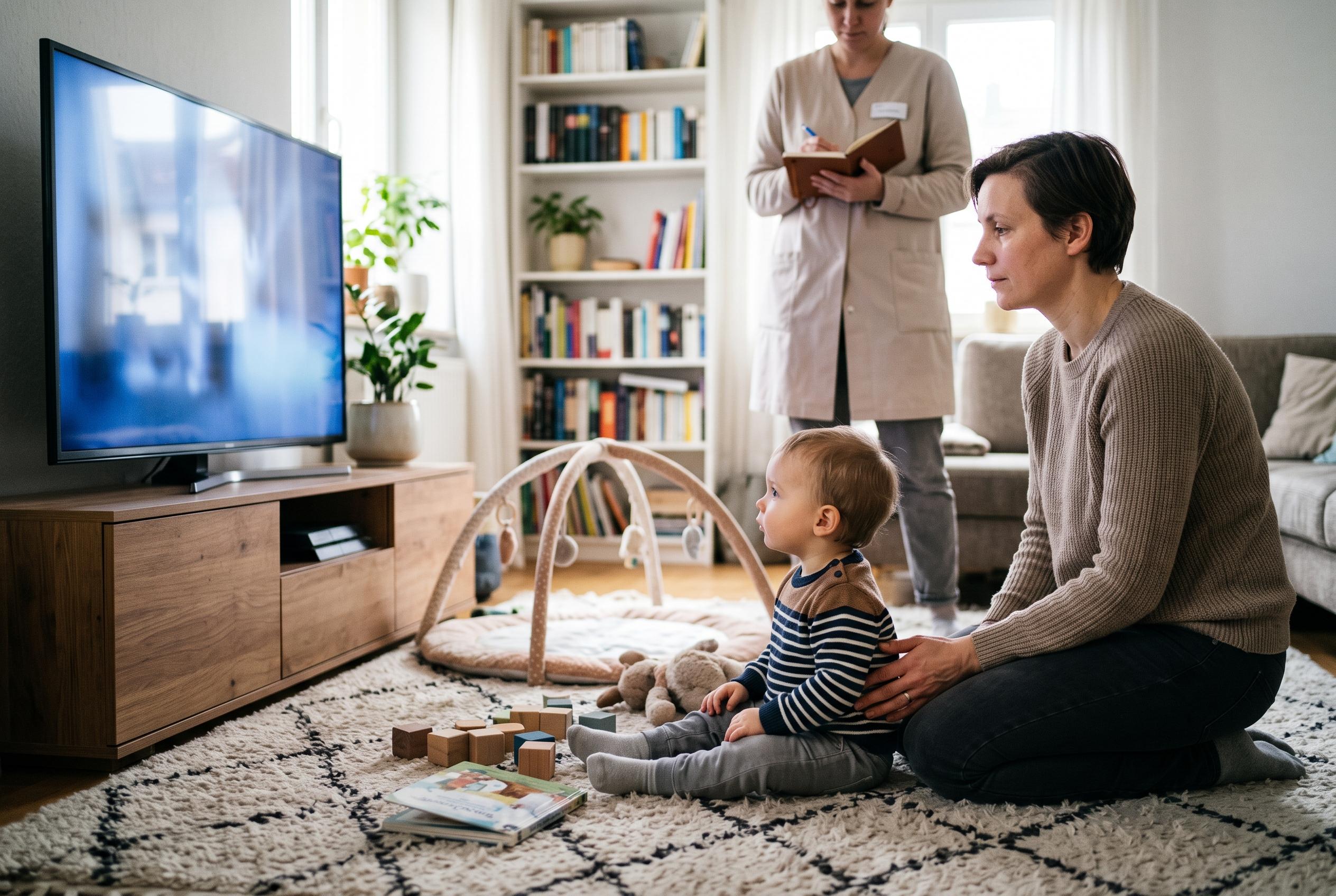

Doctors in Germany observe a surge in developmental delays among young children linked to increased passive screen use during the pandemic, prompting calls for intervention and awareness.
In a therapy room in Berlin-Charlottenburg, a small girl steps carefully across a sensory path of stones, pasta and crumpled newspaper, pausing in alarm when a reflective rescue blanket crackles beneath her feet. The child, identified only as Anna, has made striking progress over the past year, according to her physiotherapist, Antje Taubert, after arriving with marked developmental delays and little interest in eye contact or play. What first looked like an isolated case has become, in the view of doctors at the centre, part of a wider pattern they are seeing more often in young children.
Katrin Klöpper, the centre’s lead doctor, says she has watched the problem grow for about a decade, but that it has intensified since the pandemic. With nurseries and schools closed and parents under pressure to work from home, screens became an easy way to keep children occupied. The result, she says, is a growing number of very young children who struggle with attention, balance, communication and emotional regulation after long periods of passive screen time.
The concern is not limited to one clinic. A recent miniKIM study found that smart devices are now widely present even among two- to five-year-olds in Germany: one in five has a tablet, and one in 10 has a mobile phone or smartphone. At the same time, a study by DAK-Gesundheit and the University Medical Centre Hamburg-Eppendorf found that more than a quarter of 10- to 17-year-olds show risky or pathological social media use, affecting roughly 1.3 million young people. DAK says the figures point to a persistent public health issue that needs prevention, education and earlier intervention.
Doctors and therapists are careful with the language they use. The label “virtual autism” is increasingly used in popular debate, but specialists reject it because autism has different causes and is not explained by screen exposure alone. Klöpper says the children she sees are not autistic, even if some present with similar features such as limited speech, reduced gesture, avoidance of eye contact and repetitive self-soothing movements. In her experience, the symptoms often ease when screen use is sharply reduced, though she stresses that long-term research is still lacking.
What worries clinicians most is not only what screens replace in a child’s day, but also how adults use them. Klöpper describes a pattern known as technoference, in which a parent’s phone repeatedly interrupts shared moments such as feeding, reading or play. For very young children, she says, consistent eye contact and emotional response are central to development; when that connection is broken too often, some children withdraw while others act out to recover attention. She also argues that today’s smartphones are more intrusive than the television sets of previous generations because they are portable, personalised and always within reach.
Anna’s case, her father says, forced the family to confront that reality. He and his wife replaced screens with books, toys and audio stories, and he has since changed his own habits so the phone is used only for calls. The difference in his daughter is now visible in the therapy room: she asks for contact, uses simple words, and moves through the room with more confidence. For Taubert, that progress underlines both the plasticity of early childhood and the scale of the challenge now facing families, doctors and policymakers alike.
Disclaimer: This content is for informational purposes only and is not intended to be a substitute for professional medical judgment, advice, diagnosis, or treatment.