

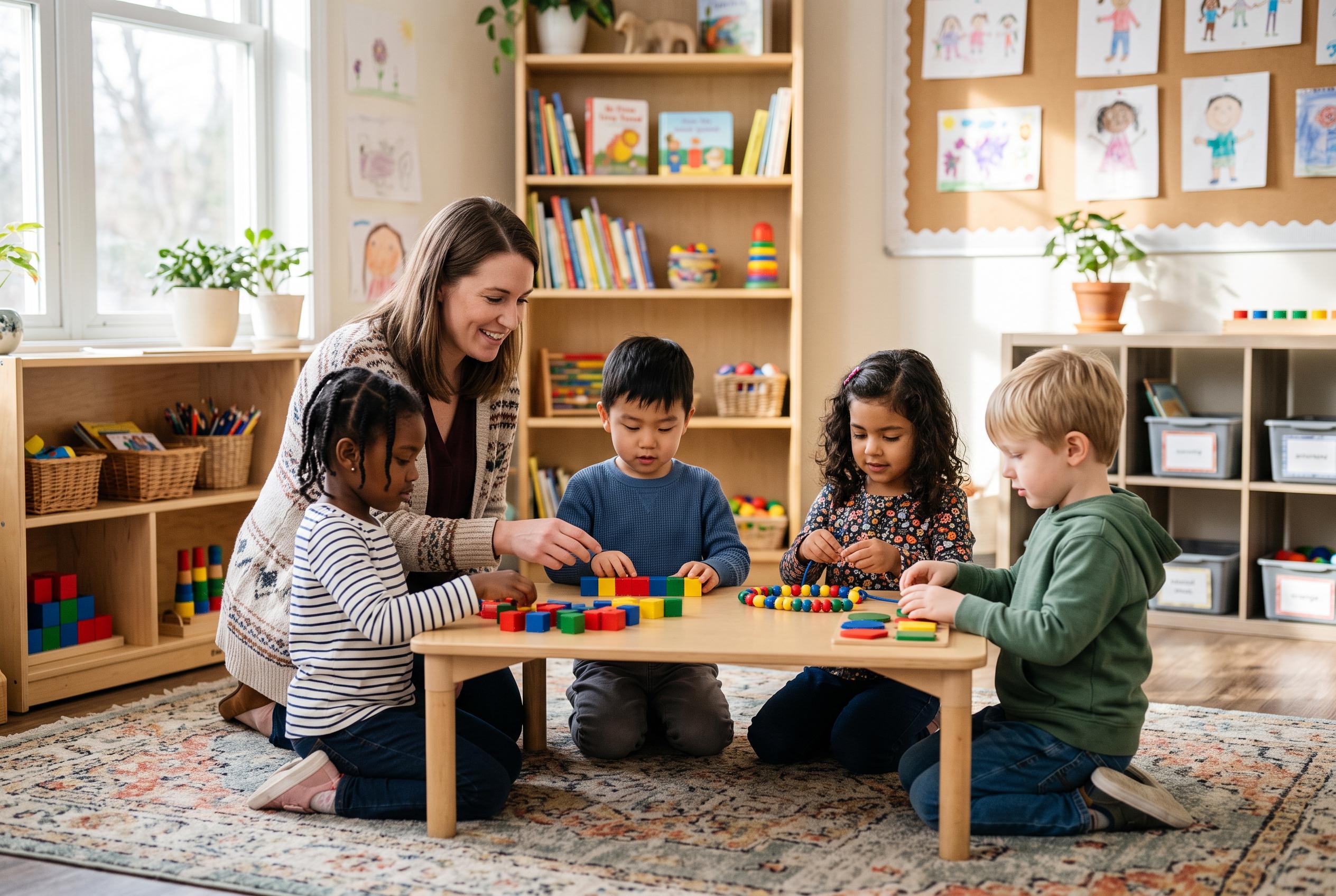

Experts warn that pushing young children too hard in maths can foster fear rather than curiosity, urging for age-appropriate, inclusive, and confidence-building approaches in kindergarten.
Math can open up opportunities in science, technology and everyday problem-solving, but educators say the earliest encounters with it matter enormously. The central warning in the California-focused essay published by the National Education Policy Centre is that when young children are pushed too hard, too fast, they can begin to fear the subject rather than explore it. That risk is especially acute in kindergarten, where the emphasis, the essay argues, should be on developmentally appropriate learning rather than pressure, labels or testing.
The piece takes aim at what it sees as a culture of “rigour” in early maths instruction, arguing that high-stakes expectations belong nowhere near five-year-olds. California is presented as a useful example: instead of asking whether current standards suit young children, the state has moved towards testing and tighter expectations, even though its own frameworks already set out a framework for early mathematics learning. The broader concern is not simply whether children can memorise more maths earlier, but whether the system is asking the right questions about readiness, curiosity and long-term confidence.
That point matters because children arrive in kindergarten with very different experiences. Some have attended preschool, others have not, and some have already been introduced to counting and number ideas at home or in earlier programmes. Research cited in the essay suggests that instruction can be badly misaligned when teachers are asked to teach a whole class as though every child is at the same stage. It also notes that children from immigrant families, including those from largely non-English-speaking homes, may begin school with weaker early skills but can make strong gains when they receive support. The implication is that low starting points should not be mistaken for fixed ability.
The article also widens the lens beyond maths alone. It argues that an excessive focus on reading and mathematics has crowded out other subjects, and that children learn better when they can see maths woven into science, stories and other classroom experiences. Edutopia, in separate guidance on participation, stresses the value of inclusive teaching, varied methods and student voice in helping children engage. That broader classroom approach, the essay suggests, would do more to build confidence than narrower drill or constant assessment.
Technology is another concern. The essay says many maths programmes now lean heavily on screens, but warns that online instruction should not dominate early learning. A 2025 report in JAMA found that higher parent-reported screen time, including television and digital media use, was associated with lower reading and maths achievement in elementary school. For younger children, the message is not that digital tools have no place, but that they should be used sparingly and carefully, rather than replacing hands-on learning and human interaction.
The article closes on anxiety, bias and the risk of treating variation in development as failure. It argues that girls may be particularly vulnerable if adults repeatedly communicate that maths is hard, exclusive or only for some children. That concern is reinforced by recent research cited in the piece from Frontiers in Psychology, which found that anxiety predicts maths achievement in kindergarten children. The National Institute of Child Health and Human Development, in guidance on learning disabilities, recommends educational interventions, therapy and other support strategies, underscoring the case for help that is tailored to the child rather than the standard. Taken together, the sources point in the same direction: early maths should build understanding and comfort, not fear.
Disclaimer: This content is for informational purposes only and is not intended to be a substitute for professional medical judgment, advice, diagnosis, or treatment.



